Grade 6 · Social StudiesECO.6.1Premium
Storerooms Full: The Knossos Courier on Crete, About 1800 BCE
Grade 6 economics: a newspaper-style retelling from Bronze Age Knossos shows how an olive and grain surplus supported crafts, social classes and trade.
Preview
OwlSheets.com
Storerooms Full: The Knossos Courier on Crete, About 1800 BCE
Read a newspaper-style retelling of a big olive harvest on Crete and trace how surplus led to new jobs, ranks and trade.
The report
Read the report and the editor's note. Then answer the questions.
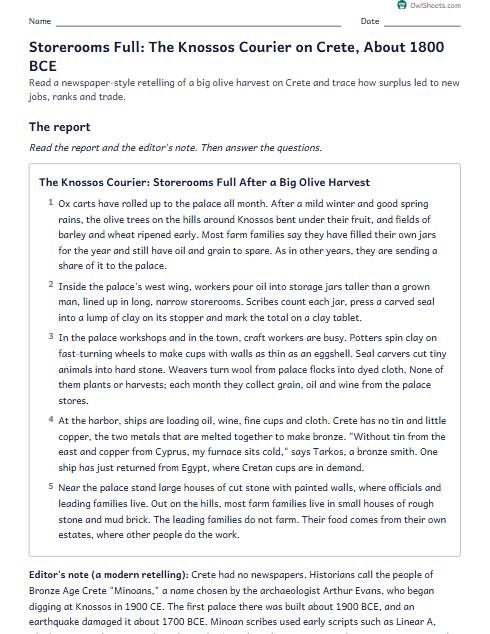
The Knossos Courier: Storerooms Full After a Big Olive Harvest
1Ox carts have rolled up to the palace all month. After a mild winter and good spring rains, the olive trees on the hills around Knossos bent under their fruit, and fields of barley and wheat ripened early. Most farm families say they have filled their own jars for the year and still have oil and grain to spare. As in other years, they are sending a share of it to the palace.
2Inside the palace's west wing, workers pour oil into storage jars taller than a grown man, lined up in long, narrow storerooms. Scribes count each jar, press a carved seal into a lump of clay on its stopper and mark the total on a clay tablet.
3In the palace workshops and in the town, craft workers are busy. Potters spin clay on fast-turning wheels to make cups with walls as thin as an eggshell. Seal carvers cut tiny animals into hard stone. Weavers turn wool from palace flocks into dyed cloth. None of them plants or harvests; each month they collect grain, oil and wine from the palace stores.
4At the harbor, ships are loading oil, wine, fine cups and cloth. Crete has no tin and little copper, the two metals that are melted together to make bronze. "Without tin from the east and copper from Cyprus, my furnace sits cold," says Tarkos, a bronze smith. One ship has just returned from Egypt, where Cretan cups are in demand.
5Near the palace stand large houses of cut stone with painted walls, where officials and leading families live. Out on the hills, most farm families live in small houses of rough stone and mud brick. The leading families do not farm. Their food comes from their own estates, where other people do the work.
- A. The palace paid them in bronze tools before the harvest.
- B. Ships from Egypt brought them extra grain to plant.
- C. The palace's scribes planted extra fields for each family.
- D. Good weather let them grow more than their families needed.
The preview shows the first questions. Unlock the worksheet to see all of it.
Related worksheets
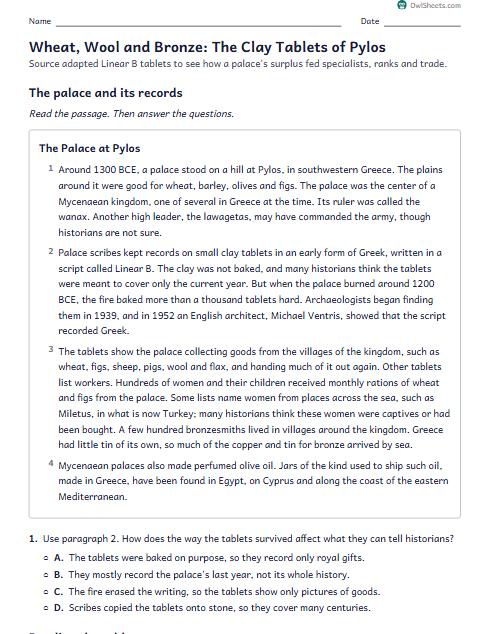
Wheat, Wool and Bronze: The Clay Tablets of Pylos
Grade 6 · ECO.6.1
14 questionsPremium
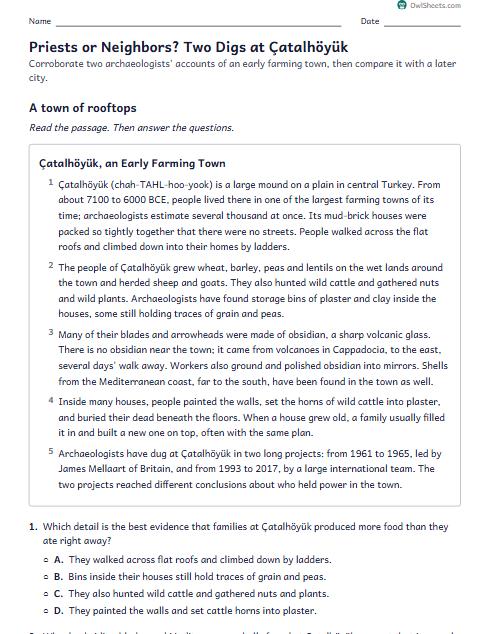
Priests or Neighbors? Two Digs at Çatalhöyük
Grade 6 · ECO.6.1
14 questionsPremium
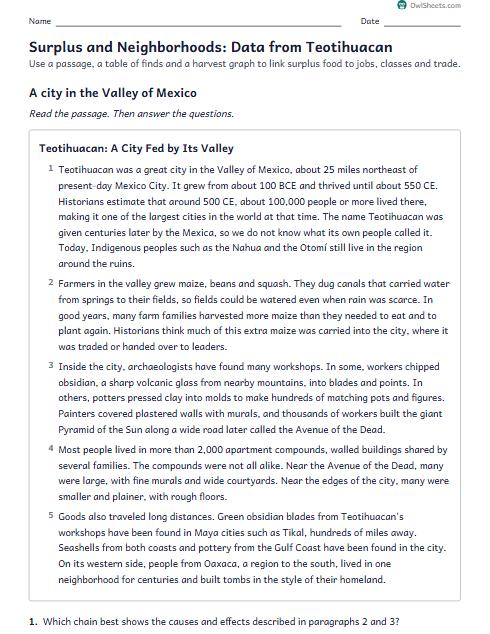
Surplus and Neighborhoods: Data from Teotihuacan
Grade 6 · ECO.6.1
13 questionsPremium
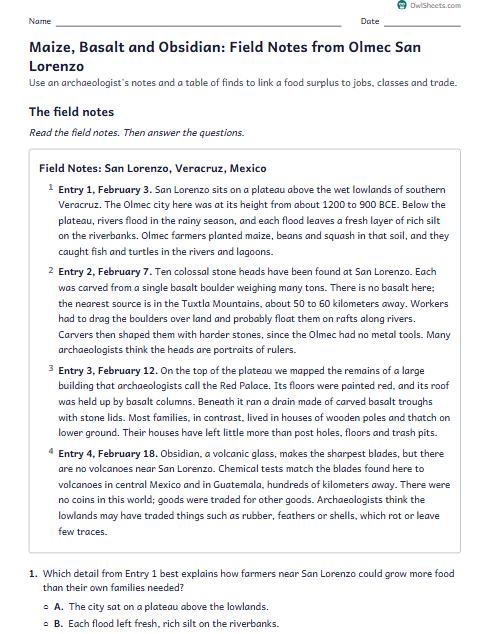
Maize, Basalt and Obsidian: Field Notes from Olmec San Lorenzo
Grade 6 · ECO.6.1
13 questionsPremium
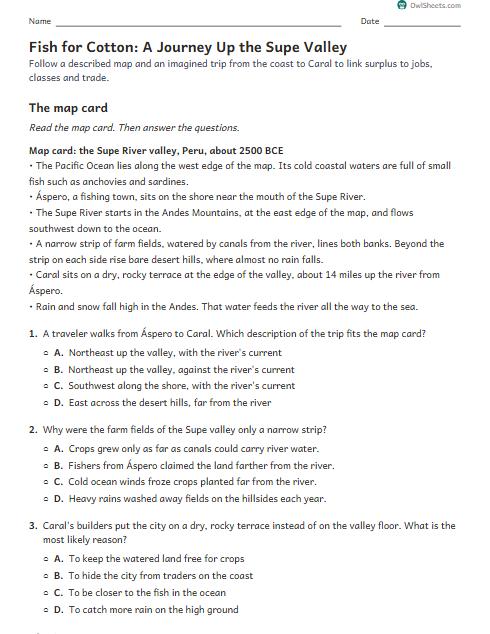
Fish for Cotton: A Journey Up the Supe Valley
Grade 6 · ECO.6.1
11 questionsFree
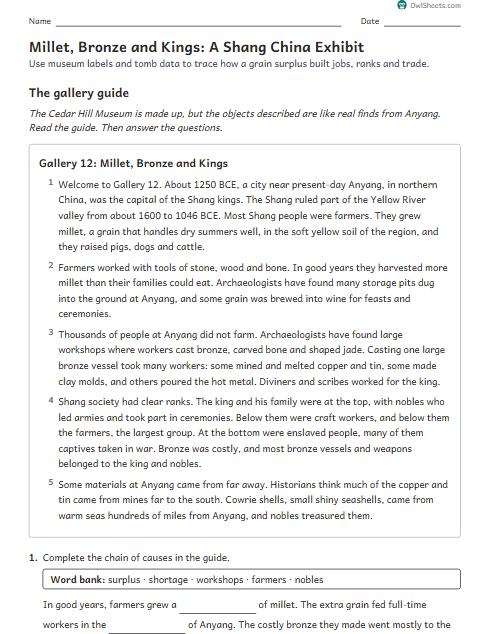
Millet, Bronze and Kings: A Shang China Exhibit
Grade 6 · ECO.6.1
10 questionsPremium