Grade 6 · Social StudiesECO.6.2Premium
Smoke on the Beach, Stamps on Silver: Sources on Trade
Grade 6 economics: source Herodotus and Aristotle to explain barter, why coins were invented and how the Persian Royal Road moved goods, news and ideas.
Preview
OwlSheets.com
Smoke on the Beach, Stamps on Silver: Sources on Trade
Source three adapted excerpts about barter, the first coins and the Persian Royal Road.
Source 1: Trading without words
Read the source note and the excerpt. Then answer the questions.
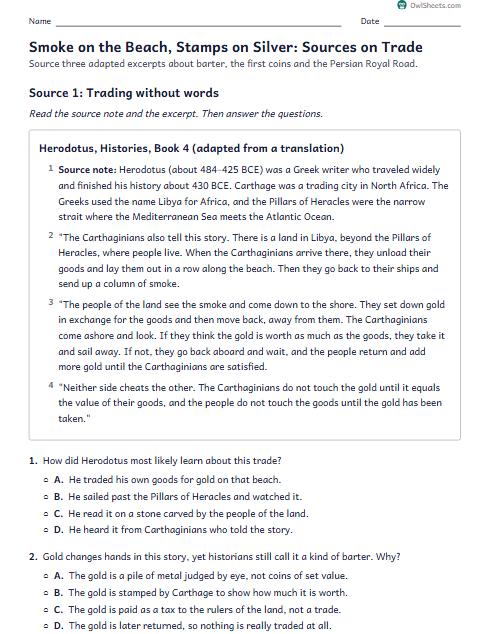
Herodotus, Histories, Book 4 (adapted from a translation)
1Source note: Herodotus (about 484–425 BCE) was a Greek writer who traveled widely and finished his history about 430 BCE. Carthage was a trading city in North Africa. The Greeks used the name Libya for Africa, and the Pillars of Heracles were the narrow strait where the Mediterranean Sea meets the Atlantic Ocean.
2"The Carthaginians also tell this story. There is a land in Libya, beyond the Pillars of Heracles, where people live. When the Carthaginians arrive there, they unload their goods and lay them out in a row along the beach. Then they go back to their ships and send up a column of smoke.
3"The people of the land see the smoke and come down to the shore. They set down gold in exchange for the goods and then move back, away from them. The Carthaginians come ashore and look. If they think the gold is worth as much as the goods, they take it and sail away. If not, they go back aboard and wait, and the people return and add more gold until the Carthaginians are satisfied.
4"Neither side cheats the other. The Carthaginians do not touch the gold until it equals the value of their goods, and the people do not touch the goods until the gold has been taken."
- A. He traded his own goods for gold on that beach.
- B. He sailed past the Pillars of Heracles and watched it.
- C. He read it on a stone carved by the people of the land.
- D. He heard it from Carthaginians who told the story.
- A. The gold is a pile of metal judged by eye, not coins of set value.
- B. The gold is stamped by Carthage to show how much it is worth.
- C. The gold is paid as a tax to the rulers of the land, not a trade.
- D. The gold is later returned, so nothing is really traded at all.
The preview shows the first questions. Unlock the worksheet to see all of it.
Related worksheets
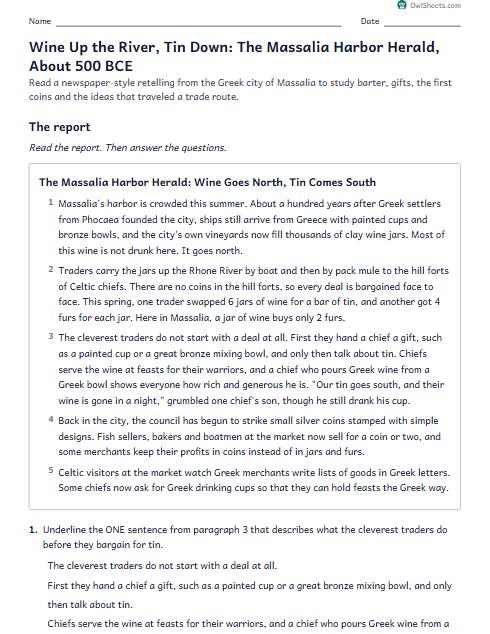
Wine Up the River, Tin Down: The Massalia Harbor Herald, About 500 BCE
Grade 6 · ECO.6.2
14 questionsPremium
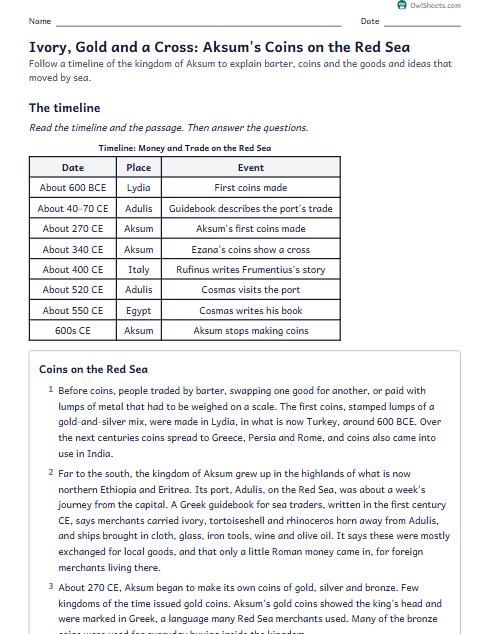
Ivory, Gold and a Cross: Aksum's Coins on the Red Sea
Grade 6 · ECO.6.2
15 questionsPremium
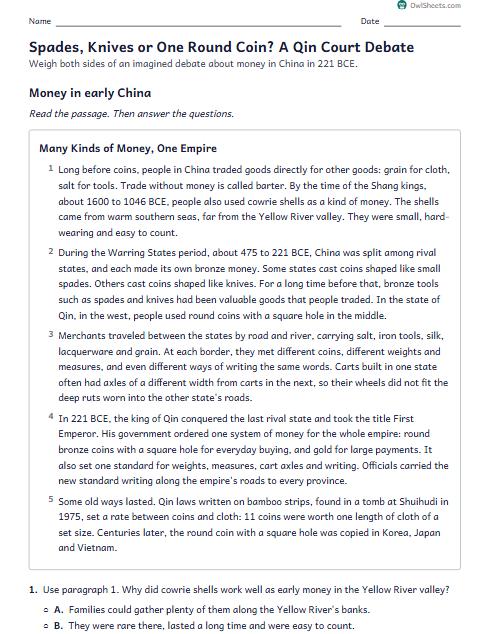
Spades, Knives or One Round Coin? A Qin Court Debate
Grade 6 · ECO.6.2
14 questionsPremium
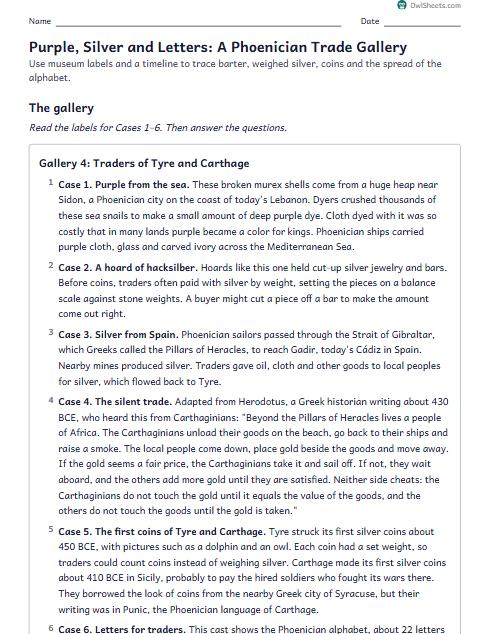
Purple, Silver and Letters: A Phoenician Trade Gallery
Grade 6 · ECO.6.2
13 questionsPremium
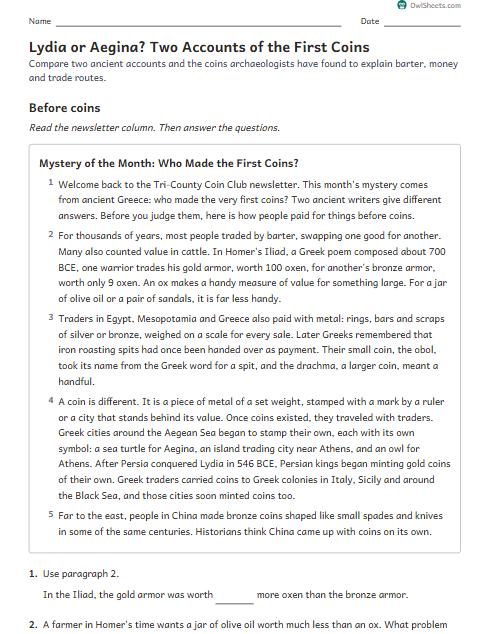
Lydia or Aegina? Two Accounts of the First Coins
Grade 6 · ECO.6.2
11 questionsPremium
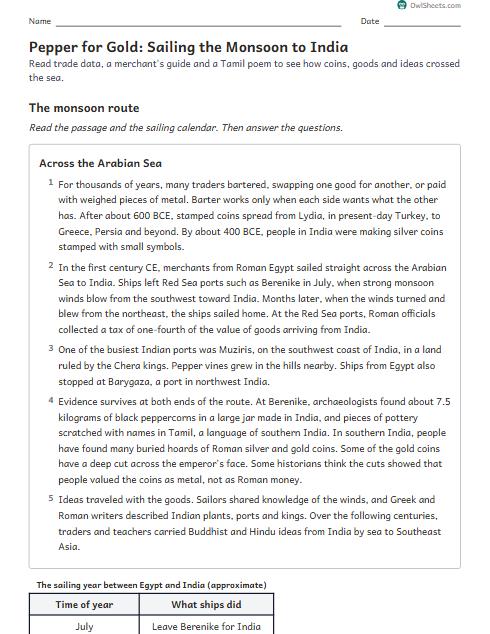
Pepper for Gold: Sailing the Monsoon to India
Grade 6 · ECO.6.2
10 questionsPremium