Grade 6 · Social StudiesECO.6.2Premium
Purple, Silver and Letters: A Phoenician Trade Gallery
Grade 6 economics: tour a Phoenician trade gallery to explain barter, weighed silver and the first coins, and how sea routes carried goods and the alphabet.
Preview
OwlSheets.com
Purple, Silver and Letters: A Phoenician Trade Gallery
Use museum labels and a timeline to trace barter, weighed silver, coins and the spread of the alphabet.
The gallery
Read the labels for Cases 1–6. Then answer the questions.
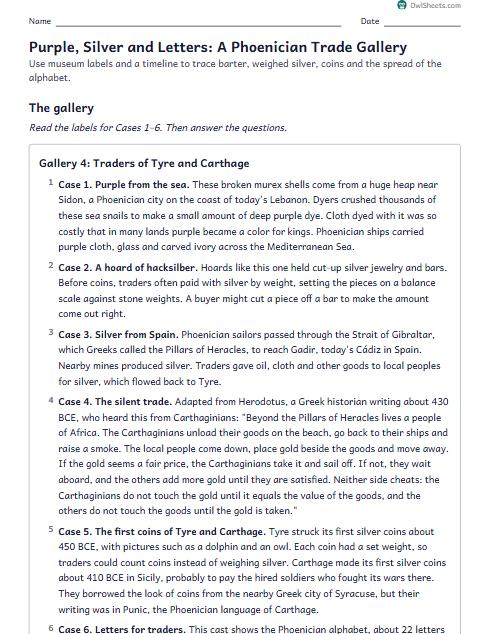
Gallery 4: Traders of Tyre and Carthage
1Case 1. Purple from the sea. These broken murex shells come from a huge heap near Sidon, a Phoenician city on the coast of today's Lebanon. Dyers crushed thousands of these sea snails to make a small amount of deep purple dye. Cloth dyed with it was so costly that in many lands purple became a color for kings. Phoenician ships carried purple cloth, glass and carved ivory across the Mediterranean Sea.
2Case 2. A hoard of hacksilber. Hoards like this one held cut-up silver jewelry and bars. Before coins, traders often paid with silver by weight, setting the pieces on a balance scale against stone weights. A buyer might cut a piece off a bar to make the amount come out right.
3Case 3. Silver from Spain. Phoenician sailors passed through the Strait of Gibraltar, which Greeks called the Pillars of Heracles, to reach Gadir, today's Cádiz in Spain. Nearby mines produced silver. Traders gave oil, cloth and other goods to local peoples for silver, which flowed back to Tyre.
4Case 4. The silent trade. Adapted from Herodotus, a Greek historian writing about 430 BCE, who heard this from Carthaginians: "Beyond the Pillars of Heracles lives a people of Africa. The Carthaginians unload their goods on the beach, go back to their ships and raise a smoke. The local people come down, place gold beside the goods and move away. If the gold seems a fair price, the Carthaginians take it and sail off. If not, they wait aboard, and the others add more gold until they are satisfied. Neither side cheats: the Carthaginians do not touch the gold until it equals the value of the goods, and the others do not touch the goods until the gold is taken."
5Case 5. The first coins of Tyre and Carthage. Tyre struck its first silver coins about 450 BCE, with pictures such as a dolphin and an owl. Each coin had a set weight, so traders could count coins instead of weighing silver. Carthage made its first silver coins about 410 BCE in Sicily, probably to pay the hired soldiers who fought its wars there. They borrowed the look of coins from the nearby Greek city of Syracuse, but their writing was in Punic, the Phoenician language of Carthage.
6Case 6. Letters for traders. This cast shows the Phoenician alphabet, about 22 letters that stood for consonant sounds. Egyptian hieroglyphs and Mesopotamian cuneiform used hundreds of signs, and mostly trained scribes could read them. Greeks who traded with Phoenicians adapted the alphabet and added letters for vowel sounds. The Greek alphabet later led to the Latin alphabet used for English today.
| Date | Event |
|---|---|
| About 1200 BCE on | Weighed hacksilber used as payment |
| About 1000 BCE | Phoenician alphabet on a king's coffin |
| About 814 BCE | Tyre founds Carthage (traditional date) |
| About 750 BCE | Earliest Greek writing with vowels |
| About 450 BCE | Tyre strikes its first silver coins |
| About 430 BCE | Herodotus writes of the silent trade |
| About 410 BCE | Carthage's first coins, made in Sicily |
- A. Purple dye was easy to gather on many beaches.
- B. The dye took thousands of snails, so it was scarce.
- C. Purple cloth was used as coins with a set weight.
- D. Kings were the ones who wove the cloth.
The preview shows the first questions. Unlock the worksheet to see all of it.
Related worksheets
Wine Up the River, Tin Down: The Massalia Harbor Herald, About 500 BCE
Grade 6 · ECO.6.2
14 questionsPremium
Ivory, Gold and a Cross: Aksum's Coins on the Red Sea
Grade 6 · ECO.6.2
15 questionsPremium
Spades, Knives or One Round Coin? A Qin Court Debate
Grade 6 · ECO.6.2
14 questionsPremium
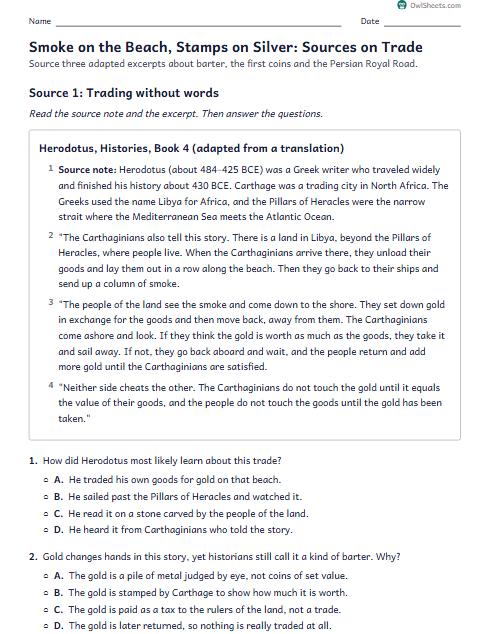
Smoke on the Beach, Stamps on Silver: Sources on Trade
Grade 6 · ECO.6.2
14 questionsPremium
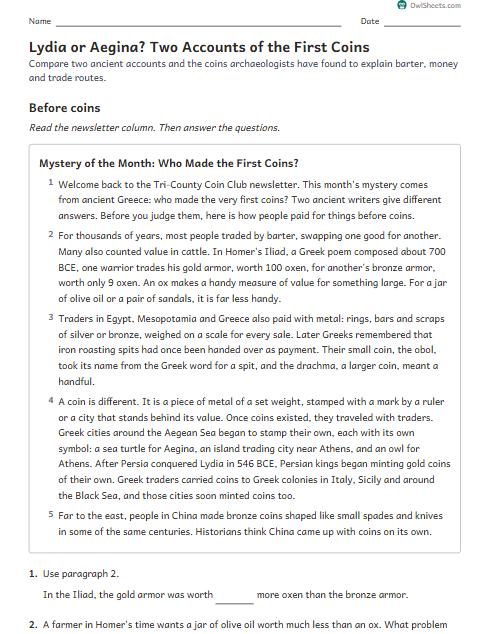
Lydia or Aegina? Two Accounts of the First Coins
Grade 6 · ECO.6.2
11 questionsPremium
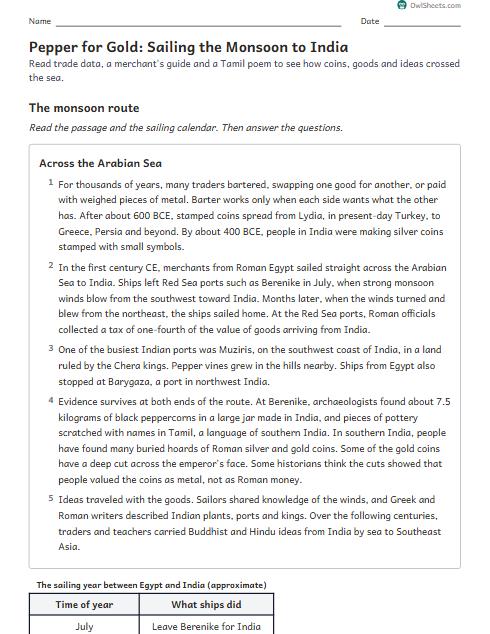
Pepper for Gold: Sailing the Monsoon to India
Grade 6 · ECO.6.2
10 questionsPremium