Grade 6 · Social StudiesECO.6.2Premium
Ivory, Gold and a Cross: Aksum's Coins on the Red Sea
Grade 6 economics: a timeline of Aksum and its Red Sea port of Adulis shows barter, the spread of coins and how trade routes carried goods and ideas.
Preview
OwlSheets.com
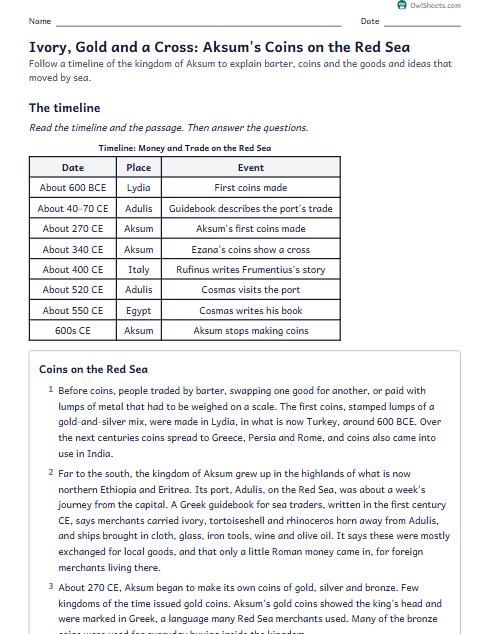
Ivory, Gold and a Cross: Aksum's Coins on the Red Sea
Follow a timeline of the kingdom of Aksum to explain barter, coins and the goods and ideas that moved by sea.
The timeline
Read the timeline and the passage. Then answer the questions.
| Date | Place | Event |
|---|---|---|
| About 600 BCE | Lydia | First coins made |
| About 40–70 CE | Adulis | Guidebook describes the port's trade |
| About 270 CE | Aksum | Aksum's first coins made |
| About 340 CE | Aksum | Ezana's coins show a cross |
| About 400 CE | Italy | Rufinus writes Frumentius's story |
| About 520 CE | Adulis | Cosmas visits the port |
| About 550 CE | Egypt | Cosmas writes his book |
| 600s CE | Aksum | Aksum stops making coins |
Coins on the Red Sea
1Before coins, people traded by barter, swapping one good for another, or paid with lumps of metal that had to be weighed on a scale. The first coins, stamped lumps of a gold-and-silver mix, were made in Lydia, in what is now Turkey, around 600 BCE. Over the next centuries coins spread to Greece, Persia and Rome, and coins also came into use in India.
2Far to the south, the kingdom of Aksum grew up in the highlands of what is now northern Ethiopia and Eritrea. Its port, Adulis, on the Red Sea, was about a week's journey from the capital. A Greek guidebook for sea traders, written in the first century CE, says merchants carried ivory, tortoiseshell and rhinoceros horn away from Adulis, and ships brought in cloth, glass, iron tools, wine and olive oil. It says these were mostly exchanged for local goods, and that only a little Roman money came in, for foreign merchants living there.
3About 270 CE, Aksum began to make its own coins of gold, silver and bronze. Few kingdoms of the time issued gold coins. Aksum's gold coins showed the king's head and were marked in Greek, a language many Red Sea merchants used. Many of the bronze coins were used for everyday buying inside the kingdom.
4Aksum's early coins showed a crescent and a disk, symbols of gods the Aksumites worshiped. About 340 CE, coins of King Ezana began to show a cross instead. According to a story written down about 400 CE by Rufinus, a church writer, a young Christian from the city of Tyre named Frumentius was on a ship that stopped at a Red Sea port, where he was captured and taken to the royal court. He later became a teacher at the court and helped Christianity spread there.
5In the early 500s CE, a merchant from Alexandria in Egypt named Cosmas sailed the Red Sea and visited Adulis. Years later he wrote a book that included stories he had heard from other traders. By the 600s, Red Sea trade had shrunk, and Aksum stopped making coins.
Aksum made its first coins about years after the first coins were made in Lydia.
The preview shows the first questions. Unlock the worksheet to see all of it.
Related worksheets
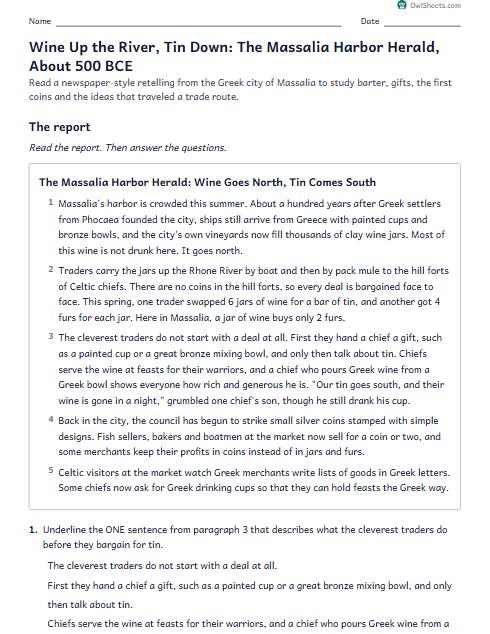
Wine Up the River, Tin Down: The Massalia Harbor Herald, About 500 BCE
Grade 6 · ECO.6.2
14 questionsPremium
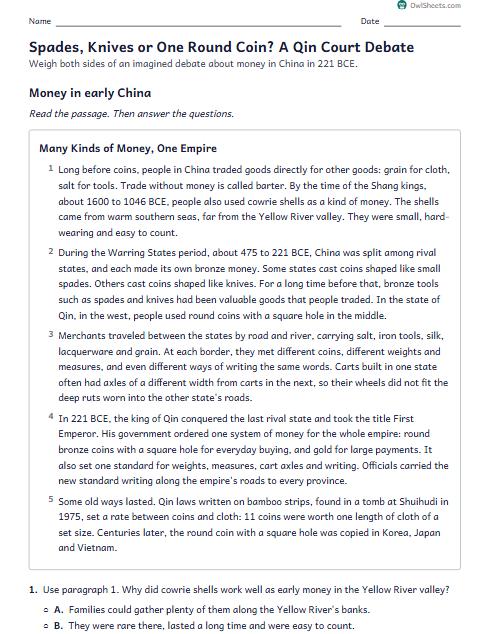
Spades, Knives or One Round Coin? A Qin Court Debate
Grade 6 · ECO.6.2
14 questionsPremium
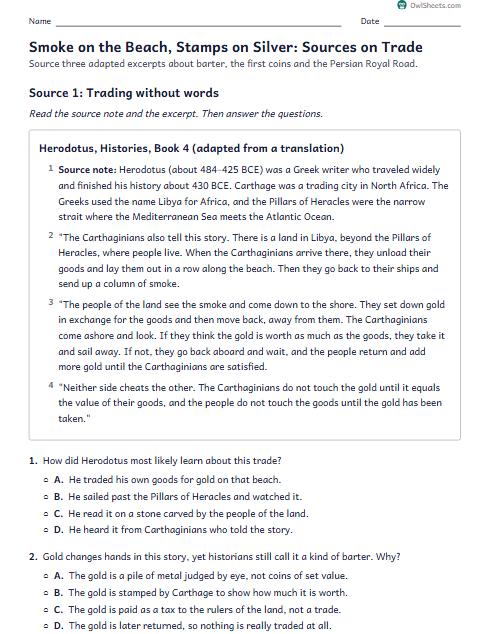
Smoke on the Beach, Stamps on Silver: Sources on Trade
Grade 6 · ECO.6.2
14 questionsPremium
Purple, Silver and Letters: A Phoenician Trade Gallery
Grade 6 · ECO.6.2
13 questionsPremium
Lydia or Aegina? Two Accounts of the First Coins
Grade 6 · ECO.6.2
11 questionsPremium
Pepper for Gold: Sailing the Monsoon to India
Grade 6 · ECO.6.2
10 questionsPremium