Grade 6 · Social StudiesECO.6.2Premium
Spades, Knives or One Round Coin? A Qin Court Debate
Grade 6 economics: an imagined Qin court debate of 221 BCE on barter, cowries, spade and knife coins, one round coin and roads that moved goods and ideas.
Preview
OwlSheets.com
Spades, Knives or One Round Coin? A Qin Court Debate
Weigh both sides of an imagined debate about money in China in 221 BCE.
Money in early China
Read the passage. Then answer the questions.
Many Kinds of Money, One Empire
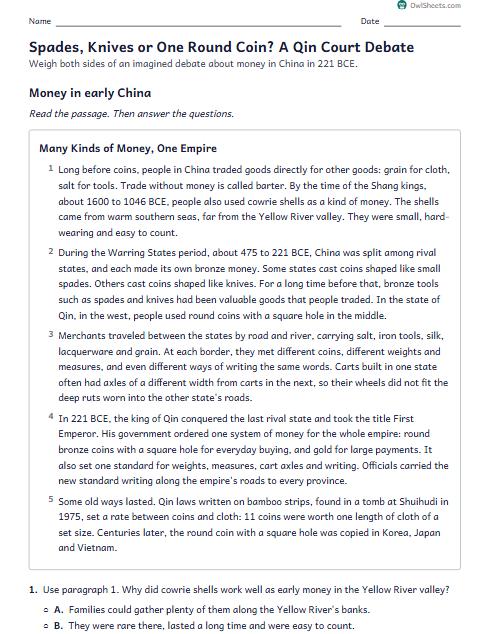
1Long before coins, people in China traded goods directly for other goods: grain for cloth, salt for tools. Trade without money is called barter. By the time of the Shang kings, about 1600 to 1046 BCE, people also used cowrie shells as a kind of money. The shells came from warm southern seas, far from the Yellow River valley. They were small, hard-wearing and easy to count.
2During the Warring States period, about 475 to 221 BCE, China was split among rival states, and each made its own bronze money. Some states cast coins shaped like small spades. Others cast coins shaped like knives. For a long time before that, bronze tools such as spades and knives had been valuable goods that people traded. In the state of Qin, in the west, people used round coins with a square hole in the middle.
3Merchants traveled between the states by road and river, carrying salt, iron tools, silk, lacquerware and grain. At each border, they met different coins, different weights and measures, and even different ways of writing the same words. Carts built in one state often had axles of a different width from carts in the next, so their wheels did not fit the deep ruts worn into the other state's roads.
4In 221 BCE, the king of Qin conquered the last rival state and took the title First Emperor. His government ordered one system of money for the whole empire: round bronze coins with a square hole for everyday buying, and gold for large payments. It also set one standard for weights, measures, cart axles and writing. Officials carried the new standard writing along the empire's roads to every province.
5Some old ways lasted. Qin laws written on bamboo strips, found in a tomb at Shuihudi in 1975, set a rate between coins and cloth: 11 coins were worth one length of cloth of a set size. Centuries later, the round coin with a square hole was copied in Korea, Japan and Vietnam.
- A. Families could gather plenty of them along the Yellow River's banks.
- B. They were rare there, lasted a long time and were easy to count.
- C. They could be eaten in hard years when the grain harvest ran short.
- D. The Shang kings stamped each shell to show its exact weight in bronze.
- A. People already valued and traded those tools, so the shapes felt familiar.
- B. The coins could also be used as real tools for digging and cutting.
- C. Each shape showed which ruler had won the most recent war.
- D. Qin's king ordered every state to copy the tools used in Qin.
The preview shows the first questions. Unlock the worksheet to see all of it.
Related worksheets
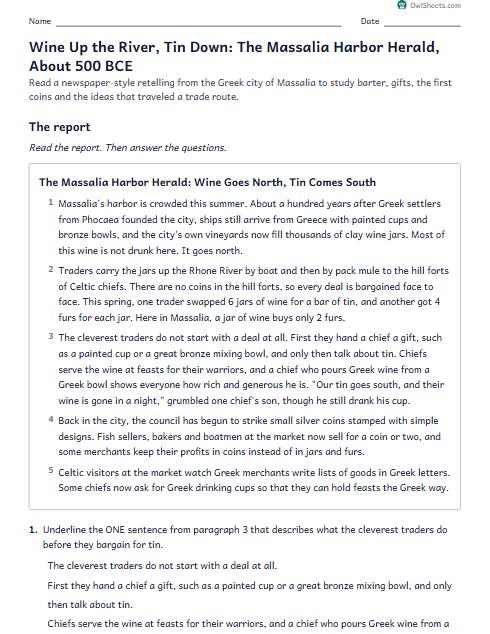
Wine Up the River, Tin Down: The Massalia Harbor Herald, About 500 BCE
Grade 6 · ECO.6.2
14 questionsPremium
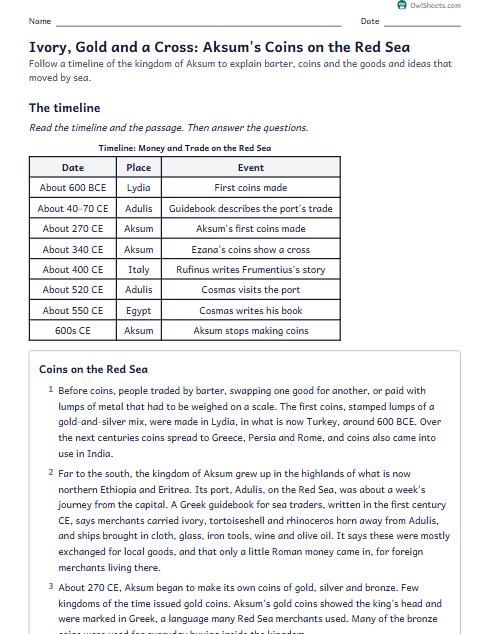
Ivory, Gold and a Cross: Aksum's Coins on the Red Sea
Grade 6 · ECO.6.2
15 questionsPremium
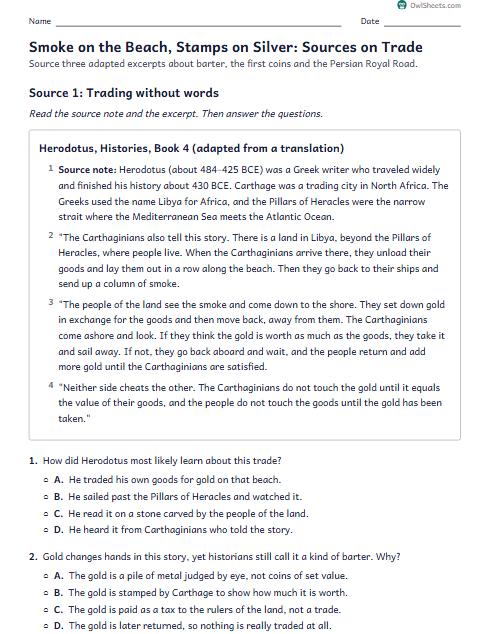
Smoke on the Beach, Stamps on Silver: Sources on Trade
Grade 6 · ECO.6.2
14 questionsPremium
Purple, Silver and Letters: A Phoenician Trade Gallery
Grade 6 · ECO.6.2
13 questionsPremium
Lydia or Aegina? Two Accounts of the First Coins
Grade 6 · ECO.6.2
11 questionsPremium
Pepper for Gold: Sailing the Monsoon to India
Grade 6 · ECO.6.2
10 questionsPremium