Grade 6 · Social StudiesHIS.6.4Premium
Seals, Pillars and Numerals: A Museum Hall of Ancient India
Grade 6 ancient India: read museum labels on an Indus seal, the Lothal basin, Ashoka's pillar and edict, a Gupta coin and the Bakhshali manuscript.
Preview
OwlSheets.com
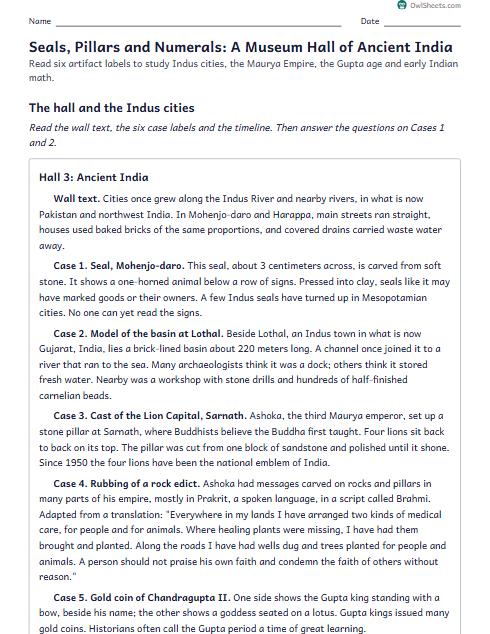
Seals, Pillars and Numerals: A Museum Hall of Ancient India
Read six artifact labels to study Indus cities, the Maurya Empire, the Gupta age and early Indian math.
The hall and the Indus cities
Read the wall text, the six case labels and the timeline. Then answer the questions on Cases 1 and 2.
Hall 3: Ancient India
Wall text. Cities once grew along the Indus River and nearby rivers, in what is now Pakistan and northwest India. In Mohenjo-daro and Harappa, main streets ran straight, houses used baked bricks of the same proportions, and covered drains carried waste water away.
Case 1. Seal, Mohenjo-daro. This seal, about 3 centimeters across, is carved from soft stone. It shows a one-horned animal below a row of signs. Pressed into clay, seals like it may have marked goods or their owners. A few Indus seals have turned up in Mesopotamian cities. No one can yet read the signs.
Case 2. Model of the basin at Lothal. Beside Lothal, an Indus town in what is now Gujarat, India, lies a brick-lined basin about 220 meters long. A channel once joined it to a river that ran to the sea. Many archaeologists think it was a dock; others think it stored fresh water. Nearby was a workshop with stone drills and hundreds of half-finished carnelian beads.
Case 3. Cast of the Lion Capital, Sarnath. Ashoka, the third Maurya emperor, set up a stone pillar at Sarnath, where Buddhists believe the Buddha first taught. Four lions sit back to back on its top. The pillar was cut from one block of sandstone and polished until it shone. Since 1950 the four lions have been the national emblem of India.
Case 4. Rubbing of a rock edict. Ashoka had messages carved on rocks and pillars in many parts of his empire, mostly in Prakrit, a spoken language, in a script called Brahmi. Adapted from a translation: "Everywhere in my lands I have arranged two kinds of medical care, for people and for animals. Where healing plants were missing, I have had them brought and planted. Along the roads I have had wells dug and trees planted for people and animals. A person should not praise his own faith and condemn the faith of others without reason."
Case 5. Gold coin of Chandragupta II. One side shows the Gupta king standing with a bow, beside his name; the other shows a goddess seated on a lotus. Gupta kings issued many gold coins. Historians often call the Gupta period a time of great learning.
Case 6. Copy of the Bakhshali manuscript. In 1881 a farmer found about 70 birch-bark leaves near Bakhshali, in what is now Pakistan. They work through problems in arithmetic and algebra. Each digit sign has a value that depends on its place, and a solid dot holds an empty place: an early zero. In 2017, radiocarbon tests on three leaves gave three different date ranges, from about 224–383 CE to about 885–993 CE. Scholars debate what this means.
| Date | Event |
|---|---|
| About 2600–1900 BCE | Indus cities thrive |
| About 1900 BCE | Many Indus cities shrink |
| About 321 BCE | Chandragupta Maurya founds empire |
| About 268–232 BCE | Ashoka rules the Maurya Empire |
| About 185 BCE | Maurya Empire ends |
| About 320–550 CE | Gupta kings rule northern India |
| About 380–415 CE | Chandragupta II rules |
| 499 CE | Aryabhata finishes a math book |
| 1837 | James Prinsep learns to read Brahmi |
- A. Indus families mainly wore seals as jewelry.
- B. Goods or traders moved between the two regions.
- C. Mesopotamian kings ruled the Indus cities.
- D. Mesopotamians carved the seals and sent them east.
The preview shows the first questions. Unlock the worksheet to see all of it.
Related worksheets
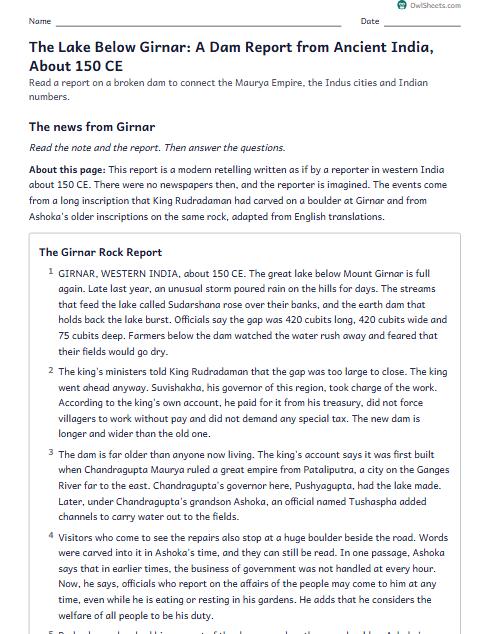
The Lake Below Girnar: A Dam Report from Ancient India, About 150 CE
Grade 6 · HIS.6.4
15 questionsPremium
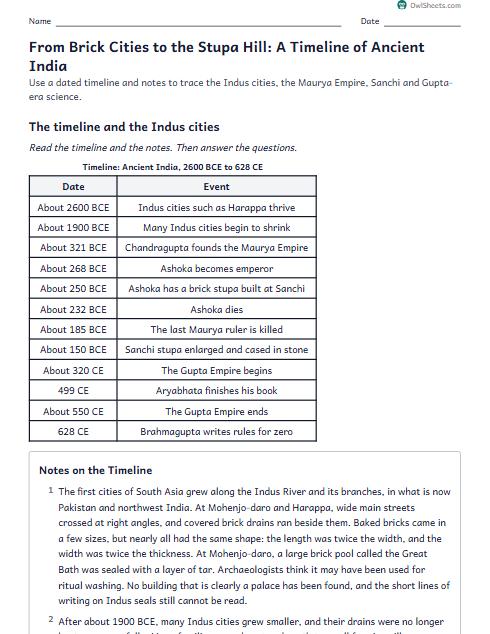
From Brick Cities to the Stupa Hill: A Timeline of Ancient India
Grade 6 · HIS.6.4
15 questionsPremium
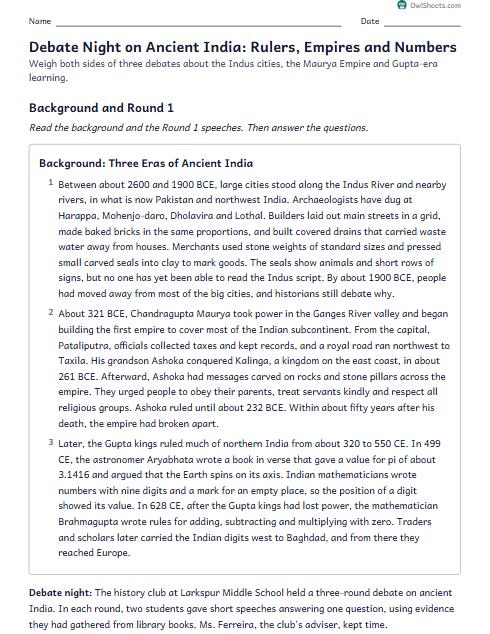
Debate Night on Ancient India: Rulers, Empires and Numbers
Grade 6 · HIS.6.4
15 questionsPremium
A Pilgrim's Record: Sourcing Faxian's Journey to Gupta India
Grade 6 · HIS.6.4
15 questionsPremium
A Greek Visitor and a King's Handbook: Two Accounts of Maurya India
Grade 6 · HIS.6.4
11 questionsFree
Ancient India by the Numbers: A Film Researcher's Data File
Grade 6 · HIS.6.4
12 questionsPremium