Grade 6 · Social StudiesHIS.6.4Premium
From Brick Cities to the Stupa Hill: A Timeline of Ancient India
Grade 6 ancient India: follow a dated timeline from Indus cities to the Maurya Empire, the Sanchi stupa and Aryabhata's and Brahmagupta's work.
Preview
OwlSheets.com
From Brick Cities to the Stupa Hill: A Timeline of Ancient India
Use a dated timeline and notes to trace the Indus cities, the Maurya Empire, Sanchi and Gupta-era science.
The timeline and the Indus cities
Read the timeline and the notes. Then answer the questions.
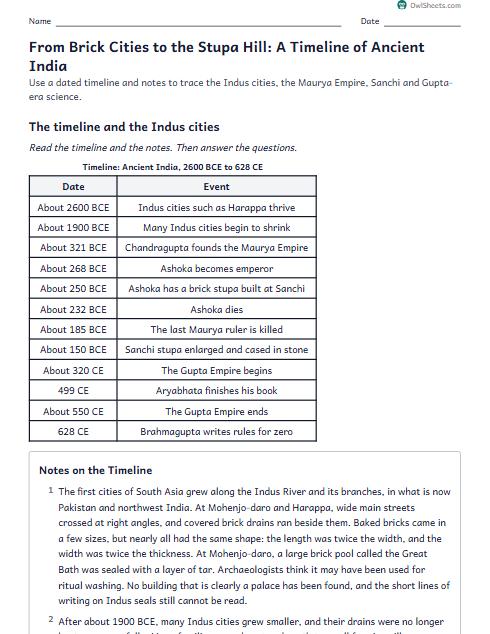
| Date | Event |
|---|---|
| About 2600 BCE | Indus cities such as Harappa thrive |
| About 1900 BCE | Many Indus cities begin to shrink |
| About 321 BCE | Chandragupta founds the Maurya Empire |
| About 268 BCE | Ashoka becomes emperor |
| About 250 BCE | Ashoka has a brick stupa built at Sanchi |
| About 232 BCE | Ashoka dies |
| About 185 BCE | The last Maurya ruler is killed |
| About 150 BCE | Sanchi stupa enlarged and cased in stone |
| About 320 CE | The Gupta Empire begins |
| 499 CE | Aryabhata finishes his book |
| About 550 CE | The Gupta Empire ends |
| 628 CE | Brahmagupta writes rules for zero |
Notes on the Timeline
1The first cities of South Asia grew along the Indus River and its branches, in what is now Pakistan and northwest India. At Mohenjo-daro and Harappa, wide main streets crossed at right angles, and covered brick drains ran beside them. Baked bricks came in a few sizes, but nearly all had the same shape: the length was twice the width, and the width was twice the thickness. At Mohenjo-daro, a large brick pool called the Great Bath was sealed with a layer of tar. Archaeologists think it may have been used for ritual washing. No building that is clearly a palace has been found, and the short lines of writing on Indus seals still cannot be read.
2After about 1900 BCE, many Indus cities grew smaller, and their drains were no longer kept up as carefully. Many families moved east and south to small farming villages. Historians suggest several causes that may have worked together: some rivers changed course or dried up, the monsoon rains may have grown weaker, and trade with Mesopotamia fell off.
3About 321 BCE, Chandragupta Maurya built an empire with its capital at Pataliputra, on the Ganges River. It soon grew too large to rule from one palace, so it was divided into provinces. Ashoka's inscriptions mention princes serving as governors in far cities such as Taxila and Ujjain. Ashoka supported Buddhist monks, and he had a brick stupa, a dome-shaped mound holding relics of the Buddha, built on a hill at Sanchi near the trading city of Vidisha. After the last Maurya ruler was killed, the empire broke into smaller kingdoms. About a century after Ashoka, workers made the stupa about twice as large and covered it in stone. Hundreds of short carvings on its stone railings name the people who paid for each part; many were monks, nuns, merchants and townspeople.
4Under the Gupta kings, scholars made advances in math and astronomy. In 499 CE, Aryabhata finished a book of short verses on both subjects. Many people at the time knew a story that a demon named Rahu swallowed the sun or the moon during an eclipse. Aryabhata explained instead that a lunar eclipse happens when the moon passes into the earth's shadow, and a solar eclipse when the moon blocks the sun, and he gave rules for working out when eclipses would happen. In 628 CE, Brahmagupta wrote rules for calculating with zero, such as: a number minus itself is zero, and a number plus zero stays the same.
The brick is cm long.
The preview shows the first questions. Unlock the worksheet to see all of it.
Related worksheets
The Lake Below Girnar: A Dam Report from Ancient India, About 150 CE
Grade 6 · HIS.6.4
15 questionsPremium
Debate Night on Ancient India: Rulers, Empires and Numbers
Grade 6 · HIS.6.4
15 questionsPremium
A Pilgrim's Record: Sourcing Faxian's Journey to Gupta India
Grade 6 · HIS.6.4
15 questionsPremium
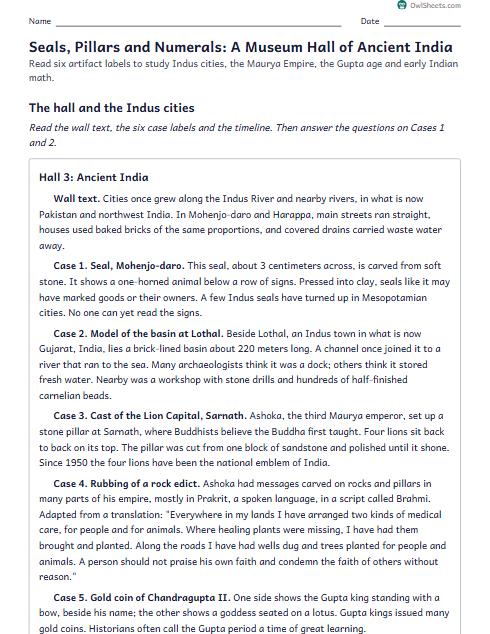
Seals, Pillars and Numerals: A Museum Hall of Ancient India
Grade 6 · HIS.6.4
14 questionsPremium
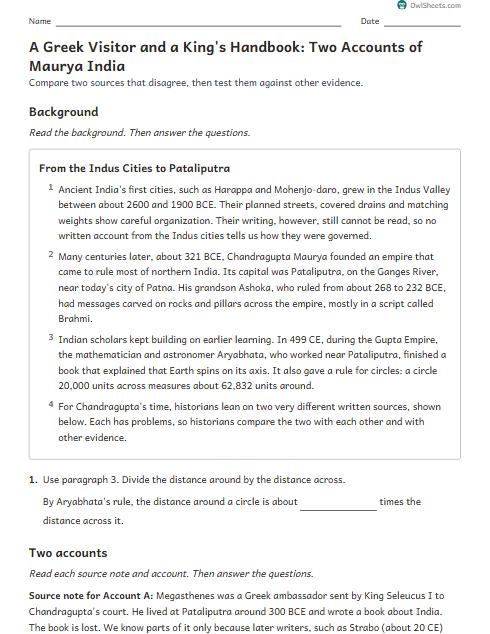
A Greek Visitor and a King's Handbook: Two Accounts of Maurya India
Grade 6 · HIS.6.4
11 questionsFree
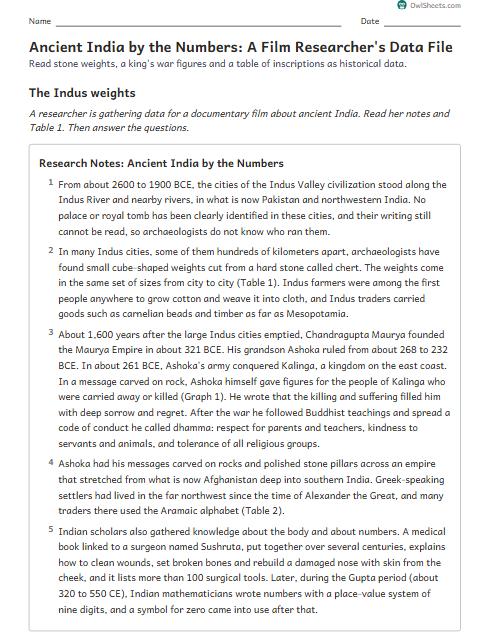
Ancient India by the Numbers: A Film Researcher's Data File
Grade 6 · HIS.6.4
12 questionsPremium