Grade 6 · Social StudiesHIS.6.4Premium
The Lake Below Girnar: A Dam Report from Ancient India, About 150 CE
Grade 6 ancient India: a news report on the Girnar dam, built under the Mauryas and rebuilt about 150 CE, links Ashoka, Indus water works and Indian numbers.
Preview
OwlSheets.com
The Lake Below Girnar: A Dam Report from Ancient India, About 150 CE
Read a report on a broken dam to connect the Maurya Empire, the Indus cities and Indian numbers.
The news from Girnar
Read the note and the report. Then answer the questions.
The Girnar Rock Report
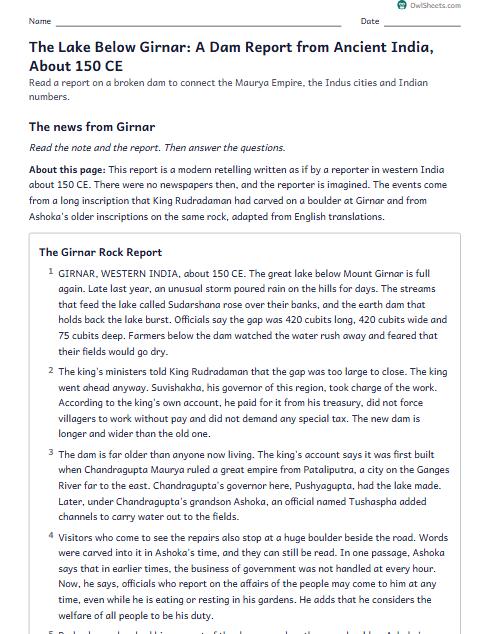
1GIRNAR, WESTERN INDIA, about 150 CE. The great lake below Mount Girnar is full again. Late last year, an unusual storm poured rain on the hills for days. The streams that feed the lake called Sudarshana rose over their banks, and the earth dam that holds back the lake burst. Officials say the gap was 420 cubits long, 420 cubits wide and 75 cubits deep. Farmers below the dam watched the water rush away and feared that their fields would go dry.
2The king's ministers told King Rudradaman that the gap was too large to close. The king went ahead anyway. Suvishakha, his governor of this region, took charge of the work. According to the king's own account, he paid for it from his treasury, did not force villagers to work without pay and did not demand any special tax. The new dam is longer and wider than the old one.
3The dam is far older than anyone now living. The king's account says it was first built when Chandragupta Maurya ruled a great empire from Pataliputra, a city on the Ganges River far to the east. Chandragupta's governor here, Pushyagupta, had the lake made. Later, under Chandragupta's grandson Ashoka, an official named Tushaspha added channels to carry water out to the fields.
4Visitors who come to see the repairs also stop at a huge boulder beside the road. Words were carved into it in Ashoka's time, and they can still be read. In one passage, Ashoka says that in earlier times, the business of government was not handled at every hour. Now, he says, officials who report on the affairs of the people may come to him at any time, even while he is eating or resting in his gardens. He adds that he considers the welfare of all people to be his duty.
5Rudradaman has had his account of the dam carved on the same boulder. Ashoka's words are in a language close to the everyday speech of his time, but Rudradaman's are in polished Sanskrit, the language of scholars and priests.
6When clerks and merchants here write numbers in figures, they use separate signs for the ones, for the tens and for the hundreds. To write 72, a clerk uses one sign that means seventy and another sign that means two. A place with nothing in it gets no sign at all, because there is no sign for zero.
- A. Governors named by the emperor ran large works far from the capital.
- B. Chandragupta traveled to Girnar to direct the building of the dam.
- C. The region kept its own kings, who sent nothing to Pataliputra.
- D. Villages near Girnar built the dam on their own, with no royal officials.
The preview shows the first questions. Unlock the worksheet to see all of it.
Related worksheets
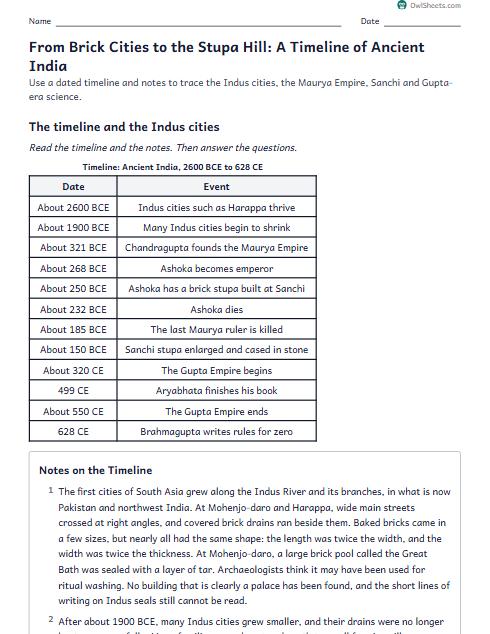
From Brick Cities to the Stupa Hill: A Timeline of Ancient India
Grade 6 · HIS.6.4
15 questionsPremium
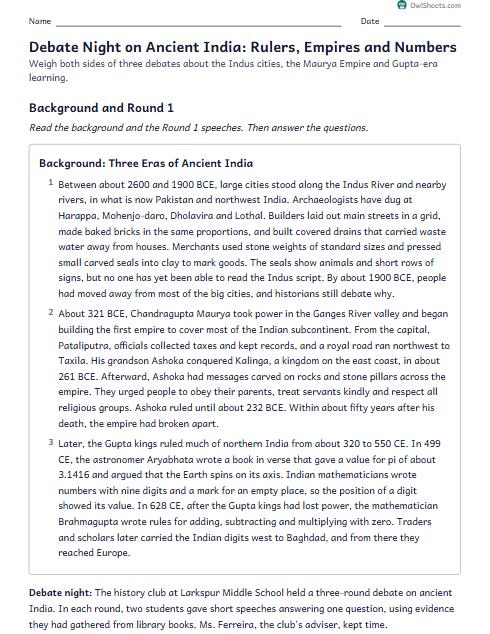
Debate Night on Ancient India: Rulers, Empires and Numbers
Grade 6 · HIS.6.4
15 questionsPremium
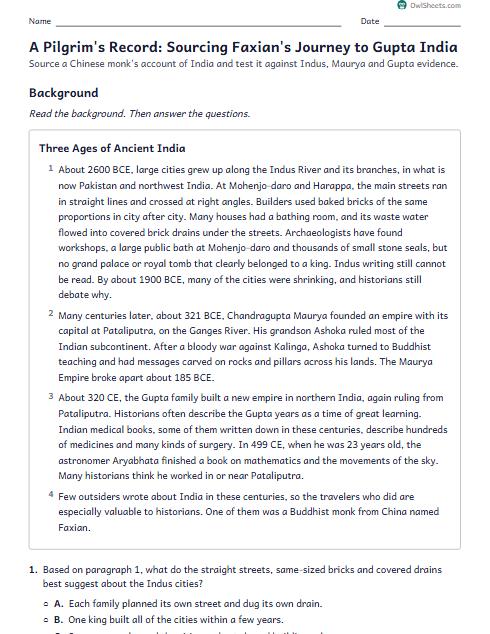
A Pilgrim's Record: Sourcing Faxian's Journey to Gupta India
Grade 6 · HIS.6.4
15 questionsPremium
Seals, Pillars and Numerals: A Museum Hall of Ancient India
Grade 6 · HIS.6.4
14 questionsPremium
A Greek Visitor and a King's Handbook: Two Accounts of Maurya India
Grade 6 · HIS.6.4
11 questionsFree
Ancient India by the Numbers: A Film Researcher's Data File
Grade 6 · HIS.6.4
12 questionsPremium