Grade 6 · Social StudiesHIS.6.4Premium
Debate Night on Ancient India: Rulers, Empires and Numbers
Grade 6 ancient India: judge a three-round student debate on Indus city government, what held the Maurya Empire together and Gupta math and science.
Preview
OwlSheets.com
Debate Night on Ancient India: Rulers, Empires and Numbers
Weigh both sides of three debates about the Indus cities, the Maurya Empire and Gupta-era learning.
Background and Round 1
Read the background and the Round 1 speeches. Then answer the questions.
Background: Three Eras of Ancient India
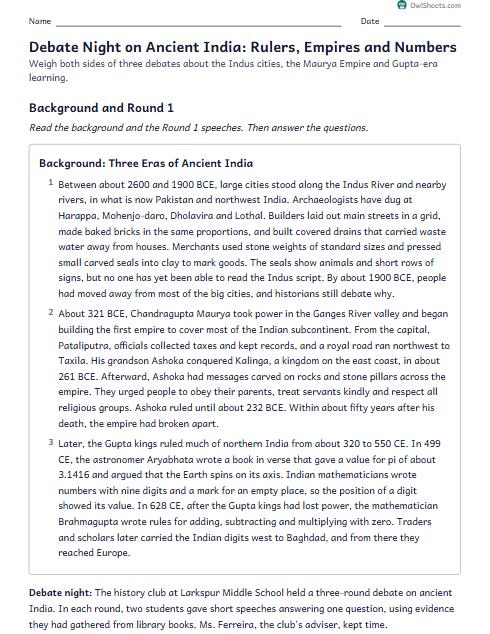
1Between about 2600 and 1900 BCE, large cities stood along the Indus River and nearby rivers, in what is now Pakistan and northwest India. Archaeologists have dug at Harappa, Mohenjo-daro, Dholavira and Lothal. Builders laid out main streets in a grid, made baked bricks in the same proportions, and built covered drains that carried waste water away from houses. Merchants used stone weights of standard sizes and pressed small carved seals into clay to mark goods. The seals show animals and short rows of signs, but no one has yet been able to read the Indus script. By about 1900 BCE, people had moved away from most of the big cities, and historians still debate why.
2About 321 BCE, Chandragupta Maurya took power in the Ganges River valley and began building the first empire to cover most of the Indian subcontinent. From the capital, Pataliputra, officials collected taxes and kept records, and a royal road ran northwest to Taxila. His grandson Ashoka conquered Kalinga, a kingdom on the east coast, in about 261 BCE. Afterward, Ashoka had messages carved on rocks and stone pillars across the empire. They urged people to obey their parents, treat servants kindly and respect all religious groups. Ashoka ruled until about 232 BCE. Within about fifty years after his death, the empire had broken apart.
3Later, the Gupta kings ruled much of northern India from about 320 to 550 CE. In 499 CE, the astronomer Aryabhata wrote a book in verse that gave a value for pi of about 3.1416 and argued that the Earth spins on its axis. Indian mathematicians wrote numbers with nine digits and a mark for an empty place, so the position of a digit showed its value. In 628 CE, after the Gupta kings had lost power, the mathematician Brahmagupta wrote rules for adding, subtracting and multiplying with zero. Traders and scholars later carried the Indian digits west to Baghdad, and from there they reached Europe.
Round 1: Were the Indus cities ruled by powerful kings?
Rafael (yes): "Cities like Mohenjo-daro did not plan themselves. On a raised mound called the citadel stand the Great Bath, a brick pool made watertight with a layer of tar, and large buildings that may have stored grain. Someone had to command thousands of workers to carry bricks and dig the drains under the streets. And bricks of the same proportions show up in cities hundreds of kilometers apart. When so many people follow one plan, I think a powerful ruler stood behind it."
Lena (no): "Big projects need leaders, but they do not need a king. At no Indus city have archaeologists found a building they can clearly call a palace, a rich royal tomb or a large statue of a ruler. Many ordinary houses had their own wells and bathing rooms, so comfort was not kept for a few. The shared bricks and weights could have spread because merchants in many cities found them useful and agreed to them. Councils of leading families or merchants in each city could have planned the streets."
The preview shows the first questions. Unlock the worksheet to see all of it.
Related worksheets
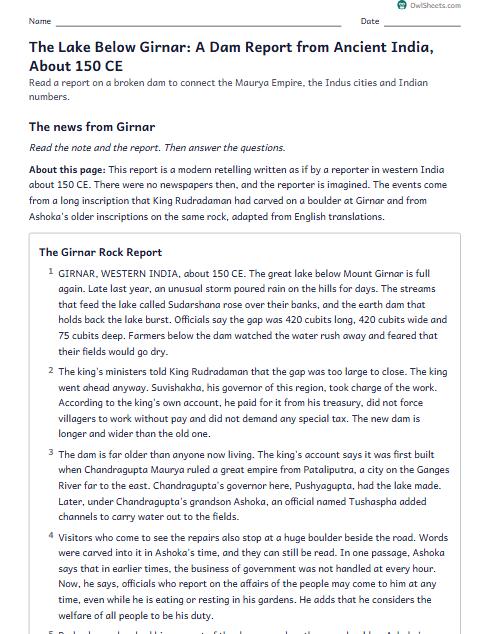
The Lake Below Girnar: A Dam Report from Ancient India, About 150 CE
Grade 6 · HIS.6.4
15 questionsPremium
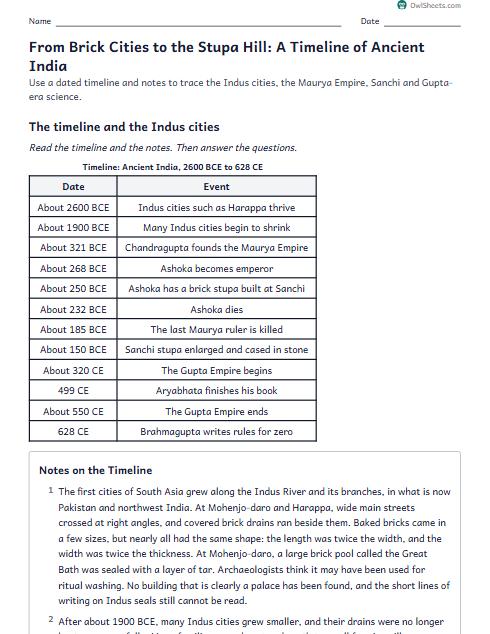
From Brick Cities to the Stupa Hill: A Timeline of Ancient India
Grade 6 · HIS.6.4
15 questionsPremium
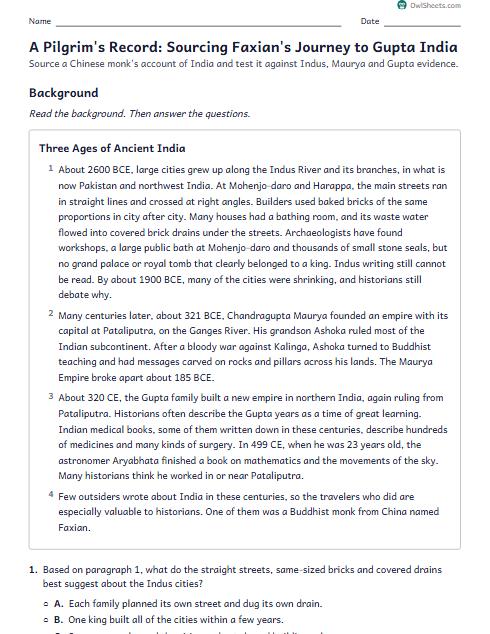
A Pilgrim's Record: Sourcing Faxian's Journey to Gupta India
Grade 6 · HIS.6.4
15 questionsPremium
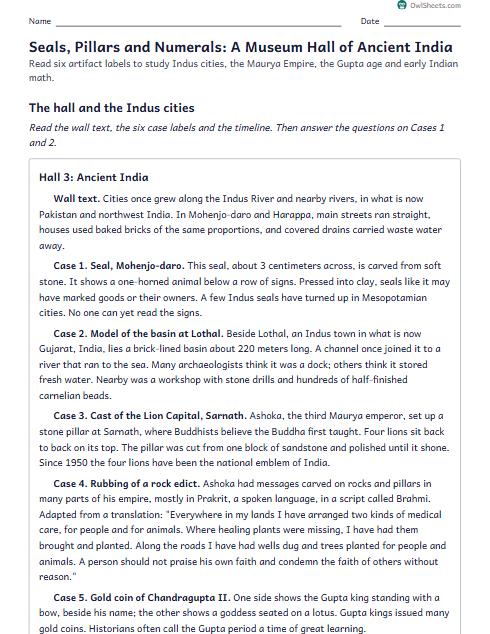
Seals, Pillars and Numerals: A Museum Hall of Ancient India
Grade 6 · HIS.6.4
14 questionsPremium
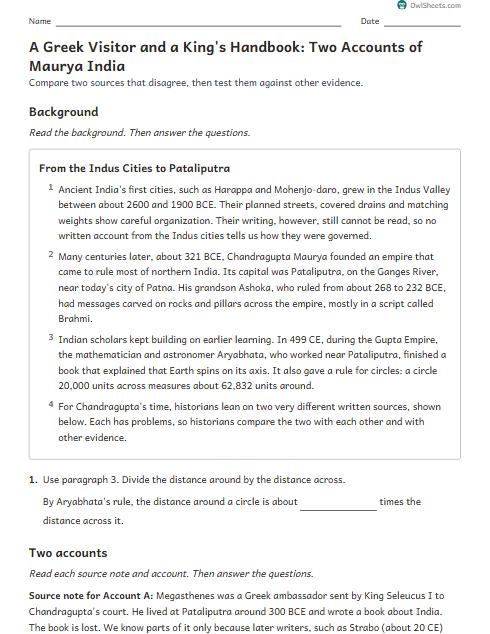
A Greek Visitor and a King's Handbook: Two Accounts of Maurya India
Grade 6 · HIS.6.4
11 questionsFree
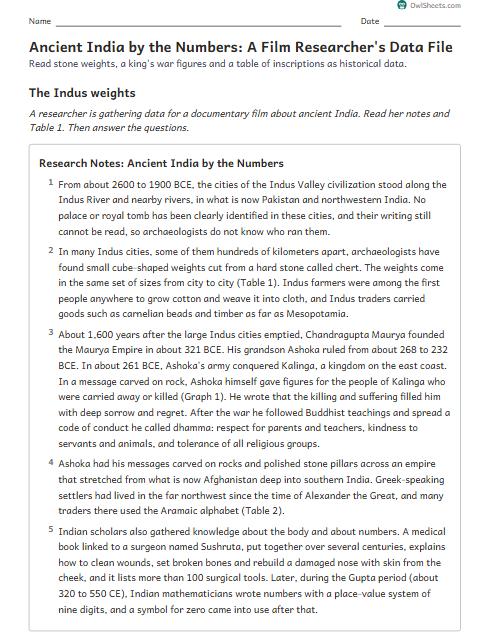
Ancient India by the Numbers: A Film Researcher's Data File
Grade 6 · HIS.6.4
12 questionsPremium