Grade 6 · Social StudiesHIS.6.4Premium
A Pilgrim's Record: Sourcing Faxian's Journey to Gupta India
Grade 6 ancient India: source the record of Faxian, a Chinese monk at Pataliputra about 405 CE, with Indus cities, the Mauryas and Aryabhata's astronomy.
Preview
OwlSheets.com
A Pilgrim's Record: Sourcing Faxian's Journey to Gupta India
Source a Chinese monk's account of India and test it against Indus, Maurya and Gupta evidence.
Background
Read the background. Then answer the questions.
Three Ages of Ancient India
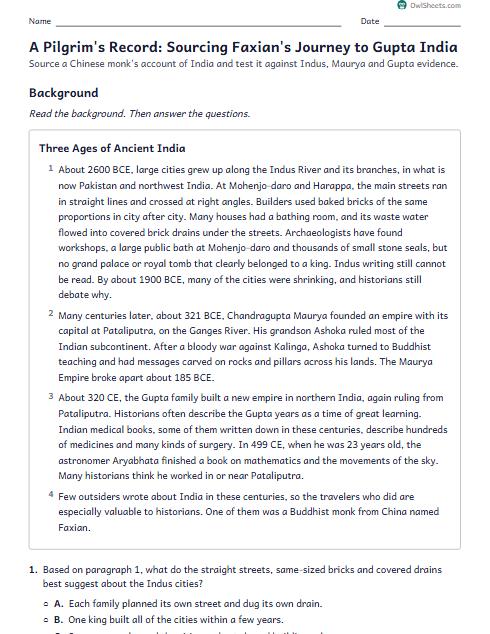
1About 2600 BCE, large cities grew up along the Indus River and its branches, in what is now Pakistan and northwest India. At Mohenjo-daro and Harappa, the main streets ran in straight lines and crossed at right angles. Builders used baked bricks of the same proportions in city after city. Many houses had a bathing room, and its waste water flowed into covered brick drains under the streets. Archaeologists have found workshops, a large public bath at Mohenjo-daro and thousands of small stone seals, but no grand palace or royal tomb that clearly belonged to a king. Indus writing still cannot be read. By about 1900 BCE, many of the cities were shrinking, and historians still debate why.
2Many centuries later, about 321 BCE, Chandragupta Maurya founded an empire with its capital at Pataliputra, on the Ganges River. His grandson Ashoka ruled most of the Indian subcontinent. After a bloody war against Kalinga, Ashoka turned to Buddhist teaching and had messages carved on rocks and pillars across his lands. The Maurya Empire broke apart about 185 BCE.
3About 320 CE, the Gupta family built a new empire in northern India, again ruling from Pataliputra. Historians often describe the Gupta years as a time of great learning. Indian medical books, some of them written down in these centuries, describe hundreds of medicines and many kinds of surgery. In 499 CE, when he was 23 years old, the astronomer Aryabhata finished a book on mathematics and the movements of the sky. Many historians think he worked in or near Pataliputra.
4Few outsiders wrote about India in these centuries, so the travelers who did are especially valuable to historians. One of them was a Buddhist monk from China named Faxian.
- A. Each family planned its own street and dug its own drain.
- B. One king built all of the cities within a few years.
- C. Some group planned the cities and set shared building rules.
- D. Builders took their city plans from the later Maurya rulers.
- A. The seals list the names of kings, so the cities most likely had several.
- B. The public bath shows that priests most likely ran each of the cities.
- C. The covered drains show that councils most likely ruled the cities.
- D. No clear palace or royal tomb has been found, so who ruled is unclear.
The preview shows the first questions. Unlock the worksheet to see all of it.
Related worksheets
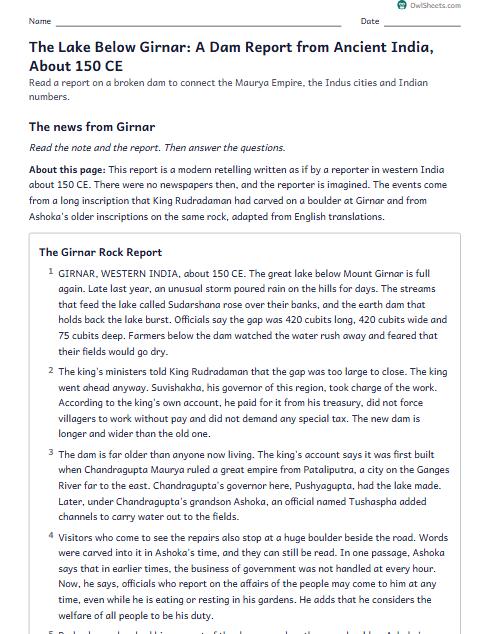
The Lake Below Girnar: A Dam Report from Ancient India, About 150 CE
Grade 6 · HIS.6.4
15 questionsPremium
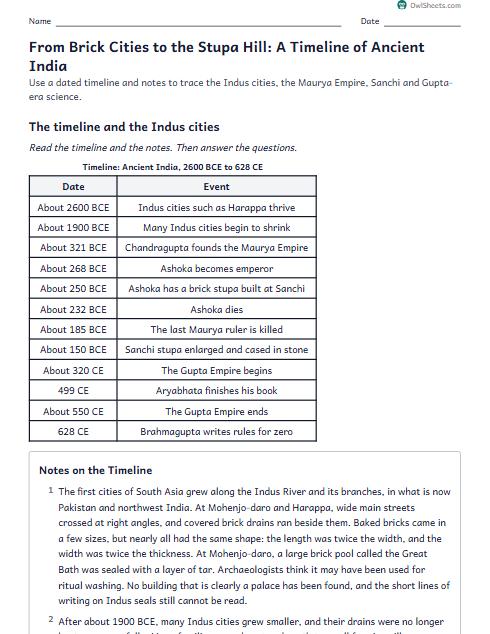
From Brick Cities to the Stupa Hill: A Timeline of Ancient India
Grade 6 · HIS.6.4
15 questionsPremium
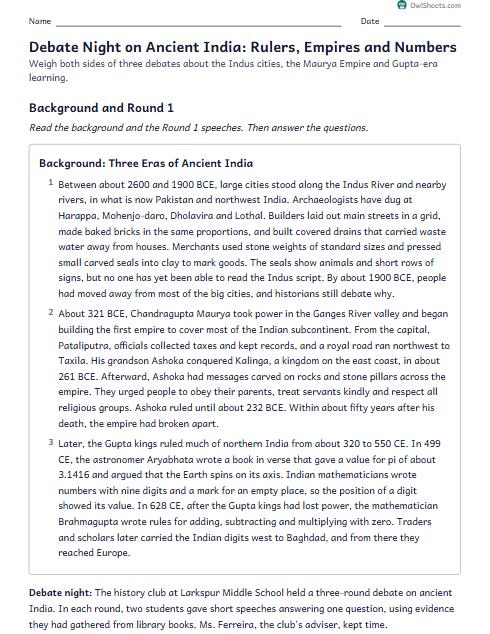
Debate Night on Ancient India: Rulers, Empires and Numbers
Grade 6 · HIS.6.4
15 questionsPremium
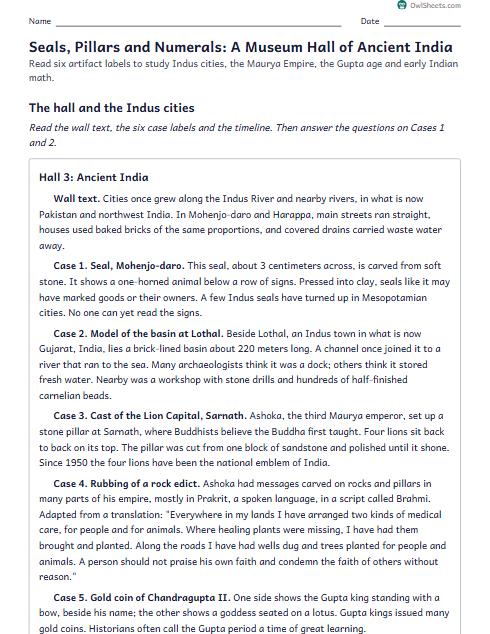
Seals, Pillars and Numerals: A Museum Hall of Ancient India
Grade 6 · HIS.6.4
14 questionsPremium
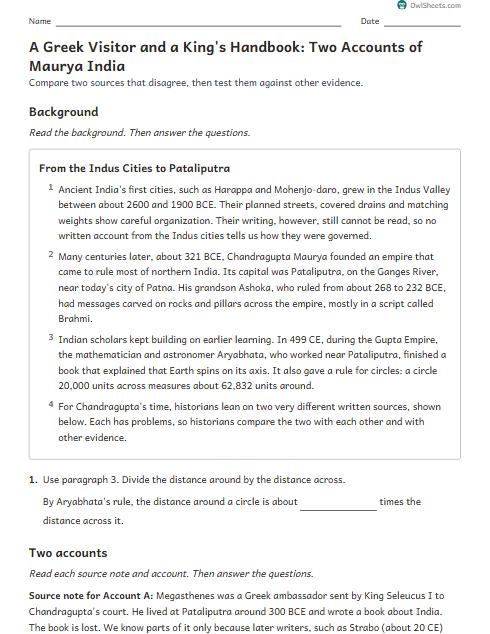
A Greek Visitor and a King's Handbook: Two Accounts of Maurya India
Grade 6 · HIS.6.4
11 questionsFree
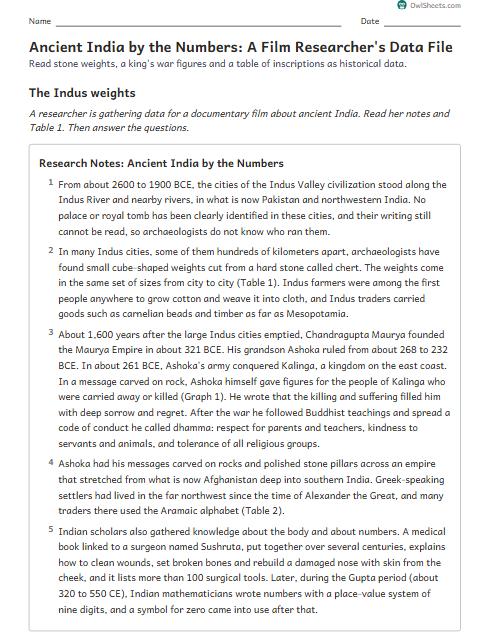
Ancient India by the Numbers: A Film Researcher's Data File
Grade 6 · HIS.6.4
12 questionsPremium