Grade 5 · Social StudiesCIV.5.4
A Letter from Grandma Yolanda About the Vote
A grandmother's letter to a new voter in a desert city traces amendments, laws, a court case and people's work that expanded voting rights.
Preview
OwlSheets.com
A Letter from Grandma Yolanda About the Vote
One Arizona family's letter shows how voting rights grew step by step.
Read the letter
Read Grandma Yolanda's letter. Then answer the questions.
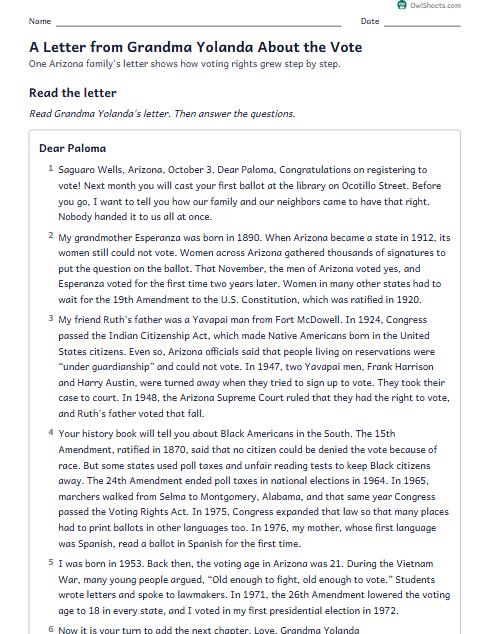
Dear Paloma
1Saguaro Wells, Arizona, October 3. Dear Paloma, Congratulations on registering to vote! Next month you will cast your first ballot at the library on Ocotillo Street. Before you go, I want to tell you how our family and our neighbors came to have that right. Nobody handed it to us all at once.
2My grandmother Esperanza was born in 1890. When Arizona became a state in 1912, its women still could not vote. Women across Arizona gathered thousands of signatures to put the question on the ballot. That November, the men of Arizona voted yes, and Esperanza voted for the first time two years later. Women in many other states had to wait for the 19th Amendment to the U.S. Constitution, which was ratified in 1920.
3My friend Ruth's father was a Yavapai man from Fort McDowell. In 1924, Congress passed the Indian Citizenship Act, which made Native Americans born in the United States citizens. Even so, Arizona officials said that people living on reservations were “under guardianship” and could not vote. In 1947, two Yavapai men, Frank Harrison and Harry Austin, were turned away when they tried to sign up to vote. They took their case to court. In 1948, the Arizona Supreme Court ruled that they had the right to vote, and Ruth's father voted that fall.
4Your history book will tell you about Black Americans in the South. The 15th Amendment, ratified in 1870, said that no citizen could be denied the vote because of race. But some states used poll taxes and unfair reading tests to keep Black citizens away. The 24th Amendment ended poll taxes in national elections in 1964. In 1965, marchers walked from Selma to Montgomery, Alabama, and that same year Congress passed the Voting Rights Act. In 1975, Congress expanded that law so that many places had to print ballots in other languages too. In 1976, my mother, whose first language was Spanish, read a ballot in Spanish for the first time.
5I was born in 1953. Back then, the voting age in Arizona was 21. During the Vietnam War, many young people argued, “Old enough to fight, old enough to vote.” Students wrote letters and spoke to lawmakers. In 1971, the 26th Amendment lowered the voting age to 18 in every state, and I voted in my first presidential election in 1972.
6Now it is your turn to add the next chapter. Love, Grandma Yolanda
- A. To show that voting rights grew in many steps over time
- B. To show that one amendment gave every group the vote
- C. To argue that Arizona gave the vote before the nation each time
- D. To explain how to find the polling place on Ocotillo Street
| Amendment to the U.S. Constitution | Law passed by Congress | Arizona voters or an Arizona court |
|---|---|---|
years
- A. The 19th Amendment had not been ratified yet.
- B. The voting age in Arizona was 25 at that time.
- C. He had not yet become a citizen of the United States.
- D. Arizona officials kept many people on reservations from voting.
- Arizona women gathered thousands of signatures.
- Two Yavapai men took their case to court.
- Marchers walked from Selma to Montgomery.
- Young people said, “Old enough to fight, old enough to vote.”
- A. Arizona's 1912 vote for women's voting rights
- B. The 26th Amendment
- C. The Voting Rights Act of 1965
- D. The 1948 Arizona Supreme Court ruling
She was years old.
Think about the steps
Use the letter to answer.
- A. The 15th Amendment applied in Arizona but not in Alabama.
- B. Some states used poll taxes and unfair tests to block them.
- C. The 15th Amendment covered women but not men.
- D. Black Americans were not yet citizens in 1965.
- A. The 24th Amendment
- B. The 19th Amendment
- C. The 1975 change to the Voting Rights Act
- D. The 26th Amendment
- A. Young voters: a state vote in 1912, then the 26th Amendment
- B. Spanish speakers: the 15th Amendment, then the 24th Amendment
- C. Native Americans: citizenship in 1924, then a court ruling in 1948
- D. Arizona women: the 19th Amendment in 1920, then a state vote in 1912
years
- A. The problem came from an Arizona rule, so an Arizona court could decide it.
- B. Congress was not allowed to pass laws about citizenship.
- C. Congress had passed a law saying Native Americans could not vote.
- D. The Arizona Supreme Court writes amendments to the U.S. Constitution.
- A. Arizona made each change before the nation did.
- B. Rights grew through amendments, laws, courts and people's work.
- C. The Constitution gave every adult the vote in 1787.
- D. One amendment in 1920 gave every group the vote.
Related worksheets
Wyoming and the Nation: Two Roads to the Vote
Grade 5 · CIV.5.4
14 questionsPremium
Pelican Key's First-Time Voter Guide
Grade 5 · CIV.5.4
14 questionsPremium
The Voting Rights Reading Room
Grade 5 · CIV.5.4
14 questionsPremium
The Block Party Money and the Three Branches
Grade 5 · CIV.5.1
14 questionsPremium
Odette's Capitol Week Diary
Grade 5 · CIV.5.1
13 questionsPremium
Program Notes for “A More Perfect Union”
Grade 5 · CIV.5.2
14 questionsPremium