Grade 5 · Social StudiesCIV.5.1Premium
The Block Party Money and the Three Branches
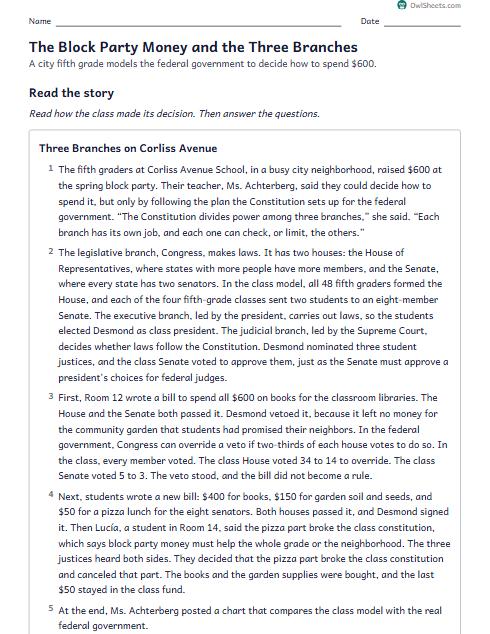
A city class models Congress, the president and the Supreme Court to spend block party money, using a veto, an override vote and a court ruling.
Preview
OwlSheets.com
The Block Party Money and the Three Branches
A city fifth grade models the federal government to decide how to spend $600.
Read the story
Read how the class made its decision. Then answer the questions.
Three Branches on Corliss Avenue
1The fifth graders at Corliss Avenue School, in a busy city neighborhood, raised $600 at the spring block party. Their teacher, Ms. Achterberg, said they could decide how to spend it, but only by following the plan the Constitution sets up for the federal government. “The Constitution divides power among three branches,” she said. “Each branch has its own job, and each one can check, or limit, the others.”
2The legislative branch, Congress, makes laws. It has two houses: the House of Representatives, where states with more people have more members, and the Senate, where every state has two senators. In the class model, all 48 fifth graders formed the House, and each of the four fifth-grade classes sent two students to an eight-member Senate. The executive branch, led by the president, carries out laws, so the students elected Desmond as class president. The judicial branch, led by the Supreme Court, decides whether laws follow the Constitution. Desmond nominated three student justices, and the class Senate voted to approve them, just as the Senate must approve a president's choices for federal judges.
3First, Room 12 wrote a bill to spend all $600 on books for the classroom libraries. The House and the Senate both passed it. Desmond vetoed it, because it left no money for the community garden that students had promised their neighbors. In the federal government, Congress can override a veto if two-thirds of each house votes to do so. In the class, every member voted. The class House voted 34 to 14 to override. The class Senate voted 5 to 3. The veto stood, and the bill did not become a rule.
4Next, students wrote a new bill: $400 for books, $150 for garden soil and seeds, and $50 for a pizza lunch for the eight senators. Both houses passed it, and Desmond signed it. Then Lucía, a student in Room 14, said the pizza part broke the class constitution, which says block party money must help the whole grade or the neighborhood. The three justices heard both sides. They decided that the pizza part broke the class constitution and canceled that part. The books and the garden supplies were bought, and the last $50 stayed in the class fund.
5At the end, Ms. Achterberg posted a chart that compares the class model with the real federal government.
| Branch | Federal government | Class model |
|---|---|---|
| Legislative | Congress: House and Senate | 48-student House, 8-member Senate |
| Executive | The president | Desmond, the class president |
| Judicial | Supreme Court, 9 justices | 3 student justices |
- A. To give the student justices the job of writing bills
- B. To model how the Constitution keeps one group from deciding alone
- C. To let the class president make the final choice alone
- D. To make sure every bill would pass on the first try
The preview shows the first questions. Unlock the worksheet to see all of it.
Related worksheets
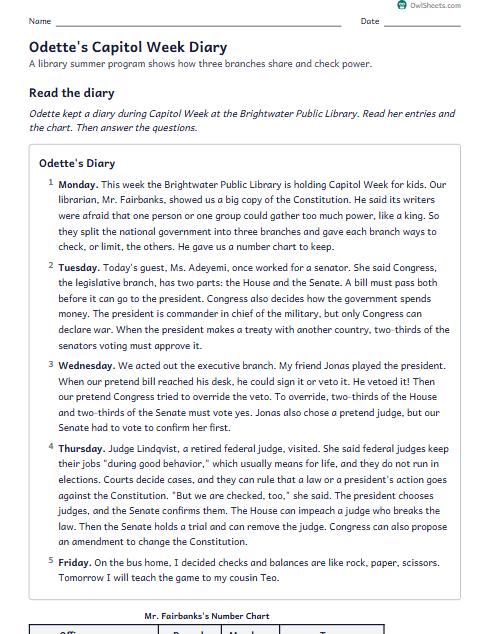
Odette's Capitol Week Diary
Grade 5 · CIV.5.1
13 questionsPremium
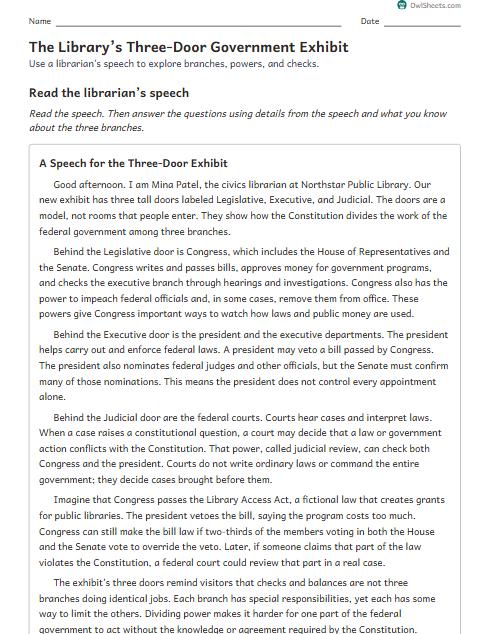
The Library’s Three-Door Government Exhibit
Grade 5 · CIV.5.1
15 questionsFree
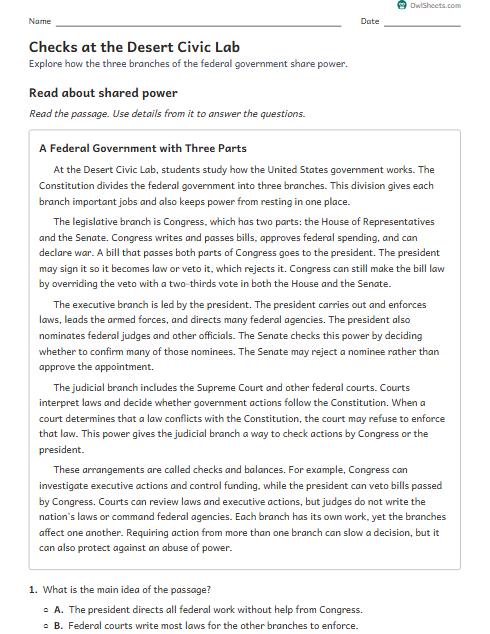
Checks at the Desert Civic Lab
Grade 5 · CIV.5.1
15 questionsPremium
A Letter from Grandma Yolanda About the Vote
Grade 5 · CIV.5.4
13 questionsFree
Wyoming and the Nation: Two Roads to the Vote
Grade 5 · CIV.5.4
14 questionsPremium
Pelican Key's First-Time Voter Guide
Grade 5 · CIV.5.4
14 questionsPremium