Grade 5 · Social StudiesCIV.5.4Premium
Wyoming and the Nation: Two Roads to the Vote
Compare two library display boards to see how a territory's law, amendments and the work of many Americans expanded voting rights over time.
Preview
OwlSheets.com
Wyoming and the Nation: Two Roads to the Vote
Compare how women won the vote in one territory and in the whole country.
Read the two boards
Read the two display boards from the library. Then answer the questions.
Two Boards at the Antelope Flats Public Library
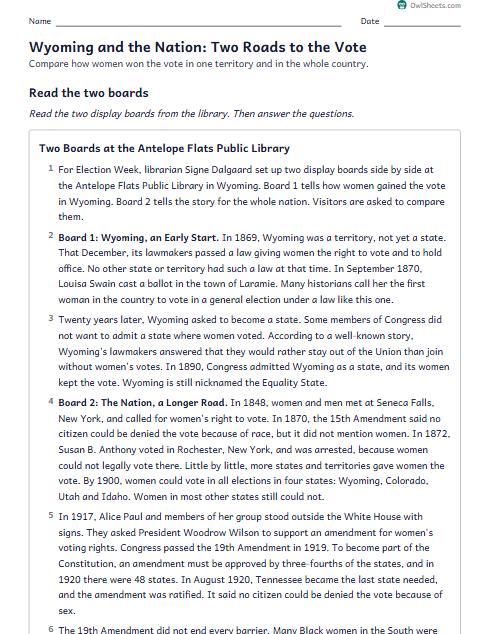
1For Election Week, librarian Signe Dalgaard set up two display boards side by side at the Antelope Flats Public Library in Wyoming. Board 1 tells how women gained the vote in Wyoming. Board 2 tells the story for the whole nation. Visitors are asked to compare them.
2Board 1: Wyoming, an Early Start. In 1869, Wyoming was a territory, not yet a state. That December, its lawmakers passed a law giving women the right to vote and to hold office. No other state or territory had such a law at that time. In September 1870, Louisa Swain cast a ballot in the town of Laramie. Many historians call her the first woman in the country to vote in a general election under a law like this one.
3Twenty years later, Wyoming asked to become a state. Some members of Congress did not want to admit a state where women voted. According to a well-known story, Wyoming's lawmakers answered that they would rather stay out of the Union than join without women's votes. In 1890, Congress admitted Wyoming as a state, and its women kept the vote. Wyoming is still nicknamed the Equality State.
4Board 2: The Nation, a Longer Road. In 1848, women and men met at Seneca Falls, New York, and called for women's right to vote. In 1870, the 15th Amendment said no citizen could be denied the vote because of race, but it did not mention women. In 1872, Susan B. Anthony voted in Rochester, New York, and was arrested, because women could not legally vote there. Little by little, more states and territories gave women the vote. By 1900, women could vote in all elections in four states: Wyoming, Colorado, Utah and Idaho. Women in most other states still could not.
5In 1917, Alice Paul and members of her group stood outside the White House with signs. They asked President Woodrow Wilson to support an amendment for women's voting rights. Congress passed the 19th Amendment in 1919. To become part of the Constitution, an amendment must be approved by three-fourths of the states, and in 1920 there were 48 states. In August 1920, Tennessee became the last state needed, and the amendment was ratified. It said no citizen could be denied the vote because of sex.
6The 19th Amendment did not end every barrier. Many Black women in the South were still kept from voting by unfair tests and taxes. Many Native American women could not vote until Congress made Native Americans citizens in 1924, and some states blocked Native voters even longer. The Voting Rights Act of 1965 helped remove many of these barriers.
- A. Women in Wyoming could vote about 50 years before the 19th Amendment.
- B. Women in Wyoming could vote only after Wyoming became a state.
- C. Women across the nation could vote before women in Wyoming.
- D. Women in both places gained the vote in the same year.
years
The preview shows the first questions. Unlock the worksheet to see all of it.
Related worksheets
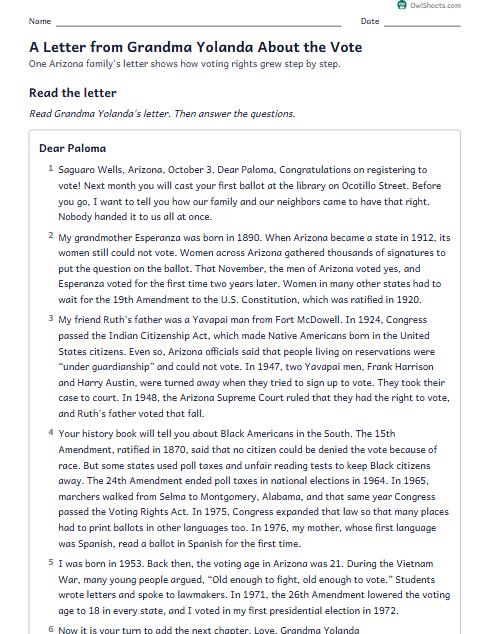
A Letter from Grandma Yolanda About the Vote
Grade 5 · CIV.5.4
13 questionsFree
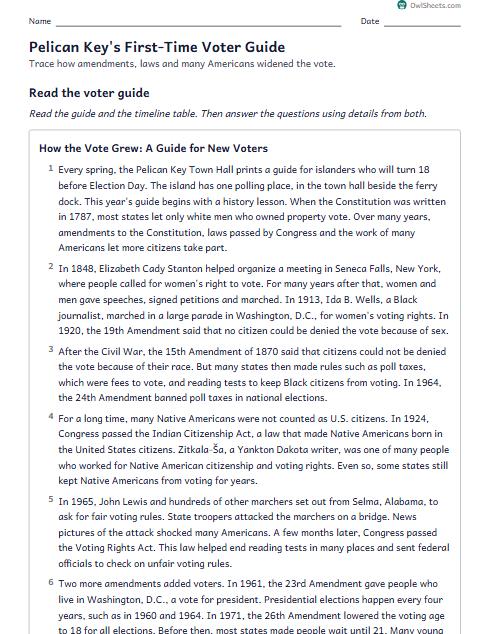
Pelican Key's First-Time Voter Guide
Grade 5 · CIV.5.4
14 questionsPremium
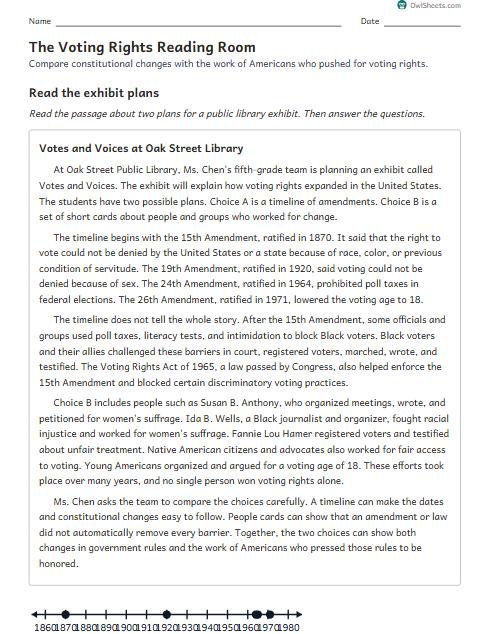
The Voting Rights Reading Room
Grade 5 · CIV.5.4
14 questionsPremium
The Block Party Money and the Three Branches
Grade 5 · CIV.5.1
14 questionsPremium
Odette's Capitol Week Diary
Grade 5 · CIV.5.1
13 questionsPremium
Program Notes for “A More Perfect Union”
Grade 5 · CIV.5.2
14 questionsPremium