Grade 5 · Social StudiesCIV.5.2Premium
Program Notes for “A More Perfect Union”
Program notes from a community play about 1787 to 1791 help students explain the Constitution's purposes and apply Bill of Rights freedoms.
Preview
OwlSheets.com
Program Notes for “A More Perfect Union”
Use a play's program notes to explain the Constitution and the Bill of Rights.
Read the program notes
Read the director's program notes. Then answer the questions using details from the notes.
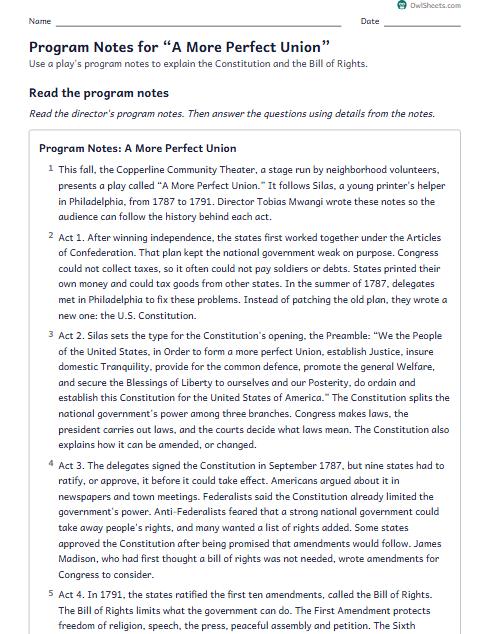
Program Notes: A More Perfect Union
1This fall, the Copperline Community Theater, a stage run by neighborhood volunteers, presents a play called “A More Perfect Union.” It follows Silas, a young printer's helper in Philadelphia, from 1787 to 1791. Director Tobias Mwangi wrote these notes so the audience can follow the history behind each act.
2Act 1. After winning independence, the states first worked together under the Articles of Confederation. That plan kept the national government weak on purpose. Congress could not collect taxes, so it often could not pay soldiers or debts. States printed their own money and could tax goods from other states. In the summer of 1787, delegates met in Philadelphia to fix these problems. Instead of patching the old plan, they wrote a new one: the U.S. Constitution.
3Act 2. Silas sets the type for the Constitution's opening, the Preamble: “We the People of the United States, in Order to form a more perfect Union, establish Justice, insure domestic Tranquility, provide for the common defence, promote the general Welfare, and secure the Blessings of Liberty to ourselves and our Posterity, do ordain and establish this Constitution for the United States of America.” The Constitution splits the national government's power among three branches. Congress makes laws, the president carries out laws, and the courts decide what laws mean. The Constitution also explains how it can be amended, or changed.
4Act 3. The delegates signed the Constitution in September 1787, but nine states had to ratify, or approve, it before it could take effect. Americans argued about it in newspapers and town meetings. Federalists said the Constitution already limited the government's power. Anti-Federalists feared that a strong national government could take away people's rights, and many wanted a list of rights added. Some states approved the Constitution after being promised that amendments would follow. James Madison, who had first thought a bill of rights was not needed, wrote amendments for Congress to consider.
5Act 4. In 1791, the states ratified the first ten amendments, called the Bill of Rights. The Bill of Rights limits what the government can do. The First Amendment protects freedom of religion, speech, the press, peaceful assembly and petition. The Sixth Amendment promises a person accused of a crime a speedy and public trial by a jury. The Ninth Amendment says that listing some rights does not mean people lose other rights. The Tenth Amendment says that powers not given to the national government belong to the states or to the people. In the last scene, Silas prints the new amendments and hangs a copy in the shop window.
- A. The national government was too weak to pay its debts.
- B. The king of Britain still made the laws for the states.
- C. The Bill of Rights had given Congress too much power.
- D. The states had agreed to use one kind of money.
- establish Justice
- insure domestic Tranquility
- provide for the common defence
- secure the Blessings of Liberty to ourselves and our Posterity
- A. Keep peace inside the country
- B. Set up fair laws and courts
- C. Protect the nation from attack
- D. Protect freedom for people now and in the future
The preview shows the first questions. Unlock the worksheet to see all of it.
Related worksheets
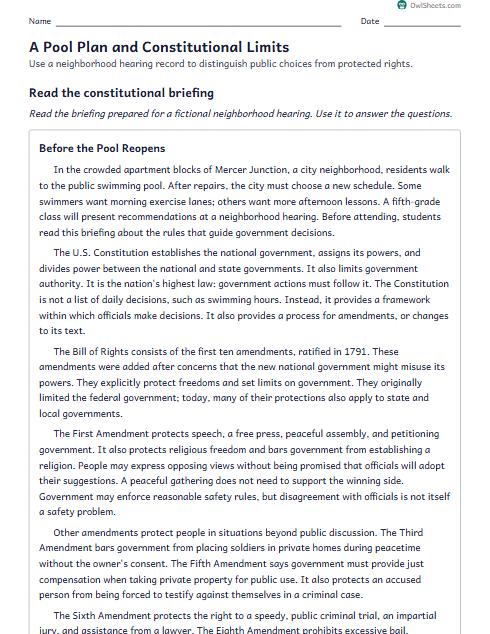
A Pool Plan and Constitutional Limits
Grade 5 · CIV.5.2
14 questionsFree
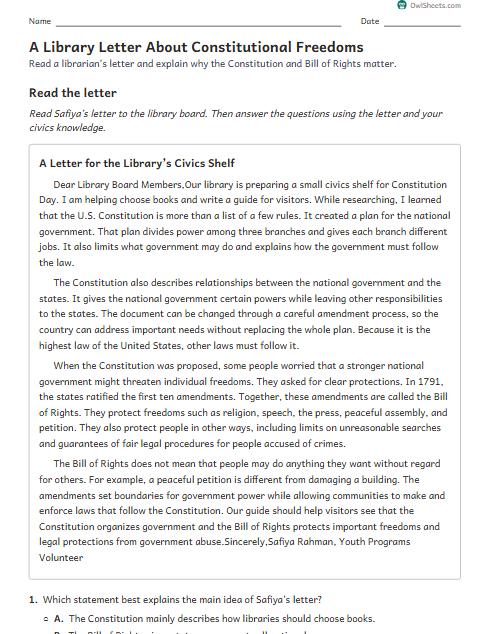
A Library Letter About Constitutional Freedoms
Grade 5 · CIV.5.2
15 questionsPremium
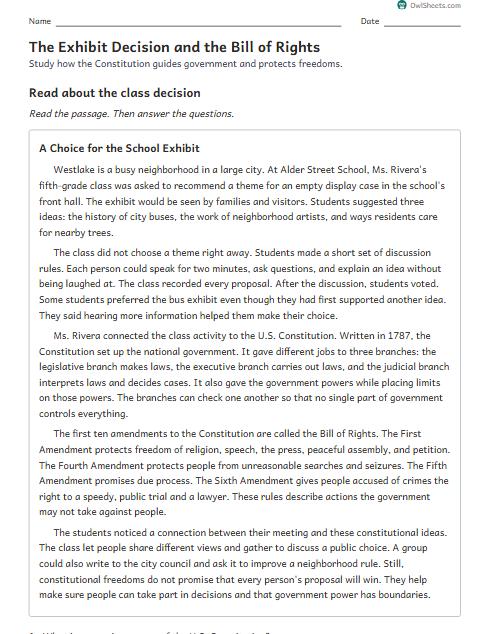
The Exhibit Decision and the Bill of Rights
Grade 5 · CIV.5.2
14 questionsPremium
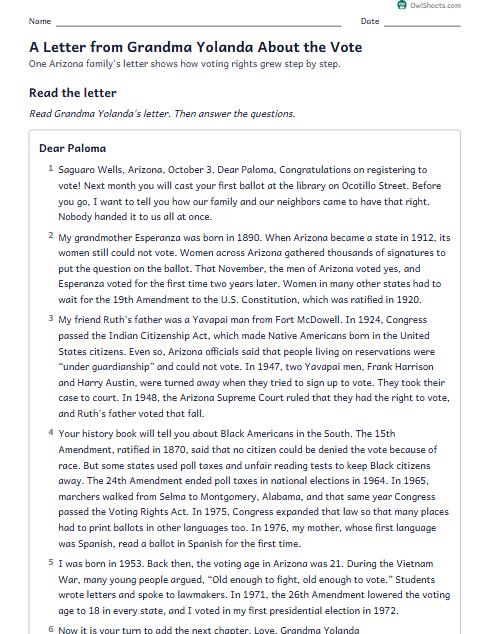
A Letter from Grandma Yolanda About the Vote
Grade 5 · CIV.5.4
13 questionsFree
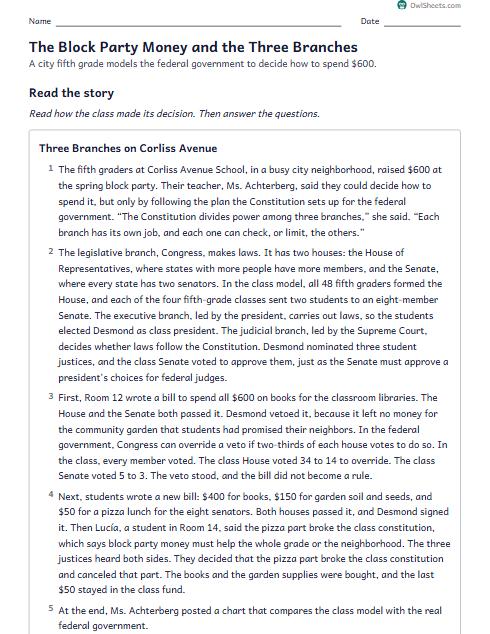
The Block Party Money and the Three Branches
Grade 5 · CIV.5.1
14 questionsPremium
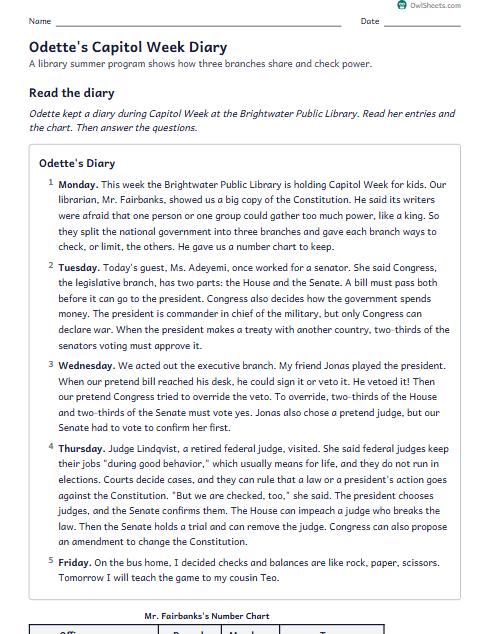
Odette's Capitol Week Diary
Grade 5 · CIV.5.1
13 questionsPremium