Grade 5 · Social StudiesCIV.5.2
A Pool Plan and Constitutional Limits
Study a city pool hearing to explain constitutional government and apply Bill of Rights protections to public decisions.
Preview
OwlSheets.com
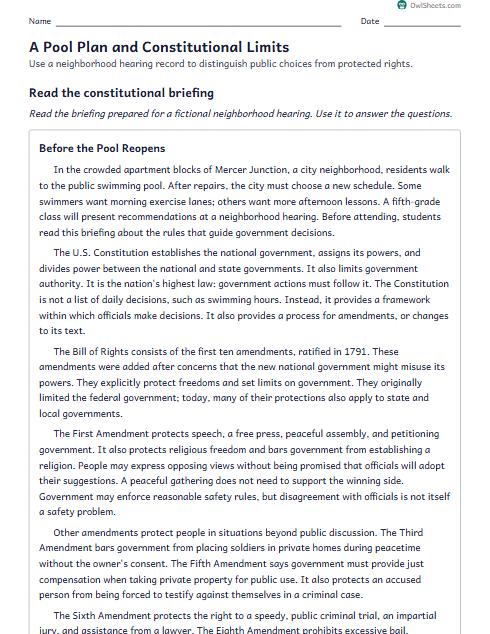
A Pool Plan and Constitutional Limits
Use a neighborhood hearing record to distinguish public choices from protected rights.
Read the constitutional briefing
Read the briefing prepared for a fictional neighborhood hearing. Use it to answer the questions.
Before the Pool Reopens
In the crowded apartment blocks of Mercer Junction, a city neighborhood, residents walk to the public swimming pool. After repairs, the city must choose a new schedule. Some swimmers want morning exercise lanes; others want more afternoon lessons. A fifth-grade class will present recommendations at a neighborhood hearing. Before attending, students read this briefing about the rules that guide government decisions.
The U.S. Constitution establishes the national government, assigns its powers, and divides power between the national and state governments. It also limits government authority. It is the nation's highest law: government actions must follow it. The Constitution is not a list of daily decisions, such as swimming hours. Instead, it provides a framework within which officials make decisions. It also provides a process for amendments, or changes to its text.
The Bill of Rights consists of the first ten amendments, ratified in 1791. These amendments were added after concerns that the new national government might misuse its powers. They explicitly protect freedoms and set limits on government. They originally limited the federal government; today, many of their protections also apply to state and local governments.
The First Amendment protects speech, a free press, peaceful assembly, and petitioning government. It also protects religious freedom and bars government from establishing a religion. People may express opposing views without being promised that officials will adopt their suggestions. A peaceful gathering does not need to support the winning side. Government may enforce reasonable safety rules, but disagreement with officials is not itself a safety problem.
Other amendments protect people in situations beyond public discussion. The Third Amendment bars government from placing soldiers in private homes during peacetime without the owner's consent. The Fifth Amendment says government must provide just compensation when taking private property for public use. It also protects an accused person from being forced to testify against themselves in a criminal case.
The Sixth Amendment protects the right to a speedy, public criminal trial, an impartial jury, and assistance from a lawyer. The Eighth Amendment prohibits excessive bail, excessive fines, and cruel and unusual punishment. Bail is a condition, often involving money, for release while awaiting trial. These protections matter even when neighbors strongly suspect someone of a crime.
A vote can settle many ordinary choices about public services. It does not erase constitutional protections. At the hearing, students must therefore ask two questions: What plan serves the neighborhood, and does the plan respect the limits on government? The neighborhood's final recommendation will go to city officials, who are responsible for the pool.
- A. The Constitution records public preferences rather than government responsibilities.
- B. The Constitution recommends neighborhood plans rather than creating binding rules.
- C. The Constitution establishes a governing framework rather than daily service schedules.
- D. The Constitution sets schedules for national services rather than city services.
- A. It replaced the Constitution's framework with local schedules.
- B. It stated specific protections against misuse of government power.
- C. It gave officials more authority over unpopular opinions.
- D. It transferred national decisions to neighborhood meetings.
The Bill of Rights replaced the Constitution's system of government.The Bill of Rights added explicit protections to the Constitution.The Bill of Rights gave each neighborhood its own national constitution.The Constitution includes a process through which amendments can be added.
- A. The Bill of Rights once replaced state laws but now replaces city votes.
- B. The Bill of Rights once limited federal power; many protections now reach local power.
- C. The Bill of Rights once guided pool schedules but now guides trials.
- D. The Bill of Rights once protected officials but now protects residents.
Evaluate the hearing record
Read the fictional hearing record. Use the briefing to judge the proposals, not just how much support each proposal receives.
Additional Proposals at the Mercer Junction Hearing
Dalia, a resident, proposes reserving a public sidewalk area for a peaceful gathering opposing the schedule, keeping the pool entrance clear.
Owen, a resident, proposes having the city require people to join a religious ceremony before using the public pool.
Ms. Chen, a city planner, proposes buying a neighboring private lot for a public pool ramp. If the city legally takes the lot instead, her proposal calls for providing just compensation.
Mr. Ortiz, a resident, proposes letting residents vote on whether a person accused of damaging pool equipment receives help from a lawyer at trial.
- A. The gathering should depend on whether its speakers helped choose the schedule.
- B. The gathering can replace the city's responsibility to manage the pool.
- C. The gathering can respect both peaceful assembly and access to the pool.
- D. The gathering should depend on whether most swimmers agree with its message.
- A. Reject it because its religious requirement conflicts with protected freedom.
- B. Reject it because the Constitution sets the pool's admission schedule.
- C. Adopt it because a popular ceremony becomes a public service.
- D. Adopt it because neighborhood support removes religious concerns.
- A. Take the lot for the public ramp without compensating its owner.
- B. Discuss a different ramp location before taking the lot.
- C. Explain the public purpose and provide just compensation.
- D. Ask the owner whether the city can purchase the lot.
The Constitution divides power between the national and state governments.The pool needs a new schedule after repairs.The Sixth Amendment protects assistance from a lawyer in a criminal trial.The Third Amendment protects homeowners from peacetime quartering without consent.
- A. A city decision can replace constitutional protections within city buildings.
- B. A large vote gives city officials power to suspend protected freedoms.
- C. A neighborhood recommendation has the same authority as an amendment.
- D. A public decision must stay within constitutional limits despite local support.
Test new situations
Apply the briefing to these new cases. For written answers, make a claim and support it with details from the sources.
- A. The government needs the owner's consent for this housing.
- B. Paying the soldiers allows officials to require the housing.
- C. A neighborhood vote can replace the owner's consent.
- D. The pool hearing can authorize the family's housing duty.
- A. The right to compensation determines who must testify.
- B. The Third Amendment protects the accused from forced testimony.
- C. The right to peaceful assembly determines who must testify.
- D. The Fifth Amendment protects the accused from forced self-incrimination.
A court sets excessive bail for a person awaiting trial.A city schedules exercise lanes earlier than some swimmers prefer.A court imposes a cruel and unusual punishment after a conviction.A neighborhood meeting chooses lessons over extra exercise time.
Related worksheets
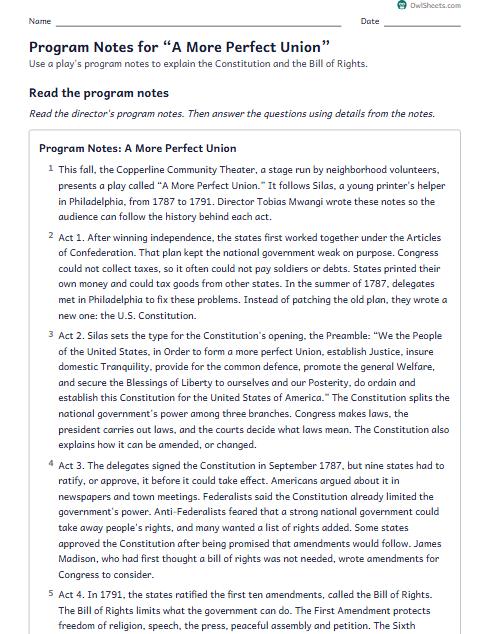
Program Notes for “A More Perfect Union”
Grade 5 · CIV.5.2
14 questionsPremium
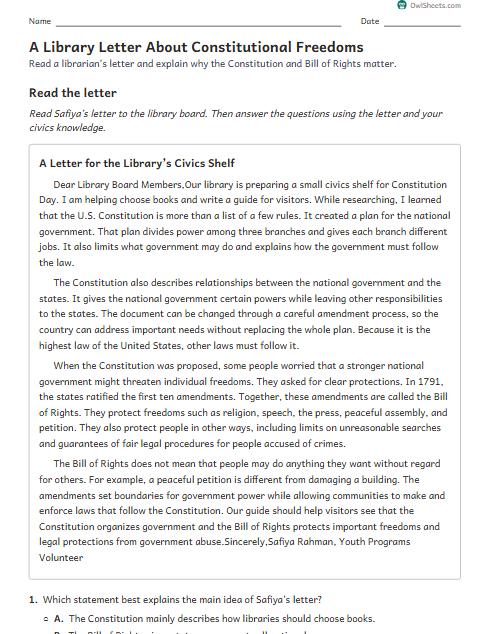
A Library Letter About Constitutional Freedoms
Grade 5 · CIV.5.2
15 questionsPremium
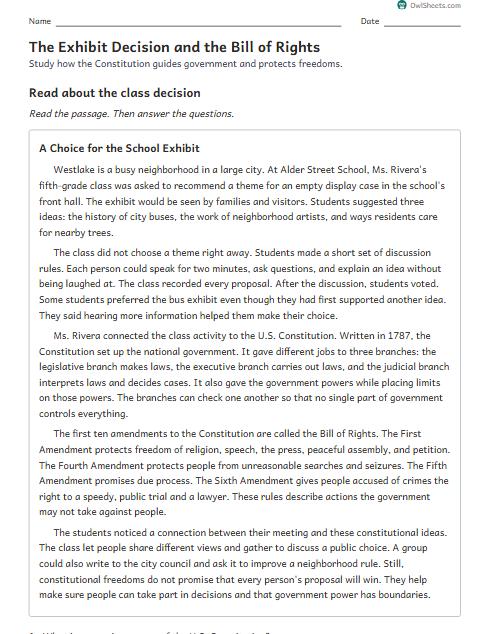
The Exhibit Decision and the Bill of Rights
Grade 5 · CIV.5.2
14 questionsPremium
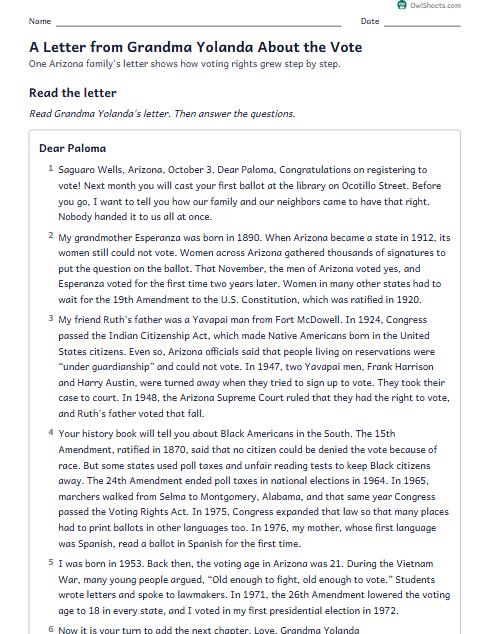
A Letter from Grandma Yolanda About the Vote
Grade 5 · CIV.5.4
13 questionsFree
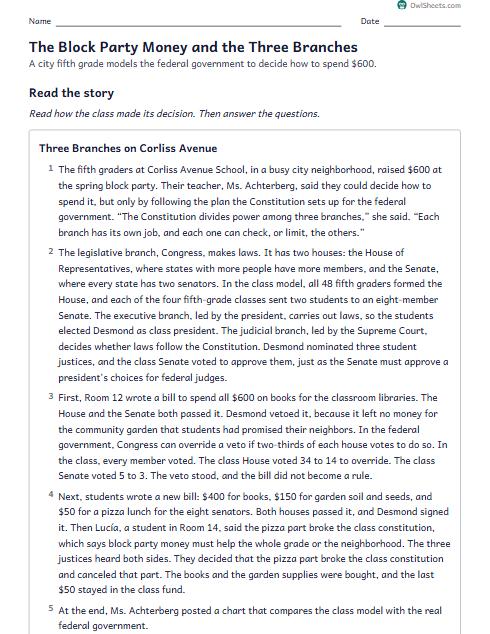
The Block Party Money and the Three Branches
Grade 5 · CIV.5.1
14 questionsPremium
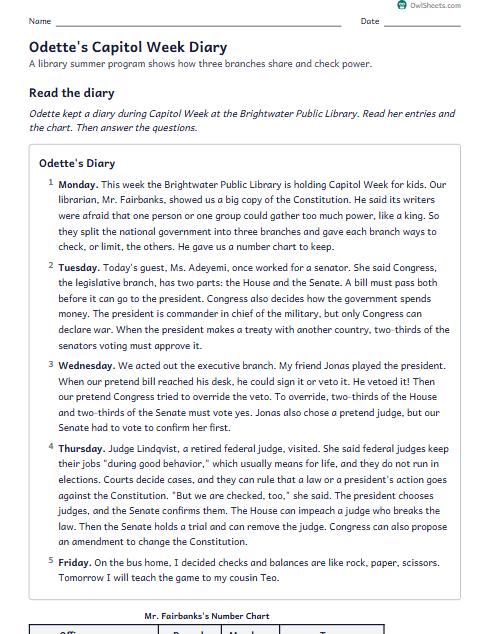
Odette's Capitol Week Diary
Grade 5 · CIV.5.1
13 questionsPremium