Grade 5 · Social StudiesCIV.5.4Premium
Pelican Key's First-Time Voter Guide
An island town's guide for new voters shows how amendments, laws and the work of many Americans expanded voting rights over time.
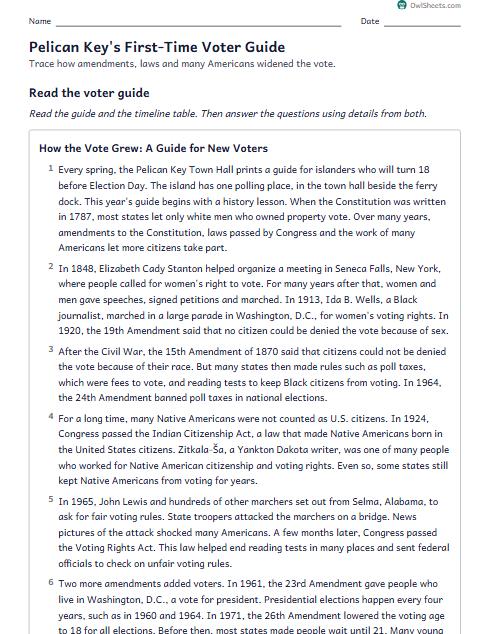
Preview
OwlSheets.com
Pelican Key's First-Time Voter Guide
Trace how amendments, laws and many Americans widened the vote.
Read the voter guide
Read the guide and the timeline table. Then answer the questions using details from both.
How the Vote Grew: A Guide for New Voters
1Every spring, the Pelican Key Town Hall prints a guide for islanders who will turn 18 before Election Day. The island has one polling place, in the town hall beside the ferry dock. This year's guide begins with a history lesson. When the Constitution was written in 1787, most states let only white men who owned property vote. Over many years, amendments to the Constitution, laws passed by Congress and the work of many Americans let more citizens take part.
2In 1848, Elizabeth Cady Stanton helped organize a meeting in Seneca Falls, New York, where people called for women's right to vote. For many years after that, women and men gave speeches, signed petitions and marched. In 1913, Ida B. Wells, a Black journalist, marched in a large parade in Washington, D.C., for women's voting rights. In 1920, the 19th Amendment said that no citizen could be denied the vote because of sex.
3After the Civil War, the 15th Amendment of 1870 said that citizens could not be denied the vote because of their race. But many states then made rules such as poll taxes, which were fees to vote, and reading tests to keep Black citizens from voting. In 1964, the 24th Amendment banned poll taxes in national elections.
4For a long time, many Native Americans were not counted as U.S. citizens. In 1924, Congress passed the Indian Citizenship Act, a law that made Native Americans born in the United States citizens. Zitkala-Ša, a Yankton Dakota writer, was one of many people who worked for Native American citizenship and voting rights. Even so, some states still kept Native Americans from voting for years.
5In 1965, John Lewis and hundreds of other marchers set out from Selma, Alabama, to ask for fair voting rules. State troopers attacked the marchers on a bridge. News pictures of the attack shocked many Americans. A few months later, Congress passed the Voting Rights Act. This law helped end reading tests in many places and sent federal officials to check on unfair voting rules.
6Two more amendments added voters. In 1961, the 23rd Amendment gave people who live in Washington, D.C., a vote for president. Presidential elections happen every four years, such as in 1960 and 1964. In 1971, the 26th Amendment lowered the voting age to 18 for all elections. Before then, most states made people wait until 21. Many young people had argued that if 18-year-olds could be drafted to fight in a war, they should be able to vote too. Students wrote letters and spoke at rallies.
| Year | Event |
|---|---|
| 1848 | Seneca Falls meeting |
| 1870 | 15th Amendment |
| 1920 | 19th Amendment |
| 1924 | Indian Citizenship Act |
| 1961 | 23rd Amendment |
| 1964 | 24th Amendment |
| 1965 | Voting Rights Act |
| 1971 | 26th Amendment |
| Amendment to the Constitution | Law passed by Congress |
|---|---|
The preview shows the first questions. Unlock the worksheet to see all of it.
Related worksheets
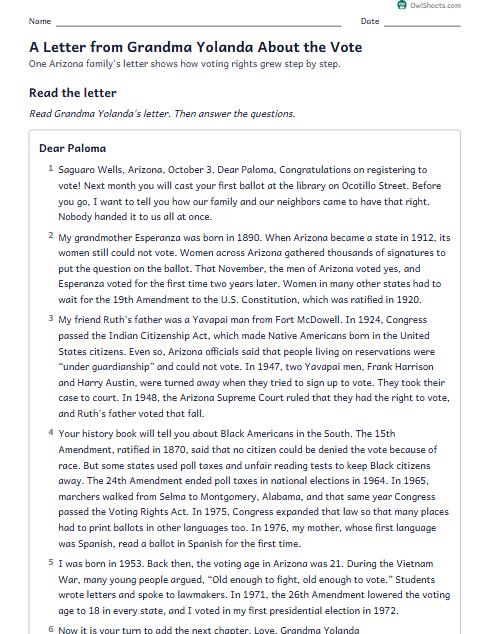
A Letter from Grandma Yolanda About the Vote
Grade 5 · CIV.5.4
13 questionsFree
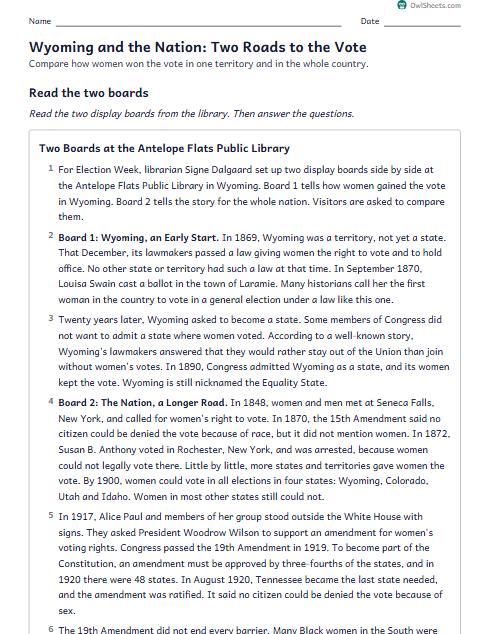
Wyoming and the Nation: Two Roads to the Vote
Grade 5 · CIV.5.4
14 questionsPremium
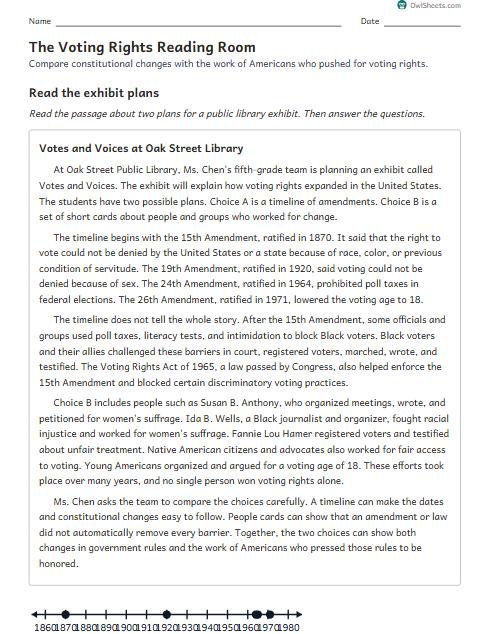
The Voting Rights Reading Room
Grade 5 · CIV.5.4
14 questionsPremium
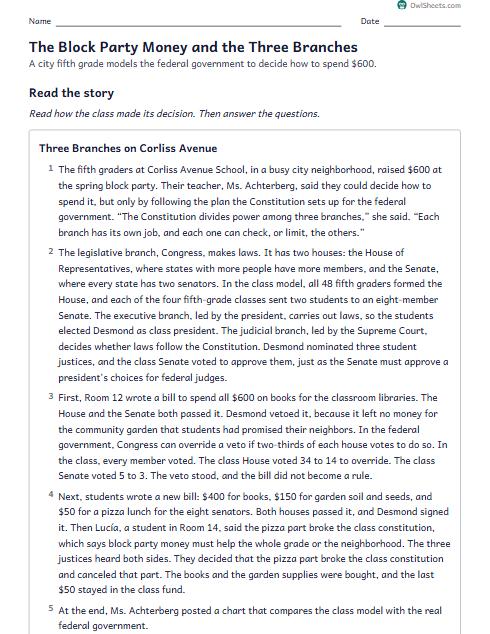
The Block Party Money and the Three Branches
Grade 5 · CIV.5.1
14 questionsPremium
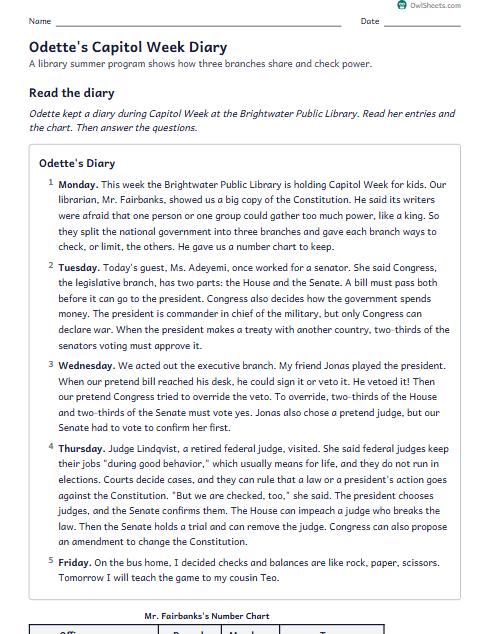
Odette's Capitol Week Diary
Grade 5 · CIV.5.1
13 questionsPremium
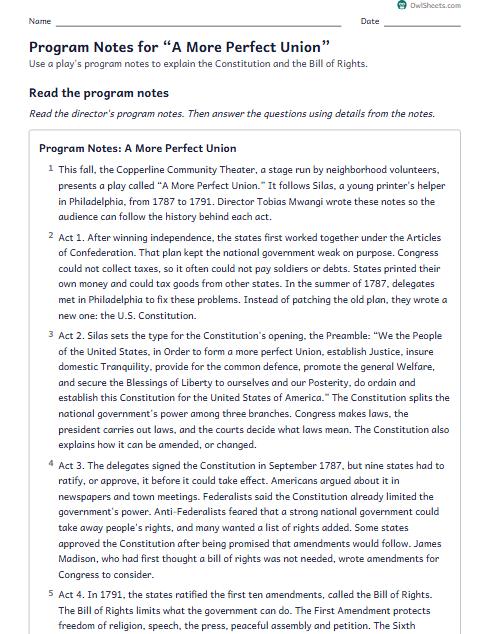
Program Notes for “A More Perfect Union”
Grade 5 · CIV.5.2
14 questionsPremium