Grade 4 · Social StudiesECO.4.1Premium
Sablewake's Dockside Decision
Study a fishing town's meeting record and work estimates to explain how ocean resources shape industries, jobs, and a shared decision.
Preview
OwlSheets.com
Sablewake's Dockside Decision
Use a town meeting record to connect ocean resources with local work.
A Question for the Town
Read the fictional meeting record. Use its details to answer the questions.
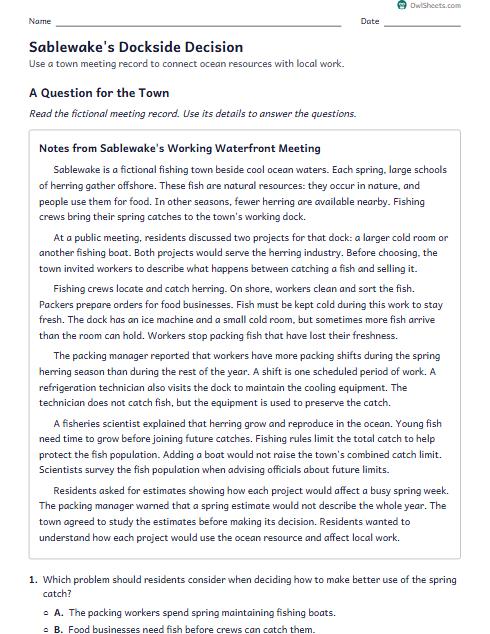
Notes from Sablewake's Working Waterfront Meeting
Sablewake is a fictional fishing town beside cool ocean waters. Each spring, large schools of herring gather offshore. These fish are natural resources: they occur in nature, and people use them for food. In other seasons, fewer herring are available nearby. Fishing crews bring their spring catches to the town's working dock.
At a public meeting, residents discussed two projects for that dock: a larger cold room or another fishing boat. Both projects would serve the herring industry. Before choosing, the town invited workers to describe what happens between catching a fish and selling it.
Fishing crews locate and catch herring. On shore, workers clean and sort the fish. Packers prepare orders for food businesses. Fish must be kept cold during this work to stay fresh. The dock has an ice machine and a small cold room, but sometimes more fish arrive than the room can hold. Workers stop packing fish that have lost their freshness.
The packing manager reported that workers have more packing shifts during the spring herring season than during the rest of the year. A shift is one scheduled period of work. A refrigeration technician also visits the dock to maintain the cooling equipment. The technician does not catch fish, but the equipment is used to preserve the catch.
A fisheries scientist explained that herring grow and reproduce in the ocean. Young fish need time to grow before joining future catches. Fishing rules limit the total catch to help protect the fish population. Adding a boat would not raise the town's combined catch limit. Scientists survey the fish population when advising officials about future limits.
Residents asked for estimates showing how each project would affect a busy spring week. The packing manager warned that a spring estimate would not describe the whole year. The town agreed to study the estimates before making its decision. Residents wanted to understand how each project would use the ocean resource and affect local work.
- A. The packing workers spend spring maintaining fishing boats.
- B. Food businesses need fish before crews can catch them.
- C. Fishing crews have more cold space than they can use.
- D. Some landed fish lose freshness before workers can pack them.
Residents discussed a larger cold room and another fishing boat.Packing workers have more shifts in spring than during the rest of the year.Scientists survey the fish population before advising officials.The dock has an ice machine and a small cold room.
The preview shows the first questions. Unlock the worksheet to see all of it.
Related worksheets
A Letter from Rookbend Recovery Center
Grade 4 · ECO.4.1
14 questionsPremium
Cinderwell Radio: Where the Work Begins
Grade 4 · ECO.4.1
14 questionsFree
Agata's Cranberry Stand
Grade 4 · ECO.4.1
14 questionsPremium
The Land Around Silverleaf Heights
Grade 4 · ECO.4.1
15 questionsPremium
Two Harbors, Different Work
Grade 4 · ECO.4.1
14 questionsPremium
Resource Roots: A Regional Work Fair
Grade 4 · ECO.4.1
14 questionsPremium