Grade 4 · Social StudiesECO.4.1Premium
A Letter from Rookbend Recovery Center
Use a recycling worker's letter and delivery records to explain how iron ore shapes regional industries and jobs.
Preview
OwlSheets.com
A Letter from Rookbend Recovery Center
Investigate how a region's resources connect to metalworking jobs.
Read the worker's letter
Read the letter about a fictional region. Choose answers supported by its details.
Marisol Keene Writes to a Fourth-Grade Class
Dear Fourth Graders, I work at Rookbend Recovery Center, where we prepare used metal for another trip through a factory. Our region has large deposits of iron ore, rock containing iron that people can remove and use. Miners dig out the ore. At a processing plant, workers turn it into iron. Steelmakers use iron to make steel for buildings, machines, and many other products.
Long before our recovery center opened, a steel mill began operating here. Trucks could bring ore from nearby mines on short trips. Supplies from outside the region took much longer to arrive. Later, factories that make steel tools opened nearby. They buy steel from the mill. Their workers shape cutting blades and assemble tools, although those factories do not dig up ore.
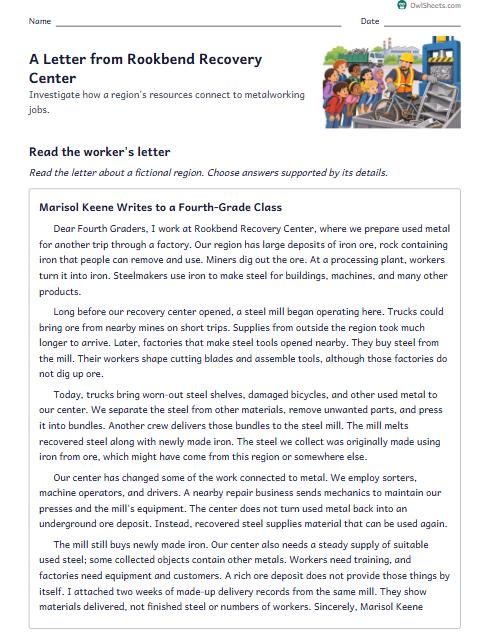
Today, trucks bring worn-out steel shelves, damaged bicycles, and other used metal to our center. We separate the steel from other materials, remove unwanted parts, and press it into bundles. Another crew delivers those bundles to the steel mill. The mill melts recovered steel along with newly made iron. The steel we collect was originally made using iron from ore, which might have come from this region or somewhere else.
Our center has changed some of the work connected to metal. We employ sorters, machine operators, and drivers. A nearby repair business sends mechanics to maintain our presses and the mill's equipment. The center does not turn used metal back into an underground ore deposit. Instead, recovered steel supplies material that can be used again.
The mill still buys newly made iron. Our center also needs a steady supply of suitable used steel; some collected objects contain other metals. Workers need training, and factories need equipment and customers. A rich ore deposit does not provide those things by itself. I attached two weeks of made-up delivery records from the same mill. They show materials delivered, not finished steel or numbers of workers. Sincerely, Marisol Keene
- A. Nearby deposits meant shorter trips for an important material.
- B. The tool factories had already trained the region's miners.
- C. The recovery center already supplied bundles of used steel.
- D. Distant suppliers could deliver materials faster than local mines.
Workers separate used steel from other collected materials.A local business sends mechanics to service presses and mill equipment.Trucks carry bundles of recovered steel to the mill.Tool factories purchase steel and shape cutting blades.
The preview shows the first questions. Unlock the worksheet to see all of it.
Related worksheets
Sablewake's Dockside Decision
Grade 4 · ECO.4.1
14 questionsPremium
Cinderwell Radio: Where the Work Begins
Grade 4 · ECO.4.1
14 questionsFree
Agata's Cranberry Stand
Grade 4 · ECO.4.1
14 questionsPremium
The Land Around Silverleaf Heights
Grade 4 · ECO.4.1
15 questionsPremium
Two Harbors, Different Work
Grade 4 · ECO.4.1
14 questionsPremium
Resource Roots: A Regional Work Fair
Grade 4 · ECO.4.1
14 questionsPremium