Grade 4 · Social StudiesECO.4.1
Cinderwell Radio: Where the Work Begins
Use a radio station's described map to explain how underground salt water and geothermal heat support industries and jobs.
Preview
OwlSheets.com
Cinderwell Radio: Where the Work Begins
Use a broadcast map to trace resources, industries, and jobs.
Prepare the Resource Report
Read the station's planning notes. Use the map description and the reporting details to answer the questions.
Planning Notes for Cinderwell Radio
Cinderwell Radio is preparing a program called “Where Our Work Begins.” Its reporters will investigate two industries in a fictional inland basin. An industry is a group of businesses doing a similar kind of work. The reporting team has collected these map notes and background facts.
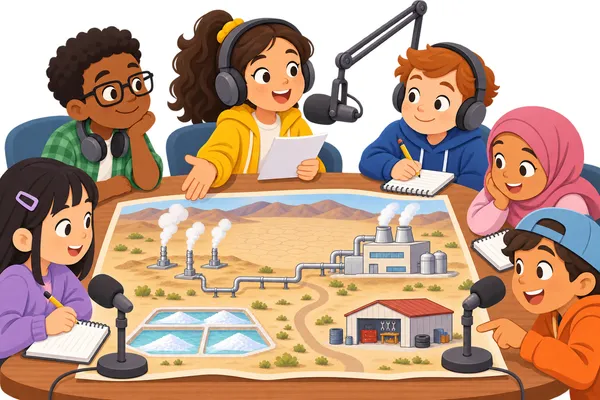
The map has six places. Cinderwell Radio is in the center. Salt Flat lies west of the station, and Salt Works lies southwest. Hotwater Field is east of the station, and Steam Plant is northeast. Equipment Shop stands south of the station. Lines connect Salt Flat to Salt Works and Hotwater Field to Steam Plant. These lines mark pipelines, not roads.
Under Salt Flat, water contains dissolved salt. Workers pump this salty water, called brine, through a pipeline to Salt Works. There, shallow outdoor ponds hold the brine. The basin has many hot, dry days. As water evaporates, salt remains. Workers collect, clean, and package the salt for sale. Pump operators, pond workers, and packers work at different steps. Packaging cartons arrive from outside the basin.
At Hotwater Field, very hot underground water produces steam as it rises through wells. A pipeline carries steam to Steam Plant. The steam turns machines that generate electricity. This use of Earth's heat is called geothermal energy. Well crews maintain the wells, and plant technicians monitor the machines. After cooling, the water is pumped back underground.
Equipment Shop repairs pumps used by both industries. Its mechanics do not collect salt or generate electricity. Some customers bring in broken equipment; others request repairs at their workplaces. The shop keeps parts for both kinds of pumps.
Neither industry began with a radio broadcast. Builders first studied the underground resources and then installed wells, pipelines, and machinery. Workers also needed training. Before expanding, managers would need evidence about how much usable brine or hot water the basin could supply. The station's map gives locations, but it does not give those amounts or count workers.
- A. Visit Salt Works, then follow its pipeline to Steam Plant.
- B. Visit Cinderwell Radio, then follow its pipeline to Salt Works.
- C. Visit Equipment Shop, then follow its pipeline to Salt Flat.
- D. Visit Hotwater Field, then follow its pipeline to Steam Plant.
- A. They help turn the packaging cartons into usable salt.
- B. They help remove water so workers can collect the salt.
- C. They heat underground water enough to run the steam machines.
- D. They replace the pumps that move brine into the ponds.
The radio station is in the center of the map.Packaging cartons arrive from outside the basin.The equipment shop keeps parts for two kinds of pumps.Steam from the wells turns electricity-generating machines.
- A. Workers must move the brine and collect, clean, and pack the salt.
- B. Workers must bring finished salt into the basin before drying it.
- C. The mechanics turn the imported cartons into salt at the shop.
- D. The steam technicians make the salt before it reaches the ponds.
- A. Resource: hot underground water; equipment: a well pump
- B. Resource: a steam pipeline; equipment: underground heat
- C. Resource: a salt carton; equipment: salty underground water
- D. Resource: a trained mechanic; equipment: a salt deposit
- A. The radio station sends its broadcasting equipment there for repair.
- B. The shop receives finished products through the two mapped pipelines.
- C. The resource-using industries need mechanics to keep their pumps working.
- D. The shop's southern location supplies heat to the underground water.
- A. Map position shows location, not the number of jobs at a workplace.
- B. The workplace farther south probably needs more people in hot weather.
- C. The workplace closer to the radio station probably has more employees.
- D. The number of pipelines shows which workplace has more employees.
Check the Next Broadcast
Apply the reporting notes to new questions and proposals. Choose answers supported by the information on the page.
The salt being packaged comes from the basin's underground brine.The cartons show that the basin has forests supplying a paper mill.The salt is brought into the basin inside the packaging cartons.A local resource can be packaged using materials brought from elsewhere.
- A. Planning radio interviews and recording local programs
- B. Monitoring generating machines and maintaining well equipment
- C. Designing cardboard cartons and printing package labels
- D. Measuring salt crystals and preparing food packages
- A. More packing equipment can make the underground water saltier.
- B. More packing equipment may not help without enough usable brine.
- C. More packing equipment can remove the need for pond workers.
- D. More packing equipment can replace the salt dissolved underground.
- A. Underground water supports the same industry wherever it is found.
- B. A steam plant would be a better fit than the tested fruit-drying rooms.
- C. Fruit-drying workers would need to make the water hotter underground.
- D. A resource's temperature can affect which industry and jobs it supports.
- A. Measurements of the distance between the station and Equipment Shop
- B. A count of listeners who heard the radio station's first report
- C. Tests of how much very hot water the underground field can supply
- D. A list of carton sizes currently purchased by the salt packers
Related worksheets
Sablewake's Dockside Decision
Grade 4 · ECO.4.1
14 questionsPremium
A Letter from Rookbend Recovery Center
Grade 4 · ECO.4.1
14 questionsPremium
Agata's Cranberry Stand
Grade 4 · ECO.4.1
14 questionsPremium
The Land Around Silverleaf Heights
Grade 4 · ECO.4.1
15 questionsPremium
Two Harbors, Different Work
Grade 4 · ECO.4.1
14 questionsPremium
Resource Roots: A Regional Work Fair
Grade 4 · ECO.4.1
14 questionsPremium