Grade 4 · Social StudiesCIV.4.3Premium
Weighing a Proposal in Congress
Trace a fictional market-scale bill through Congress, examine revisions, and compare signing and veto outcomes.
Preview
OwlSheets.com
Weighing a Proposal in Congress
Follow a fictional bill about checking grocery market scales.
A Proposal on the Scale
Read the informational passage. Use it to answer the questions. The proposal and its record are fictional.
From Market Scales to a National Proposal
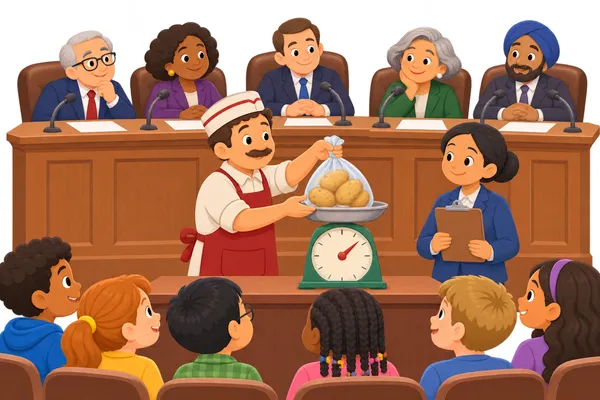
At a neighborhood grocery market, a clerk places a bag of potatoes on a scale. Its weight helps determine the price. Sellers and shoppers both have reasons to want accurate scales. Imagine that grocery owners from several states ask Congress to create a national grant program. The grants would help pay for equipment used to check market scales. This proposal is fictional, but its journey shows real steps in making a federal law.
An idea from grocery owners is not yet a bill before Congress. A senator agrees to introduce the written proposal in the Senate. Bills can begin in either the Senate or the House of Representatives, although bills for raising revenue must begin in the House. Together, these two chambers make up Congress.
The proposal goes to a Senate committee, a smaller group that studies certain subjects. At a hearing, members listen to grocery owners and scale inspectors. Members ask questions about costs and equipment. They may change, or amend, the bill. The committee votes to send a revised bill to the full Senate. Many proposals do not get this far.
The full Senate debates the proposal and votes. If it passes, the House must also consider it, including committee review, debate, and a vote. The House may suggest changes. Before the proposal can reach the president, both chambers must approve exactly the same wording. Approval of an earlier version does not count as approval of a later one.
This passage follows two possible paths after Congress agrees. The president can sign the bill, making it a law. Or the president can reject it with a veto and return it to Congress with objections. Congress can try to override the veto. That requires a two-thirds vote in each chamber. If either chamber falls short, the veto stands. A bill can therefore pass several votes without becoming a law.
- A. Replaced the need for a congressional vote
- B. Prepared an idea for a lawmaker to consider
- C. Completed the Senate's introduction of a bill
- D. Earned the committee's approval of a bill
- A. Bills supported by grocery owners skip introduction.
- B. Bills introduced in the Senate skip House review.
- C. Bills about grants begin with the president's signature.
- D. Bills other than revenue bills may start in either chamber.
The preview shows the first questions. Unlock the worksheet to see all of it.
Related worksheets
Airport Fieldwork and a Bill's Flight Plan
Grade 4 · CIV.4.3
14 questionsPremium
The Elevator Notice Bill: A Capitol Route Challenge
Grade 4 · CIV.4.3
14 questionsPremium
Checking the National Park Sound Bill
Grade 4 · CIV.4.3
13 questionsPremium
Two Proposals from Granite Gap
Grade 4 · CIV.4.3
13 questionsFree
A Bill's Journey from the Park Bulletin
Grade 4 · CIV.4.3
14 questionsPremium
A Market Idea Takes Shape
Grade 4 · CIV.4.3
15 questionsPremium