Grade 4 · Social StudiesCIV.4.3
Two Proposals from Granite Gap
Compare two fictional mountain-road bills to explain committee work, congressional votes, presidential action, and veto overrides.
Preview
OwlSheets.com
Two Proposals from Granite Gap
Compare two fictional bills as they move through Congress.
Compare the Records
Read the guide and the fictional records. Circle one answer for each multiple-choice question.
Mountain Ideas, National Decisions
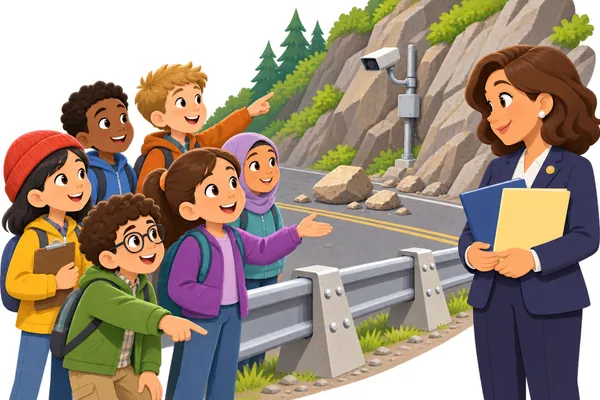
Granite Gap is a fictional mountain town beside a federal road. Falling rocks sometimes block the road after heavy rain. Residents discuss two possible projects: detectors that warn drivers when rocks fall, and stronger barriers that catch rocks beside the road. They send their ideas to members of the United States Congress. The two bills and their records below are made up for practice.
A bill is a proposed law. A resident can suggest an idea, but a member of Congress formally introduces a bill. Congress has two chambers: the House of Representatives and the Senate. These project bills begin in the House, although many bills can begin in either chamber.
After introduction, a committee studies a bill closely. Committee members may hear from people with useful information, suggest changes, and decide whether to send the bill to the full chamber. The full chamber can debate the proposal and vote. Committee approval is a step toward that vote, not a replacement for it.
A bill that passes one chamber still needs approval from the other. The second chamber also reviews and votes on it. Both chambers must pass exactly the same wording before the bill goes to the president. If one chamber changes the wording, more work and votes may be needed.
The president can sign a bill into law or veto it. A veto returns the bill to Congress with the president's objections. Congress can try to override, or overcome, the veto. That requires a two-thirds vote in each chamber. A large enough vote in one chamber does not replace the required vote in the other. The records below follow bills whose presidents either signed or vetoed them; they do not show every possible outcome.
| Stage | Detector Bill | Barrier Bill |
|---|---|---|
| Introduction | A House member introduces it. | A House member introduces it. |
| House committee | Hears engineers; sends bill forward. | Studies costs; sends bill forward. |
| Full House | Debates and passes it. | Debates and passes it. |
| Senate | Reviews and passes the same wording. | Reviews and passes the same wording. |
| President | Signs the bill. | Vetoes the bill. |
| Override votes | No override vote needed. | House reaches 2/3; Senate below 2/3. |
- A. One received a signature; the other's veto was not overcome.
- B. One began with a resident's idea; the other began in Congress.
- C. One received committee study; the other skipped that stage.
- D. One passed both chambers; the other passed just the House.
- A. The smaller group's close study before the House vote
- B. The president's decision about signing each proposal
- C. The full Senate's vote on the final bill wording
- D. The residents' discussion of the two possible projects
The president vetoed the Barrier Bill.A House committee studied the Barrier Bill's costs.The Senate's override vote fell below two-thirds.The House debated and passed the Barrier Bill.
- A. Both proposals have become laws, but neither has received funding.
- B. The Detector Bill is a law, but the Barrier Bill still needs study.
- C. Both proposals have advanced, but neither has finished the process.
- D. The Barrier Bill is a law, but the Detector Bill still needs study.
| Happened to both bills | Happened just to Detector Bill | Happened just to Barrier Bill |
|---|---|---|
- A. The president explaining the veto in greater detail
- B. The residents sending another letter to Congress
- C. The House committee hearing from more engineers
- D. The Senate also reaching a two-thirds override vote
Check New Cases
Use the guide to check these new fictional cases. Each case is separate from the two bill records.
- A. A newspaper prints a summary of the proposal.
- B. An engineer offers advice about the research plan.
- C. The resident gathers signatures from nearby households.
- D. The senator introduces the proposal in the Senate.
- A. The president signs it before the House reviews it.
- B. The House reviews it and considers its own vote.
- C. The Senate committee signs it into federal law.
- D. The town's residents hold the second chamber's vote.
- A. Place introduction between committee study and the first House vote.
- B. Place committee study after the Senate vote and presidential signature.
- C. Place committee study between introduction and the first House vote.
- D. Place the first House vote before introduction and committee study.
Sign the bill into law on the president's behalf.Listen to road workers explain the proposal's effects.Count its own vote as approval by both full chambers.Suggest changes after examining the proposal's details.
- A. Residents can answer a veto by approving the bill in town.
- B. Congress can overcome a veto with two-thirds in each chamber.
- C. A committee can answer a veto by signing the bill itself.
- D. One chamber can overcome a veto with its own two-thirds vote.
Related worksheets
Airport Fieldwork and a Bill's Flight Plan
Grade 4 · CIV.4.3
14 questionsPremium
The Elevator Notice Bill: A Capitol Route Challenge
Grade 4 · CIV.4.3
14 questionsPremium
Checking the National Park Sound Bill
Grade 4 · CIV.4.3
13 questionsPremium
Weighing a Proposal in Congress
Grade 4 · CIV.4.3
13 questionsPremium
A Bill's Journey from the Park Bulletin
Grade 4 · CIV.4.3
14 questionsPremium
A Market Idea Takes Shape
Grade 4 · CIV.4.3
15 questionsPremium