Grade 4 · Social StudiesCIV.4.3Premium
Checking the National Park Sound Bill
Use a national park bill file, congressional vote graph, and presidential action log to explain how a federal bill becomes law.
Preview
OwlSheets.com
Checking the National Park Sound Bill
Use a vote graph and an editor’s packet to check a bill’s progress.
Read the editor’s guide
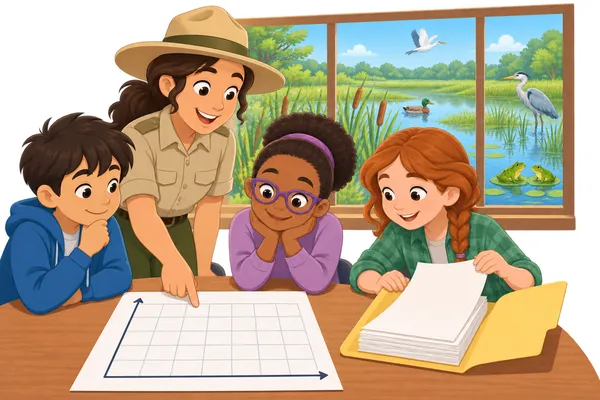
An editor is checking a report about a proposed national park law. Read the guide, then use its rules to answer the questions.
What Counts as Proof?
Loomreed National Park and the Sound Study Bill are invented for this worksheet. The park has wetlands where visitors hear frogs and birds. Some visitors suggest studying how human-made noise affects wildlife sounds. Their proposal would provide federal money for sound-recording equipment and research in national parks. The editor gathers records to check what happened to this idea. The lawmaking rules below describe the real federal process in a simplified way.
People may suggest ideas, write proposals, or contact Congress. However, a member of the House of Representatives or the Senate must introduce a bill to place it formally before Congress. Most bills may begin in either chamber. An idea does not become law because many people support it.
Usually, a committee studies the bill. This smaller group of lawmakers may hear from people with useful knowledge, examine costs, and suggest changes. A committee may send the bill forward, or it may leave the bill without further action. Committee support is not a vote by the full chamber. The full chamber can debate the proposal and vote on it.
The other chamber also considers the bill, usually with committee work and a full-chamber vote. For the ordinary passage votes in this packet, more yes votes than no votes means approval. Both chambers must approve exactly the same wording before the bill goes to the president. If one chamber changes the wording, the chambers must settle their differences and approve matching text.
The president may sign the bill, making it law, or veto it, returning it with objections to the chamber where it began. The president cannot rewrite the bill’s wording while signing it. After a veto, Congress may vote again. Overriding a veto requires at least two-thirds support in each chamber, not just a majority or a combined total.
A signature is not the only route to a law. If the president neither signs nor returns a bill within ten days, not counting Sundays, it becomes law when Congress remains in session. There is an exception: if Congress adjourns in a way that prevents the bill’s return, an unsigned bill does not become law. This is called a pocket veto. An editor must check the timing and whether Congress was in session before reporting what presidential silence meant.
- A. A congressional record showing a member introducing the bill
- B. A ranger’s report recommending sound-recording equipment
- C. A newspaper article describing support for the proposal
- D. A visitor petition asking Congress to study park sounds
Ask wildlife researchers how the recording equipment would be used.Count a visitor petition as the full Senate’s approval vote.Sign the proposal into law before the full House debates it.Compare equipment prices with the amount requested in the bill.
The preview shows the first questions. Unlock the worksheet to see all of it.
Related worksheets
Airport Fieldwork and a Bill's Flight Plan
Grade 4 · CIV.4.3
14 questionsPremium
The Elevator Notice Bill: A Capitol Route Challenge
Grade 4 · CIV.4.3
14 questionsPremium
Weighing a Proposal in Congress
Grade 4 · CIV.4.3
13 questionsPremium
Two Proposals from Granite Gap
Grade 4 · CIV.4.3
13 questionsFree
A Bill's Journey from the Park Bulletin
Grade 4 · CIV.4.3
14 questionsPremium
A Market Idea Takes Shape
Grade 4 · CIV.4.3
15 questionsPremium