
Worksheet
One Word, Two Jobs: A Sled Dog Race
At a sled dog race, students see how one word can be a noun or a verb and explain what nouns, pronouns, verbs, adjectives and adverbs do.
Grade 3ELAInteractive · Printable
Aligned toL.3.1.a
What’s included
- Single worksheet
- Auto-graded online
- 1 Common Core standard
- Printable answer key
- 10 questions
- Classroom-ready
Details
- Format
- Interactive · Printable
- Grade
- Grade 3
- Subject
- ELA
- Question types
- Fill in the blank, Multiple choice, Matching, Circle the answer, Sorting, Short answer
About this worksheet
What students practice
- Students tell whether the same word is used as a noun or a verb in different sentences.
- Students explain the job of a noun, pronoun, verb, adjective or adverb in a particular sentence.
- Students find the word an adjective describes and the noun a pronoun stands for.
How to use
Start with the word race: act out "the dogs race" and point to "the race" on a poster. Then let students work through the sheet and share their own sentences from the last question.
Curriculum
Common Core standard covered
Explain what nouns, pronouns, verbs, adjectives, and adverbs do in general and in particular sentences.
Preview
OwlSheets.com
One Word, Two Jobs: A Sled Dog Race
The same word can do different jobs in different sentences.
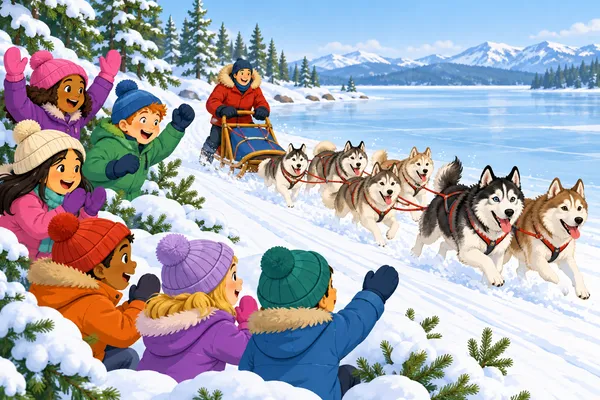
One word, two jobs
Some words can do different jobs. Read each sentence to see what the word does there.
1. The dogs race across the snow.
2. The race starts at noon.
What job does the word race do in each sentence?
- A. It is a verb in sentence 1 and a noun in sentence 2.
- B. It is a noun in sentence 1 and a verb in sentence 2.
- C. It is a verb in both sentences.
- D. It is a noun in both sentences.
| Noun | Verb |
|---|---|
1. Miko is a fast dog.
2. Miko runs fast up the hill.
In which sentence is fast an adverb that tells how Miko runs?
- A. Sentence 1
- B. Sentence 2
- C. Both sentences
- D. Neither sentence
Words at the race
Think about what each word does in its sentence.
- Aunt Lena gently pats each dog.
- She hooks the dogs to the sled.
- The sled has long wooden runners.
- The dogs dash down the trail.
- Kaya wears a warm hat.
- A. shows an action
- B. describes a noun
- C. takes the place of a noun
- D. names a thing
- E. tells how an action happens
Soontheracebeginsnearthefrozenlake.
Aunt Lenafeedsthedogs,andthenshebrushesthem.
The sleepy puppy curls up next to Kaya's boots.
The adjective sleepy describes the noun .
The last team finally crosses the finish line.
Which word in this sentence is an adverb?
- A. last
- B. crosses
- C. finally
- D. line
The mushers shake hands because they all raced well.
What job does the word they do in this sentence?
- A. It shows the action of shaking hands.
- B. It takes the place of the dogs.
- C. It tells how well the mushers raced.
- D. It takes the place of the mushers.
Your turn
Related worksheets
 Worksheet
Grade 3
Shearing Day at the Wool Barn: What Words Do
Language · L.3.1.a
Premium12 questions
 Worksheet
Grade 3
Red Pandas in the Treetops: What Each Word Does
Language · L.3.1.a
Premium10 questions
 Worksheet
Grade 3
Mila's Karate Class: Nouns, Verbs and More
Language · L.3.1.a
Premium9 questions
 Worksheet
Grade 3
Word Jobs at the Science Fair
Language · L.3.1.a
Premium12 questions
 Worksheet
Grade 3
Saplings and Shovels at the Tree Nursery
Language · L.3.6
Premium11 questions
 Worksheet
Grade 3
The Teddy Clinic: Plural Nouns
Language · L.3.1.b
Premium12 questions