Grade 3 · Social StudiesHIS.3.2
A Year Along River and Coast
Use a seasonal timeline to compare Mandan and Wampanoag homes, foods, tools, and land use.
Preview
OwlSheets.com
A Year Along River and Coast
Follow a seasonal timeline of two Native nations.
Follow the Seasons
Read the introduction and timeline. The seasons move in order from spring to winter.
Two Homelands, One Year of Seasons
Mandan and Wampanoag people are living peoples with communities today. This timeline describes some traditional activities before electric tools and refrigerators. It is not a record of one family's year. Families' activities varied with weather and local conditions. The Mandan homeland includes the Missouri River region of the northern Great Plains. The Wampanoag homeland includes coastal areas of what are now Massachusetts and Rhode Island.
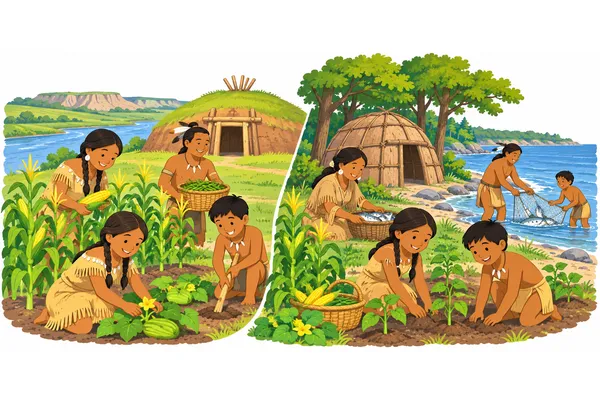
SPRING → Mandan gardeners prepared river-bottom soil and planted corn, beans, and squash. They used hoes, including hoes made with bison shoulder bones, to work the soil. In Wampanoag communities, people caught fish moving through rivers in spring. Nets and woven fish traps helped with this work. Wampanoag families also planted corn, beans, and squash.
SUMMER → Mandan gardeners tended their crops. Some groups traveled to hunt bison on the grasslands. On hunting trips, hide-covered tipis could be taken down and carried. Back in villages, earth lodges had wooden frames covered with earth. Wampanoag people gathered shellfish along the coast and cared for gardens. Their wetus had bent sapling frames covered with mats or bark. Nearby woods supplied these building materials.
AUTUMN → Mandan families harvested their gardens. They dried foods and kept supplies in storage pits. Bison supplied meat, hides, and bones used for tools. Wampanoag families also harvested crops and dried food. They gathered nuts from woodlands. Baskets helped carry gathered foods and crops. Drying food reduced the need to find fresh food each day.
WINTER During cold weather, stored foods helped feed families in both nations. Hunting continued, too. Mandan earth lodges offered shelter from cold Plains winds. Wampanoag bark-covered wetus sheltered families during cold weather. People also repaired tools and made useful objects. The next spring brought another round of planting, fishing, and other seasonal work.
- A. To show which tools were invented first
- B. To show how work changed during a year
- C. To show which nation began farming first
- D. To show how far apart the homelands were
- A. Harvest crops → plant seeds → tend crops
- B. Plant seeds → harvest crops → tend crops
- C. Plant seeds → tend crops → harvest crops
- D. Tend crops → harvest crops → plant seeds
Bison bones were used to make tools.Gardeners tended crops during summer.Traveling hunters used hide-covered tipis.Families dried foods after the harvest.
- A. After spring and before summer
- B. During spring, before planting
- C. After summer and before winter
- D. After winter and before spring
- A. A bark covering made for a coastal wetu
- B. A tipi covering and frame they could carry
- C. An earth covering over a village lodge
- D. A food-storage pit beside a garden
- A. Drying foods supplied materials for fishing nets.
- B. Gathering nuts supplied frames for winter homes.
- C. Planting gardens supplied fresh winter crops.
- D. Preserving harvests supplied food for cold months.
Use the Timeline
Return to the timeline for evidence. Think about the order of work and the resources in each homeland.
- A. Put harvesting after summer because crops need time to grow.
- B. Put harvesting beside planting because both use soil.
- C. Put harvesting before planting because pits hold seeds.
- D. Put harvesting in winter because families eat then.
Planting corn, beans, and squashCatching spring fish with nets and trapsMaking home frames from bent saplingsGathering shellfish along the coast
- A. A nearby woodland with young trees
- B. A river channel with migrating fish
- C. A coastal shore with shellfish beds
- D. A garden plot with ripening squash
- A. Winter shelter followed the autumn harvest.
- B. Wampanoag baskets carried nuts and crops.
- C. Spring river fishing came before shellfish gathering.
- D. Summer included both crop care and bison hunting.
- A. Hoes worked garden soil; baskets carried harvested foods.
- B. Nets and baskets did the same job in different seasons.
- C. Baskets worked garden soil; hoes carried harvested foods.
- D. Hoes caught river fish; nets carried gathered nuts.
Related worksheets
A History Poster for the Bicycle Shop
Grade 3 · HIS.3.2
13 questionsPremium
A Snow Map of Two Homelands
Grade 3 · HIS.3.2
14 questionsPremium
Two Homelands in a Teaching Garden
Grade 3 · HIS.3.2
13 questionsPremium
Homelands Through Time
Grade 3 · HIS.3.2
15 questionsPremium
Field Notes from Three Homelands
Grade 3 · HIS.3.2
14 questionsPremium
Homes Across Native Nations: Then and Now
Grade 3 · HIS.3.2
14 questionsPremium