Grade 3 · Social StudiesHIS.3.2Premium
A History Poster for the Bicycle Shop
Help a bicycle shop prepare a history poster comparing traditional Hopi and Seminole homes, foods, tools, and uses of their homelands.
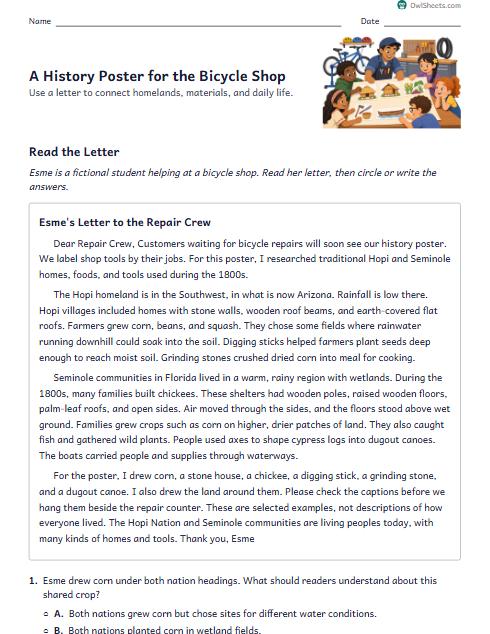
Preview
OwlSheets.com
A History Poster for the Bicycle Shop
Use a letter to connect homelands, materials, and daily life.
Read the Letter
Esme is a fictional student helping at a bicycle shop. Read her letter, then circle or write the answers.
Esme's Letter to the Repair Crew
Dear Repair Crew, Customers waiting for bicycle repairs will soon see our history poster. We label shop tools by their jobs. For this poster, I researched traditional Hopi and Seminole homes, foods, and tools used during the 1800s.
The Hopi homeland is in the Southwest, in what is now Arizona. Rainfall is low there. Hopi villages included homes with stone walls, wooden roof beams, and earth-covered flat roofs. Farmers grew corn, beans, and squash. They chose some fields where rainwater running downhill could soak into the soil. Digging sticks helped farmers plant seeds deep enough to reach moist soil. Grinding stones crushed dried corn into meal for cooking.
Seminole communities in Florida lived in a warm, rainy region with wetlands. During the 1800s, many families built chickees. These shelters had wooden poles, raised wooden floors, palm-leaf roofs, and open sides. Air moved through the sides, and the floors stood above wet ground. Families grew crops such as corn on higher, drier patches of land. They also caught fish and gathered wild plants. People used axes to shape cypress logs into dugout canoes. The boats carried people and supplies through waterways.
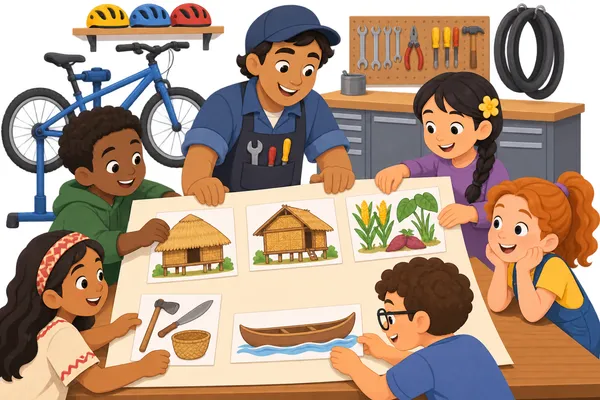
For the poster, I drew corn, a stone house, a chickee, a digging stick, a grinding stone, and a dugout canoe. I also drew the land around them. Please check the captions before we hang them beside the repair counter. These are selected examples, not descriptions of how everyone lived. The Hopi Nation and Seminole communities are living peoples today, with many kinds of homes and tools. Thank you, Esme
- A. Both nations grew corn but chose sites for different water conditions.
- B. Both nations planted corn in wetland fields.
- C. Both nations needed the same amount of rain for their fields.
- D. Both nations grew corn but got their other foods from fishing.
- A. Palm leaves covering the roof
- B. Open spaces between the roof supports
- C. Wooden poles holding up the roof
- D. A wooden platform above the soil
The preview shows the first questions. Unlock the worksheet to see all of it.
Related worksheets
A Snow Map of Two Homelands
Grade 3 · HIS.3.2
14 questionsPremium
Two Homelands in a Teaching Garden
Grade 3 · HIS.3.2
13 questionsPremium
A Year Along River and Coast
Grade 3 · HIS.3.2
13 questionsFree
Homelands Through Time
Grade 3 · HIS.3.2
15 questionsPremium
Field Notes from Three Homelands
Grade 3 · HIS.3.2
14 questionsPremium
Homes Across Native Nations: Then and Now
Grade 3 · HIS.3.2
14 questionsPremium