Grade 3 · Social StudiesHIS.3.2Premium
Two Homelands in a Teaching Garden
Use a community garden plan and graph to explore how Muscogee and Akimel O'odham people used regional resources for homes and food.
Preview
OwlSheets.com
Two Homelands in a Teaching Garden
Connect homes, foods, tools, and water to different regions.
Read the Garden Plan
Read the booklet. Use its details to answer the questions.
Rootpath Community Garden Planning Booklet
At Rootpath Community Garden, volunteers are making teaching beds about two Native American nations. This booklet describes examples from long ago, not rules for every family. The beds are models, not copies of whole homelands.
Muscogee (Creek) historic homelands are in the Southeast, where forests and rivers provided many resources. Farmers grew corn, beans, and squash. Rain watered many fields. Farmers loosened soil with hoes and carried crops in baskets. People also fished in rivers and hunted animals such as deer. Many homes had wooden frames with clay-covered walls. Builders gathered wood from trees and clay from the soil.
Akimel O'odham historic homelands lie along rivers in the Sonoran Desert of the Southwest. Rain is scarce there. Long ago, farmers dug canals, or channels, to guide river water to their fields. They grew corn, beans, and squash. Wooden digging sticks helped make holes for seeds. Baskets held gathered or harvested food. Some traditional homes had wooden frames covered with brush. Trees and other plants along rivers supplied building materials, even in this dry region.
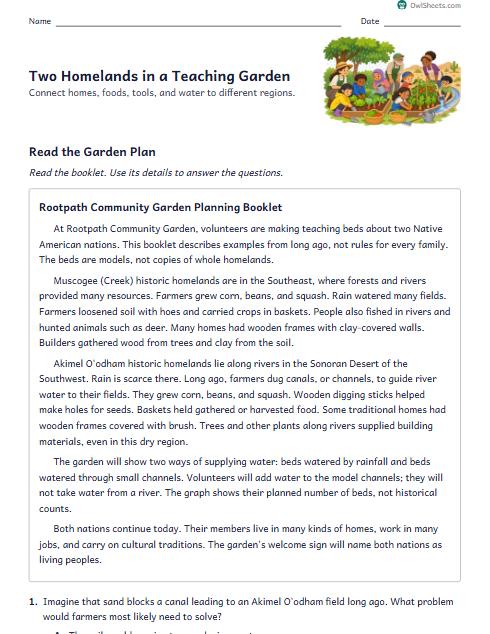
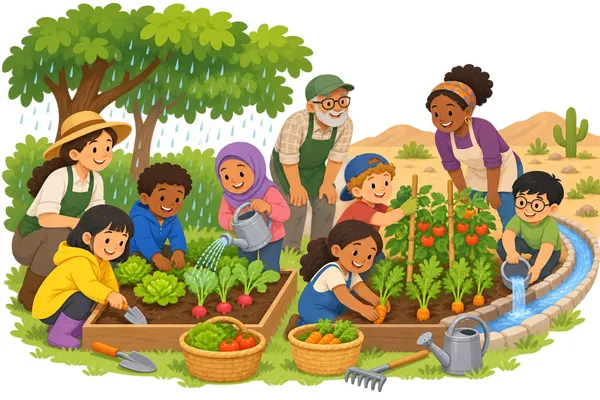
The garden will show two ways of supplying water: beds watered by rainfall and beds watered through small channels. Volunteers will add water to the model channels; they will not take water from a river. The graph shows their planned number of beds, not historical counts.
Both nations continue today. Their members live in many kinds of homes, work in many jobs, and carry on cultural traditions. The garden's welcome sign will name both nations as living peoples.
- A. The soil would receive too much river water.
- B. The crops would receive less river water.
- C. The baskets would have less room for crops.
- D. The digging sticks would make deeper holes.
- A. Beans gathered from a field
- B. Wood gathered from the forest
- C. Clay gathered from the soil
- D. Brush gathered along a river
The preview shows the first questions. Unlock the worksheet to see all of it.
Related worksheets
A History Poster for the Bicycle Shop
Grade 3 · HIS.3.2
13 questionsPremium
A Snow Map of Two Homelands
Grade 3 · HIS.3.2
14 questionsPremium
A Year Along River and Coast
Grade 3 · HIS.3.2
13 questionsFree
Homelands Through Time
Grade 3 · HIS.3.2
15 questionsPremium
Field Notes from Three Homelands
Grade 3 · HIS.3.2
14 questionsPremium
Homes Across Native Nations: Then and Now
Grade 3 · HIS.3.2
14 questionsPremium