
Worksheet
The Great Hamster Hunt: Starting a Story
Read a story about a missing class hamster, find the narrator, characters, situation and event order, then plan a story of your own.
Grade 3ELAInteractive · Printable
Aligned toW.3.3.a
What’s included
- Single worksheet
- Auto-graded online
- 1 Common Core standard
- Printable answer key
- 12 questions
- Classroom-ready
Details
- Format
- Interactive · Printable
- Grade
- Grade 3
- Subject
- ELA
- Question types
- Fill in the blank, Multiple choice, Matching, Circle the answer, Short answer
About this worksheet
What students practice
- Students identify the narrator, the characters and the situation at the start of a story.
- Students put story events in an order that unfolds naturally.
- Students plan a narrator, a situation and a sequence of events for their own story.
How to use
Read the hamster story aloud and talk about how the beginning sets up everything that follows, then have students answer the questions and plan their own story.
Curriculum
Common Core standard covered
Establish a situation, introduce a narrator or characters, and organize an event sequence that unfolds naturally.
Preview
OwlSheets.com
The Great Hamster Hunt: Starting a Story
Set up the situation, meet the characters and order the events.
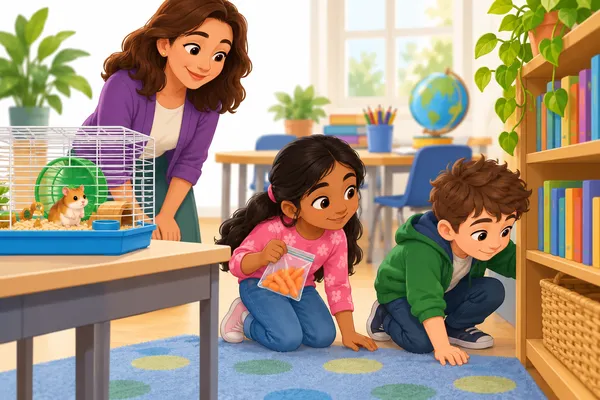
Read the story
Read Priya's story. Notice who tells it and how one event leads to the next.
The Great Hamster Hunt
1My name is Priya, and this week it was my turn to take care of Peanut, our class hamster. On Monday morning, I walked into Room 12 with a bag of fresh carrots. When I got to Peanut's cage, the little door was open. Peanut was gone!
2I ran to tell our teacher, Mr. Bell. He did not panic. "Hamsters like dark, quiet places," he said. "Let's search carefully and keep our voices low."
3My friend Theo and I looked under the reading rug and behind the bookshelf. We found a lost crayon and an old spelling test, but no hamster. Then Theo had an idea. The lost-and-found box was dark and full of soft hats and scarves. He set a carrot on the floor next to it, and the whole class sat very still.
4After a few quiet minutes, a tiny pink nose poked out of the lost-and-found box. Peanut crept over to the carrot and began to nibble. His cheeks puffed up as he stuffed bits of carrot inside.
5Mr. Bell gently scooped Peanut up and carried him back to his cage. This time, he clicked the door shut and checked it twice. Theo and I gave each other a high five, and Peanut went right back to munching.
How the story is built
Answer the questions about Priya's story.
- A. Theo, a friend in Room 12
- B. Mr. Bell, the class teacher
- C. Priya, who cares for Peanut
- D. Peanut, the class hamster
The character who sets a carrot next to the lost-and-found box is .
- A. She forgot to bring carrots for Peanut's breakfast.
- B. The cage door is open, and Peanut is gone.
- C. Theo does not want to help her clean the cage.
- D. Mr. Bell is too busy to help her look.
My name is Priya, and this week it was my turn to take care of Peanut, our class hamster.On Monday morning, I walked into Room 12 with a bag of fresh carrots.When I got to Peanut's cage, the little door was open.Peanut was gone!
- 1st
- 2nd
- 3rd
- 4th
- A. Theo sets a carrot on the floor.
- B. Priya finds the cage door open.
- C. Mr. Bell carries Peanut back to his cage.
- D. Priya and Theo look behind the bookshelf.
- A. A tiny nose pokes out of the lost-and-found box.
- B. Priya runs to tell Mr. Bell that the cage is open.
- C. Mr. Bell tells the class to keep their voices low.
- D. Mr. Bell clicks the cage door shut and checks it.
Plan a story
Answer the questions about other stories. Then plan a story of your own.
- A. Then everyone clapped, and the curtain closed for good.
- B. Next, I forgot my line, but Ben whispered it to me.
- C. School plays can be about many kinds of things.
- D. My name is Rosa, and tonight is my first school play.
A. Wei found the book under his bed and returned it just in time.
B. Wei borrowed a book about volcanoes from the school library.
C. The day the book was due, Wei could not find it anywhere.
D. He read a chapter every night before bed.
Which order makes the events unfold naturally?
- A. B, C, D, A
- B. B, D, C, A
- C. D, B, C, A
- D. B, D, A, C
- A. One day, something happened that I will never forget.
- B. Grandpa is my favorite person in the whole world.
- C. I helped Grandpa fix his old boat at the dock.
- D. The old boat had a hole, and it needed fixing.
Related worksheets
 Worksheet
Grade 3
The Lunchbox Mix-Up: Narrator, Situation and Events
Writing · W.3.3.a
Premium12 questions
 Worksheet
Grade 3
A Room for Abuela: Setting Up a Story
Writing · W.3.3.a
Premium11 questions
 Worksheet
Grade 3
Thirsty No More: Soraya Researches Cactus Plants
Writing · W.3.7
Premium10 questions
 Worksheet
Grade 3
Mealworms for Room 9: Finding Strong Reasons
Writing · W.3.1.b
Premium10 questions
 Worksheet
Grade 3
Delphine Runs the Welcome Booth: Showing Feelings in a Story
Writing · W.3.3.b
Premium9 questions
 Worksheet
Grade 3
Fish on the Storm Drains: Linking an Opinion to Its Reasons
Writing · W.3.1.c
Premium10 questions