
WorksheetPremium
Habitat Detectives at the Photo Station
Compare plant and animal variety using a classroom photo investigation, observation records, and a graph.
Grade 2ScienceInteractive · Printable
Aligned to2-LS4-1
Or unlock every Premium worksheet with Premium
What’s included
- Single worksheet
- Auto-graded online
- 1 NGSS standard
- Printable answer key
- 13 questions
- Classroom-ready
Details
- Format
- Interactive · Printable
- Grade
- Grade 2
- Subject
- Science
- Question types
- Fill in the blank, Multiple choice, Circle the answer, Sorting, Short answer
About this worksheet
What students practice
- Students compare the kinds of plants and animals recorded in two habitats.
- Students distinguish the number of living things from the number of kinds.
- Students support a habitat comparison with observation records and graph data.
How to use
Read the investigation and records together. Have students use the records and graph to answer, then discuss what photographs can and cannot show.
Curriculum
NGSS standard covered
Compare the variety of plants and animals living in different habitats.
Preview
OwlSheets.com
Habitat Detectives at the Photo Station
Use classroom observation records to compare two habitats.
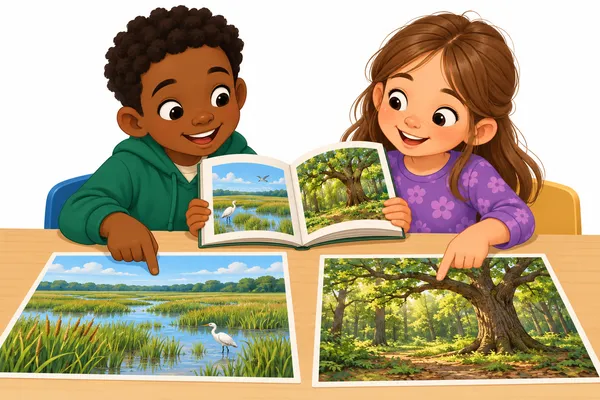
At the Classroom Photo Station
Read about the investigation. Use the class records to answer.
Looking for Living Kinds
A habitat is a place where living things make their homes. At a classroom photo station, a class studied pictures of a marsh and an oak woodland. A marsh has shallow water and wet ground. An oak woodland has many oak trees.
Step 1: The teacher gave each group four clear photographs of each habitat. The photographs showed different parts of each place.
Step 2: Each group studied each set for ten minutes. Students used picture guides to name the plants and animals they saw.
Step 3: Students made a list for each habitat. They counted each kind only once, even when it appeared many times. Six ducks appeared in the marsh pictures. Ten ants appeared in the woodland pictures.
Step 4: The class checked the lists and made a graph. The lists tell what students found in the photographs. Living things outside the photographs were not recorded.
Plants: cattail, duckweed, willow, pondweed
Animals: duck, frog, dragonfly, snail
Plants: oak, fern, willow
Animals: squirrel, woodpecker, ant, snail
Each name stands for one kind in these records.
The preview shows the first questions. Unlock the worksheet to see all of it.
Related worksheets
 Worksheet
Grade 2
Living Places on the Bridge Walkway
Life Science · 2-LS4-1
Premium16 questions
 Worksheet
Grade 2
Life in Two Pumpkin Patch Places
Life Science · 2-LS4-1
Premium14 questions
 Worksheet
Grade 2
Two Living Places at the Bike Shop
Life Science · 2-LS4-1
Free14 questions
 Worksheet
Grade 2
Living Kinds at the Sheep Farm
Life Science · 2-LS4-1
Premium14 questions
 Worksheet
Grade 2
Living Things Beside the Shot-Put Field
Life Science · 2-LS4-1
Premium14 questions
 Worksheet
Grade 2
Habitat Plans for the Outdoor Kitchen
Life Science · 2-LS4-1
Premium13 questions