
Worksheet
How to Make a Flip Book
Read an original how-to text about making a flip book, then explain how each step connects to the next and why it works.
Grade 2ELAInteractive · Printable
Aligned toRI.2.3
What’s included
- Single worksheet
- Auto-graded online
- 1 Common Core standard
- Printable answer key
- 10 questions
- Classroom-ready
Details
- Format
- Interactive · Printable
- Grade
- Grade 2
- Subject
- ELA
- Question types
- Fill in the blank, Multiple choice, Circle the answer, Sorting, Short answer
About this worksheet
What students practice
- Students describe how the steps in a how-to text are connected.
- Students tell the reason a text gives for a step in a procedure.
- Students put the steps of a procedure in order using order words.
How to use
Read the how-to text together and circle the order words first, next, then and last. If you have time, let students make a small flip book after they finish the questions.
Curriculum
Common Core standard covered
Describe how a series of historical events, science ideas, or steps in a procedure are connected in a text.
Preview
OwlSheets.com
How to Make a Flip Book
Read a how-to text and tell how the steps connect.
Read the how-to text
How to Make a Flip Book
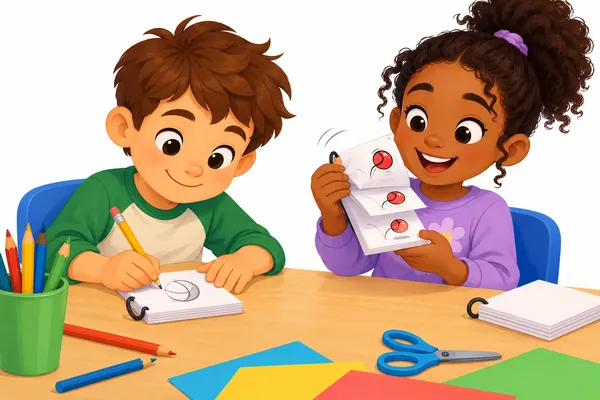
1Do you want to make a drawing that moves? Try making a flip book! A flip book is a small stack of pages with a picture on each one. When you flip the pages fast, the picture seems to move.
2You will need a small pad of paper and a pencil. A pad works well because its pages are stuck together at one edge, so they stay in order.
3First, choose a simple action, such as a ball bouncing. You will draw the ball on many pages, so a simple shape saves time.
4Next, draw the ball near the bottom of the first page. Then turn to the second page and draw the ball again, just a little higher. Keep going, moving the ball up a tiny bit on each page. When it reaches the top, draw it a little lower on each page until it lands. If the ball moves too far from one page to the next, it will jump instead of gliding.
5Last, hold the pad by its stuck edge. Flip the pages quickly with your thumb. Your brain joins the pictures together, so the ball seems to bounce!
Follow the steps
Answer each question. Look back at the paragraph a question names.
, choose a simple action.
, draw the ball on the first page.
, flip the pages with your thumb.
- A. Its pages are thick, so the pencil will not rip them.
- B. Its pages are stuck together, so they stay in order.
- C. Its pages are small, so the book fits in a pocket.
- D. Its pages are white, so the ball is easy to see.
- A. A simple shape looks better than a fancy one.
- B. A small pad has no room for a big picture.
- C. You draw it on many pages, so it saves time.
- D. A simple shape is easier to color in with markers.
Next, draw the ball near the bottom of the first page.Then turn to the second page and draw the ball again, just a little higher.Keep going, moving the ball up a tiny bit on each page.When it reaches the top, draw it a little lower on each page until it lands.If the ball moves too far from one page to the next, it will jump instead of gliding.
- A. Draw the ball again, a bit higher.
- B. Flip all the pages fast with your thumb.
- C. Choose a simple action for the ball.
- D. Draw the ball lower until it lands.
How the steps connect
Think about how each step leads to the next.
- A. staying still in the same spot
- B. moving in a quick, jerky way
- C. growing bigger on each page
- D. moving in a smooth, easy way
| A step to do | A reason why |
|---|---|
Your joins the pictures together, so the ball seems to bounce!
- A. The ball would seem to jump around.
- B. The ball would seem to stay still.
- C. The ball would seem to bounce higher.
- D. The pages would fall out of order.
Related worksheets
 Worksheet
Grade 2
How a Xylophone Makes Music
Reading: Informational Text · RI.2.3
Premium10 questions
 Worksheet
Grade 2
A New Life for Old Paper
Reading: Informational Text · RI.2.3
Premium10 questions
 Worksheet
Grade 2
Squid Tricks: Word Clues in the Sea
Reading: Informational Text · RI.2.4
Premium10 questions
 Worksheet
Grade 2
Igloos: Houses Made of Snow
Reading: Informational Text · RI.2.1
Premium10 questions
 Worksheet
Grade 2
Teeth for Every Job
Reading: Informational Text · RI.2.2
Premium9 questions
 Worksheet
Grade 2
Welders Join Metal
Reading: Informational Text · RI.2.1
Premium11 questions