
Worksheet
A Fair Choice by Willow River
Grade 1 civics practice with school and community rights, responsibilities, and fair voting steps.
Grade 1Social StudiesInteractive · Printable
Aligned toCIV.1.3
What’s included
- Single worksheet
- Auto-graded online
- 1 C3 Framework standard
- Printable answer key
- 13 questions
- Classroom-ready
Details
- Format
- Interactive · Printable
- Grade
- Grade 1
- Subject
- Social Studies
- Question types
- Fill in the blank, Multiple choice, Matching, Circle the answer, Sorting, Short answer
About this worksheet
What students practice
- Students identify rights and responsibilities at school and in a river town community.
- Students describe fair voting steps, including sharing ideas, one vote each, and open counting.
How to use
Read Ana's letter aloud, discuss the examples of rights and responsibilities, then have students complete the voting and new-situation questions.
Curriculum
C3 Framework standard covered
Describe rights and responsibilities at school and in the community, including fair ways to decide, like voting.
Preview
OwlSheets.com
A Fair Choice by Willow River
Read Ana's letter about rights, responsibilities, and voting.
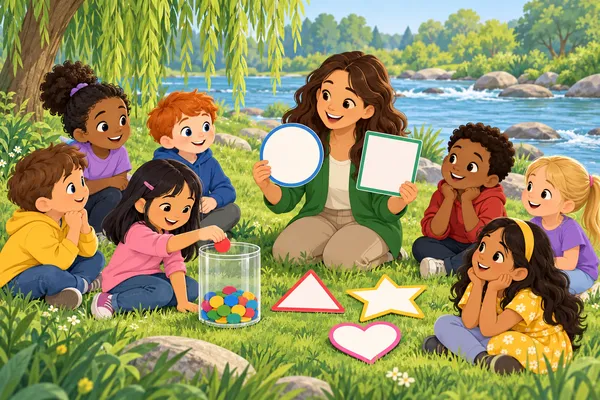
Read Ana's letter
Read the letter. Then answer the questions.
A Note from Ana
Dear Class 1B, Our town is next to the Willow River. At school, every child has a right to learn, ask questions, and feel safe. We also have responsibilities: listen when others speak, use class materials carefully, and follow directions.
At Saturday's riverfront cleanup, everyone has a right to enjoy the path and feel safe. We have a responsibility to put trash in bins and leave room for walkers.
Our class must choose a design for a sign by the river path. We will hear each idea, give each person one vote, count votes where everyone can see, and use the design with the most votes. Even if our choice does not win, we can respect the fair decision. From, Ana
- A. So Ana can choose alone.
- B. So no one has to share.
- C. So the class can skip counting.
- D. So each idea gets a chance to be heard.
Learn at schoolUse class materials carefullyAsk questionsFeel safe
| Right | Responsibility |
|---|---|
Each person gets one .
- Hear each idea
- Give each person one vote
- Count votes where everyone can see
- A. People can check the count
- B. Each person has one choice
- C. Everyone gets a chance to share
- A. Choose a new sign without counting.
- B. Let one child add extra votes.
- C. Count the votes where everyone can see.
- D. Ask people to vote again until all agree.
- A. Change the rules for the vote.
- B. Respect the fair decision.
- C. Hide the winning design.
- D. Tell others their ideas do not matter.
Use fair choices
Think about what people should do at school and in the community.
Let each child share an ideaGive one child all the votesGive each child one voteCount the votes where everyone can see
- A. Leave room for walkers.
- B. Run in front of walkers.
- C. Put trash beside the path.
- D. Block the path with a bag.
Lee borrows crayons during art. Lee should use them .
- A. Let that child have two votes.
- B. Let the child who drew the sign pick the winner.
- C. Give each person one vote.
- D. Ask one adult to choose without hearing ideas.
Related worksheets
 Worksheet
Grade 1
A Letter from Sunstone Courtyard
Civics & Government · CIV.1.1
Free15 questions
 Worksheet
Grade 1
Two Safety Plans on Moonfin Island
Civics & Government · CIV.1.1
Premium14 questions
 Worksheet
Grade 1
Cactus Lantern Class Council
Civics & Government · CIV.1.2
Premium14 questions
 Worksheet
Grade 1
Leaders and Shade Plans
Civics & Government · CIV.1.2
Free14 questions
 Worksheet
Grade 1
Stonecap's Two Heritage Stops
Civics & Government · CIV.1.4
Premium15 questions
 Worksheet
Grade 1
Metro Square's American Display
Civics & Government · CIV.1.4
Free14 questions