
Worksheet
A Letter from Sunstone Courtyard
Read a child's letter about a desert city garden and explain why rules and laws help a community and what can happen when they are broken.
Grade 1Social StudiesInteractive · Printable
Aligned toCIV.1.1
What’s included
- Single worksheet
- Auto-graded online
- 1 C3 Framework standard
- Printable answer key
- 15 questions
- Classroom-ready
Details
- Format
- Interactive · Printable
- Grade
- Grade 1
- Subject
- Social Studies
- Question types
- Fill in the blank, Multiple choice, Circle the answer, Short answer
About this worksheet
What students practice
- Students explain how rules and laws help protect people and shared places.
- Students identify possible results when a community rule or law is broken.
How to use
Read the letter aloud, discuss how the rules and law help the shared garden, and then have students answer the application questions.
Curriculum
C3 Framework standard covered
Explain the purpose of rules and laws in a community and what happens when they are broken.
Preview
OwlSheets.com
A Letter from Sunstone Courtyard
Read a letter about rules, laws, and their purposes.
Read the letter
Listen as your teacher reads the letter. Then answer the questions.
A Letter from Sunstone Courtyard
Dear Talia,
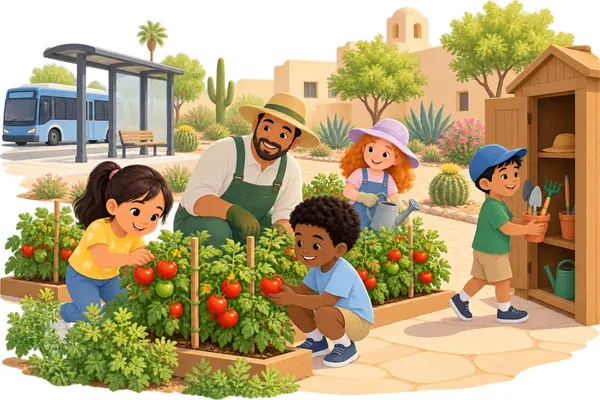
Yesterday my class visited Sunstone Courtyard, a shared garden beside the bus stop in our desert city. A sign gives three garden rules: walk on the stone paths, take only ripe tomatoes, and return tools to the shed. These rules help the garden stay safe and ready for everyone. One city law says people may use only the marked spigots in public gardens. The law helps protect the city's limited water. A gardener may ask someone who breaks a garden rule to fix the problem, such as putting a tool away. A city worker may give a person a ticket for breaking the water law. I liked helping care for a place we all use!
Your friend, Milo
- A. So people can reach the bus stop first.
- B. So the plants and garden beds are cared for.
- C. So visitors can take every tomato.
- D. So city workers can close the garden.
- A. A city worker may change the bus route.
- B. The visitor may take all the ripe tomatoes.
- C. A gardener may ask the visitor to put it away.
- D. The water law may turn into a garden rule.
Walk on the stone paths is a garden .
Walk on the stone paths.Take only ripe tomatoes.The garden is beside a bus stop.Milo writes to Talia.
- A. It leaves tomatoes growing for the garden and its visitors.
- B. It lets visitors use water from any place.
- C. It keeps the bus stop open at night.
- D. It makes city workers give fewer tickets.
Rules and laws
Use the letter to think about how a rule and a law work.
- A. The rule is made by a city worker, and the law is made by a gardener.
- B. The rule concerns water, and the law concerns tomatoes.
- C. The rule gives a ticket, and the law asks people to use tools.
- D. The rule is for one shared garden, and the law covers public gardens in the city.
A city worker may give a person a for breaking the water law.
- A. It helps every visitor pick an unripe tomato.
- B. It helps gardeners leave tools outside.
- C. It helps people save the city's limited water.
- D. It helps buses drive on the garden paths.
- A. Leave the rake there for the next visitor.
- B. Move the rake to the shed and explain the garden rule.
- C. Use the rake to pick the green tomatoes.
- D. Ask a city worker for a water ticket.
- A. A gardener may ask the person to take ripe tomatoes.
- B. The person may add a new path to the garden.
- C. The person may move the bus stop into the shed.
- D. A city worker may give the person a ticket.
Use what you know
Think about new situations. Choose the answer that best fits the letter.
Ari walks on the stone path.Bea returns the shovel to the shed.Cal uses an unmarked spigot in the garden.Dee picks green tomatoes.
- A. Using an unmarked spigot in a public garden.
- B. Taking an unripe tomato from a garden bed.
- C. Using a marked spigot in a public garden.
- D. Receiving a ticket from a city worker.
- A. The city's water supply could grow larger.
- B. The bus stop could become a tomato shed.
- C. The garden tools could put themselves away.
- D. The garden could become damaged or harder to share.
Related worksheets
 Worksheet
Grade 1
Two Safety Plans on Moonfin Island
Civics & Government · CIV.1.1
Premium14 questions
 Worksheet
Grade 1
Rules in Briarwood Neighborhood
Civics & Government · CIV.1.1
Premium14 questions
 Worksheet
Grade 1
Cactus Lantern Class Council
Civics & Government · CIV.1.2
Premium14 questions
 Worksheet
Grade 1
Leaders and Shade Plans
Civics & Government · CIV.1.2
Free14 questions
 Worksheet
Grade 1
Stonecap's Two Heritage Stops
Civics & Government · CIV.1.4
Premium15 questions
 Worksheet
Grade 1
Metro Square's American Display
Civics & Government · CIV.1.4
Free14 questions