
WorksheetPremium
Sky Stations in the Coral Reef Classroom
Compare sun, moon, and star observations from two coral reef aquarium stations to find repeating patterns and make predictions.
Grade 1ScienceInteractive · Printable
Aligned to1-ESS1-1
Or unlock every Premium worksheet with Premium
What’s included
- Single worksheet
- Auto-graded online
- 1 NGSS standard
- Printable answer key
- 15 questions
- Classroom-ready
Details
- Format
- Interactive · Printable
- Grade
- Grade 1
- Subject
- Science
- Question types
- Fill in the blank, Multiple choice, Matching, Circle the answer, Sorting, Short answer
About this worksheet
What students practice
- Students use observations to describe repeating patterns of the sun, moon, and stars.
- Students compare sky observations from two places and make predictions from those patterns.
- Students use evidence from clear-sky records to explain a prediction.
How to use
Read the aquarium records aloud. Ask students to point to the record that supports each answer, and accept dictated sentences for the written responses.
Curriculum
NGSS standard covered
Use observations of the sun, moon and stars to describe patterns that can be predicted.
Preview
OwlSheets.com
Sky Stations in the Coral Reef Classroom
Use sky observations from two aquarium stations to find patterns and make predictions.
Read the station records
Listen to the observations from two places in the coral reef classroom aquarium. Use the records to answer the questions.
Two Aquarium Sky Stations
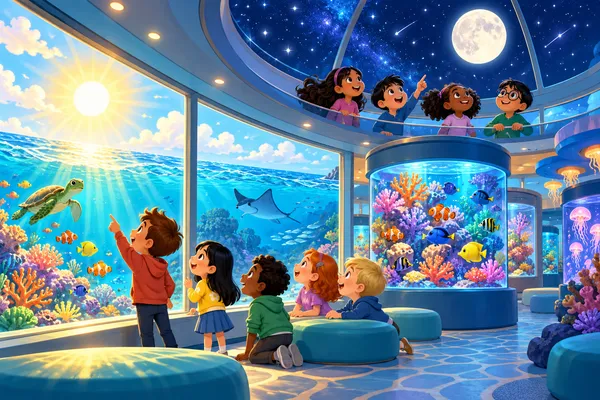
In Ms. Nia's coral reef classroom, students watched the sky from two stations. The glass-wall station was beside the sunlit reef tank. The roof-window station was above the dim evening tank.
For two clear school days, the class checked the glass-wall station at 8 a.m., noon, and 4 p.m. At 8 a.m., the sun was low in the east. At noon, it was high. At 4 p.m., it was low in the west. The same three observations happened on both days.
After dark, the class checked the roof-window station. On both nights, the moon was above the blue-coral sign at the early check. The class also saw stars on both clear nights.
- A. The glass-wall station
- B. The roof-window station
- C. The sunlit reef tank
- D. The blue-coral sign
On each clear day, how many times did the class check the sun at the glass-wall station? times
The preview shows the first questions. Unlock the worksheet to see all of it.
Related worksheets
 Worksheet
Grade 1
The Rooftop Sky Route
Earth & Space Science · 1-ESS1-1
Free14 questions
 Worksheet
Grade 1
The Lighthouse Sky Window Plan
Earth & Space Science · 1-ESS1-1
Premium15 questions
 Worksheet
Grade 1
Sky Notes at the Kitchen Serving Hatch
Earth & Space Science · 1-ESS1-1
Premium13 questions
 Worksheet
Grade 1
Sky Clues on the Classroom Easel
Earth & Space Science · 1-ESS1-1
Premium13 questions
 Worksheet
Grade 1
Sky Checks at Tide Pool Cove
Earth & Space Science · 1-ESS1-1
Premium13 questions
 Worksheet
Grade 1
Sky Cards for the Snowshoe Hut
Earth & Space Science · 1-ESS1-1
Premium13 questions