Grade 8 · Social StudiesHIS.8.3Premium
From Upper Sandusky to Kaw Point: A Wyandot Timeline, 1795–1855
Grade 8 westward expansion: a dated timeline follows the Wyandot from Ohio to Kaw Point through the Louisiana Purchase, removal and manifest destiny.
Preview
OwlSheets.com
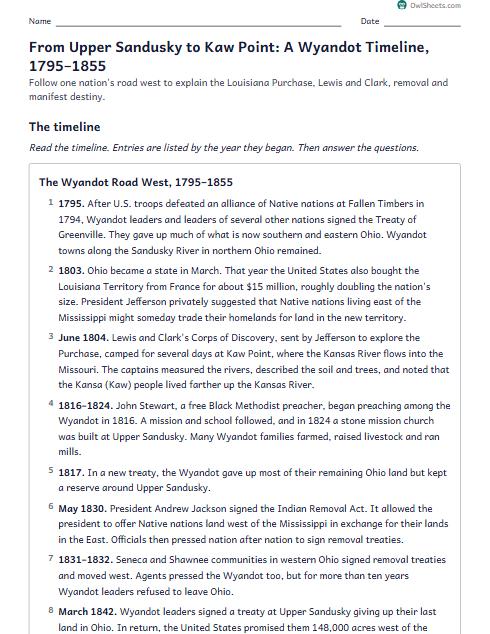
From Upper Sandusky to Kaw Point: A Wyandot Timeline, 1795–1855
Follow one nation's road west to explain the Louisiana Purchase, Lewis and Clark, removal and manifest destiny.
The timeline
Read the timeline. Entries are listed by the year they began. Then answer the questions.
The Wyandot Road West, 1795–1855
11795. After U.S. troops defeated an alliance of Native nations at Fallen Timbers in 1794, Wyandot leaders and leaders of several other nations signed the Treaty of Greenville. They gave up much of what is now southern and eastern Ohio. Wyandot towns along the Sandusky River in northern Ohio remained.
21803. Ohio became a state in March. That year the United States also bought the Louisiana Territory from France for about $15 million, roughly doubling the nation's size. President Jefferson privately suggested that Native nations living east of the Mississippi might someday trade their homelands for land in the new territory.
3June 1804. Lewis and Clark's Corps of Discovery, sent by Jefferson to explore the Purchase, camped for several days at Kaw Point, where the Kansas River flows into the Missouri. The captains measured the rivers, described the soil and trees, and noted that the Kansa (Kaw) people lived farther up the Kansas River.
41816–1824. John Stewart, a free Black Methodist preacher, began preaching among the Wyandot in 1816. A mission and school followed, and in 1824 a stone mission church was built at Upper Sandusky. Many Wyandot families farmed, raised livestock and ran mills.
51817. In a new treaty, the Wyandot gave up most of their remaining Ohio land but kept a reserve around Upper Sandusky.
6May 1830. President Andrew Jackson signed the Indian Removal Act. It allowed the president to offer Native nations land west of the Mississippi in exchange for their lands in the East. Officials then pressed nation after nation to sign removal treaties.
71831–1832. Seneca and Shawnee communities in western Ohio signed removal treaties and moved west. Agents pressed the Wyandot too, but for more than ten years Wyandot leaders refused to leave Ohio.
8March 1842. Wyandot leaders signed a treaty at Upper Sandusky giving up their last land in Ohio. In return, the United States promised them 148,000 acres west of the Mississippi, yearly payments, and payment for their houses, mills and farms.
9July 1843. About 700 Wyandot left Upper Sandusky, often called the last Native nation to leave Ohio under a treaty. They rode in wagons to Cincinnati and took steamboats down the Ohio and up the Mississippi and Missouri rivers. The land promised in 1842 had not been set aside for them when they arrived. They camped on low ground near the Missouri River, and many fell sick. Dozens died in the first year.
10December 1843. The Wyandot bought land at the fork of the Kansas and Missouri rivers, including Kaw Point, from the Delaware (Lenape) Nation. The Delaware had themselves been moved to Kansas from the East about 1830.
111845. Editor John L. O'Sullivan wrote that it was the nation's "manifest destiny to overspread the continent." Wagon trains bound for Oregon and Santa Fe outfitted in Westport and Independence, Missouri.
12May 1854. The Kansas-Nebraska Act created Kansas Territory and opened it to white settlers. Settlers and land companies wanted the rich land at the river fork.
13January 1855. In a new treaty, the Wyandot ended their national government in Kansas, divided their land among families, and many became U.S. citizens. Within a few years much of the land had passed to white buyers, and the town of Wyandotte grew there. Some Wyandot families later moved to Indian Territory, now Oklahoma.
- A. It closed the Mississippi River, so Ohio farmers needed more Wyandot land.
- B. It gave the government western land where eastern nations could later be sent.
- C. It made the Wyandot subjects of France until the purchase treaty was signed.
- D. It moved the western border of the new state of Ohio out to the Mississippi River.
The preview shows the first questions. Unlock the worksheet to see all of it.
Related worksheets
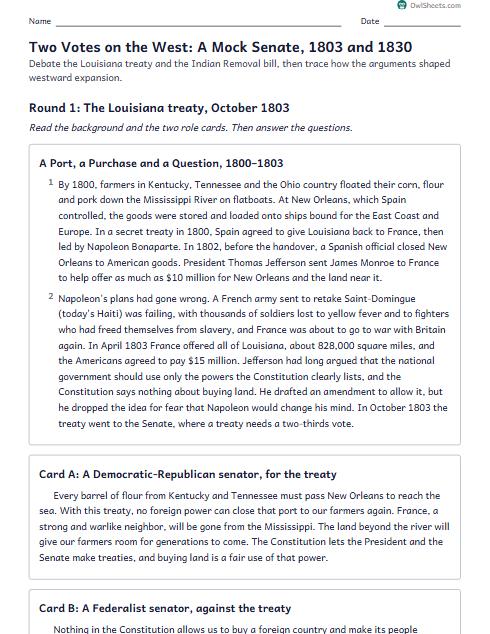
Two Votes on the West: A Mock Senate, 1803 and 1830
Grade 8 · HIS.8.3
14 questionsPremium
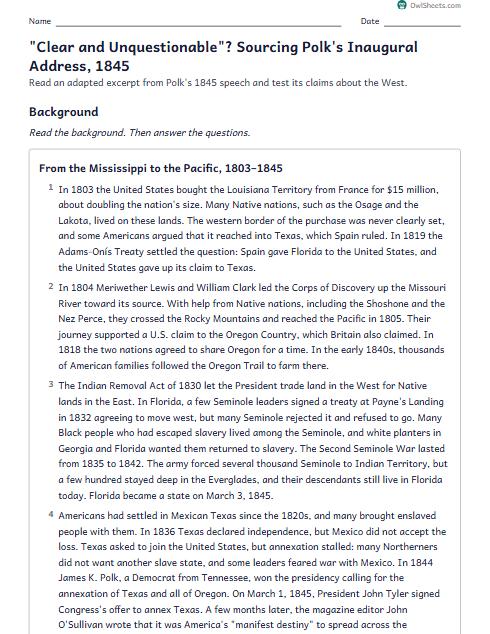
"Clear and Unquestionable"? Sourcing Polk's Inaugural Address, 1845
Grade 8 · HIS.8.3
14 questionsPremium
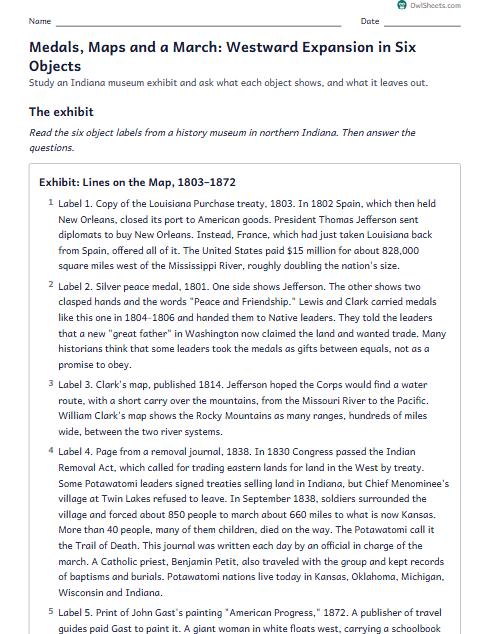
Medals, Maps and a March: Westward Expansion in Six Objects
Grade 8 · HIS.8.3
14 questionsPremium
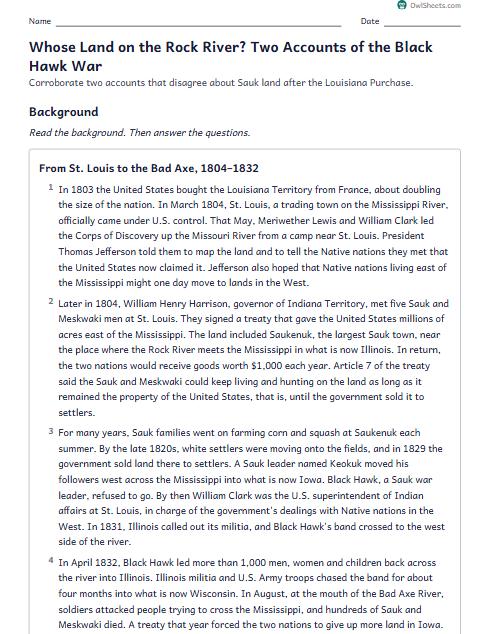
Whose Land on the Rock River? Two Accounts of the Black Hawk War
Grade 8 · HIS.8.3
13 questionsPremium
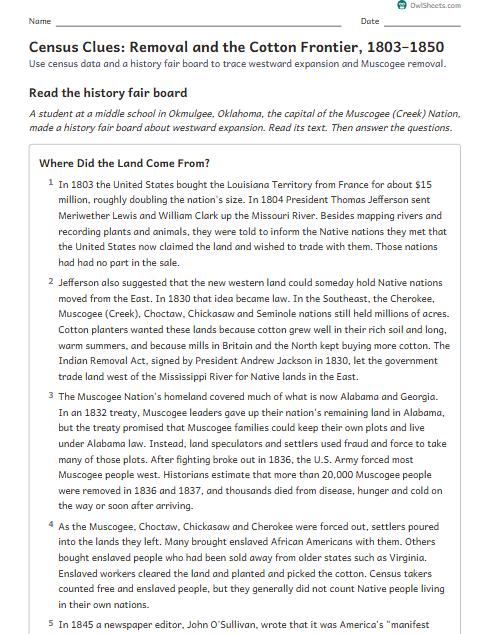
Census Clues: Removal and the Cotton Frontier, 1803–1850
Grade 8 · HIS.8.3
11 questionsFree
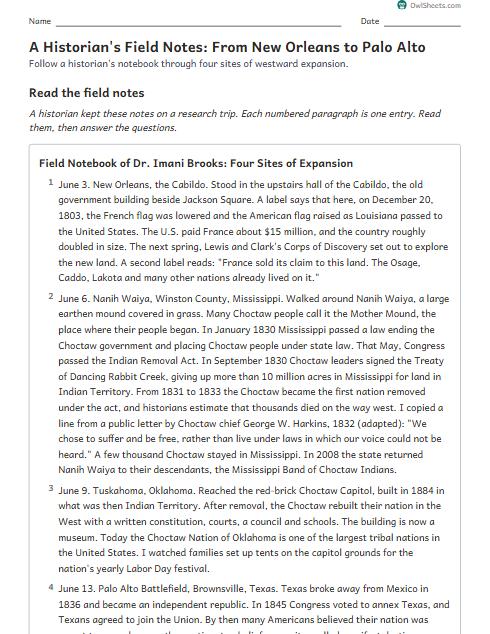
A Historian's Field Notes: From New Orleans to Palo Alto
Grade 8 · HIS.8.3
11 questionsPremium