Grade 8 · Social StudiesHIS.8.3Premium
Whose Land on the Rock River? Two Accounts of the Black Hawk War
Grade 8 westward expansion: from the Louisiana Purchase and Lewis and Clark to Sauk removal and manifest destiny, with two accounts of the Black Hawk War.
Preview
OwlSheets.com
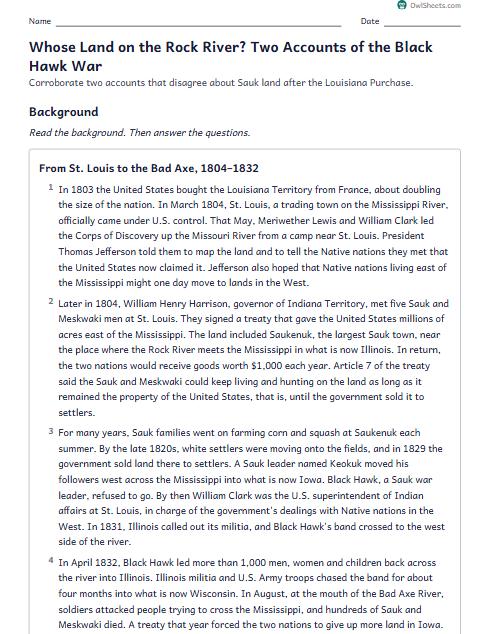
Whose Land on the Rock River? Two Accounts of the Black Hawk War
Corroborate two accounts that disagree about Sauk land after the Louisiana Purchase.
Background
Read the background. Then answer the questions.
From St. Louis to the Bad Axe, 1804–1832
1In 1803 the United States bought the Louisiana Territory from France, about doubling the size of the nation. In March 1804, St. Louis, a trading town on the Mississippi River, officially came under U.S. control. That May, Meriwether Lewis and William Clark led the Corps of Discovery up the Missouri River from a camp near St. Louis. President Thomas Jefferson told them to map the land and to tell the Native nations they met that the United States now claimed it. Jefferson also hoped that Native nations living east of the Mississippi might one day move to lands in the West.
2Later in 1804, William Henry Harrison, governor of Indiana Territory, met five Sauk and Meskwaki men at St. Louis. They signed a treaty that gave the United States millions of acres east of the Mississippi. The land included Saukenuk, the largest Sauk town, near the place where the Rock River meets the Mississippi in what is now Illinois. In return, the two nations would receive goods worth $1,000 each year. Article 7 of the treaty said the Sauk and Meskwaki could keep living and hunting on the land as long as it remained the property of the United States, that is, until the government sold it to settlers.
3For many years, Sauk families went on farming corn and squash at Saukenuk each summer. By the late 1820s, white settlers were moving onto the fields, and in 1829 the government sold land there to settlers. A Sauk leader named Keokuk moved his followers west across the Mississippi into what is now Iowa. Black Hawk, a Sauk war leader, refused to go. By then William Clark was the U.S. superintendent of Indian affairs at St. Louis, in charge of the government's dealings with Native nations in the West. In 1831, Illinois called out its militia, and Black Hawk's band crossed to the west side of the river.
4In April 1832, Black Hawk led more than 1,000 men, women and children back across the river into Illinois. Illinois militia and U.S. Army troops chased the band for about four months into what is now Wisconsin. In August, at the mouth of the Bad Axe River, soldiers attacked people trying to cross the Mississippi, and hundreds of Sauk and Meskwaki died. A treaty that year forced the two nations to give up more land in Iowa. In the 1840s, many Sauk and Meskwaki were moved again, to Kansas. Their nations still exist today, with homes in Oklahoma, Iowa, Kansas and Nebraska.
5The Indian Removal Act of 1830 let President Andrew Jackson trade land in the West for Native land in the East through treaties. In 1845, a New York editor, John L. O'Sullivan, wrote that Americans had a "manifest destiny" to spread across the continent.
- A. Harrison had been named governor of Louisiana by the French king.
- B. The Sauk had moved to St. Louis after Lewis and Clark arrived there.
- C. St. Louis had only just come under U.S. control after the Purchase.
- D. Congress had just passed the Indian Removal Act to allow such treaties.
- A. No, because the treaty said they had to leave as soon as it was signed.
- B. No, because Lewis and Clark had already claimed the land for settlers.
- C. Yes, because the government had not yet sold the land to settlers.
- D. Yes, because the treaty gave the land back to the Sauk after ten years.
The preview shows the first questions. Unlock the worksheet to see all of it.
Related worksheets
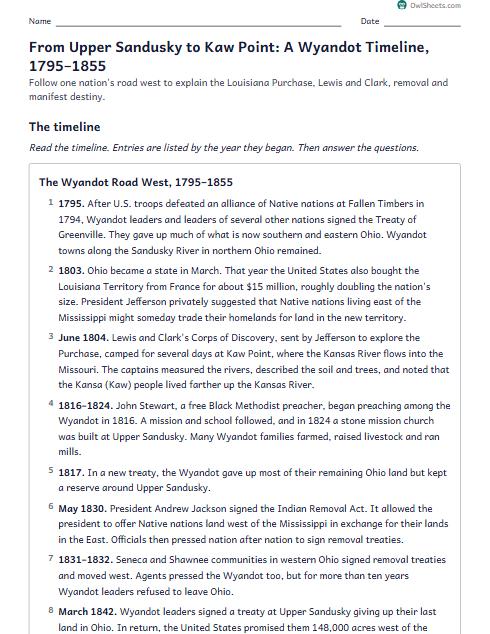
From Upper Sandusky to Kaw Point: A Wyandot Timeline, 1795–1855
Grade 8 · HIS.8.3
14 questionsPremium
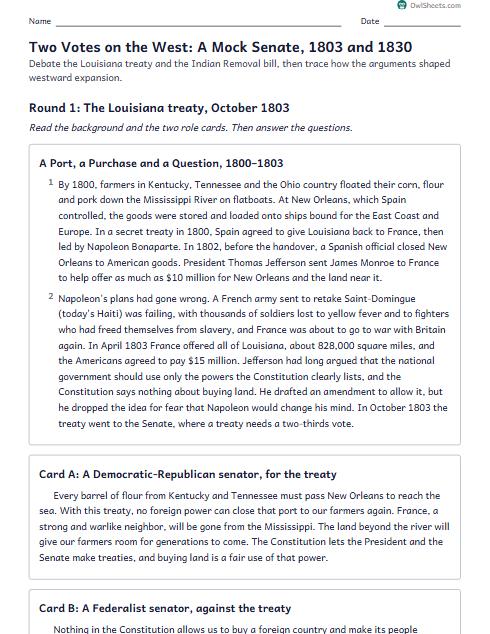
Two Votes on the West: A Mock Senate, 1803 and 1830
Grade 8 · HIS.8.3
14 questionsPremium
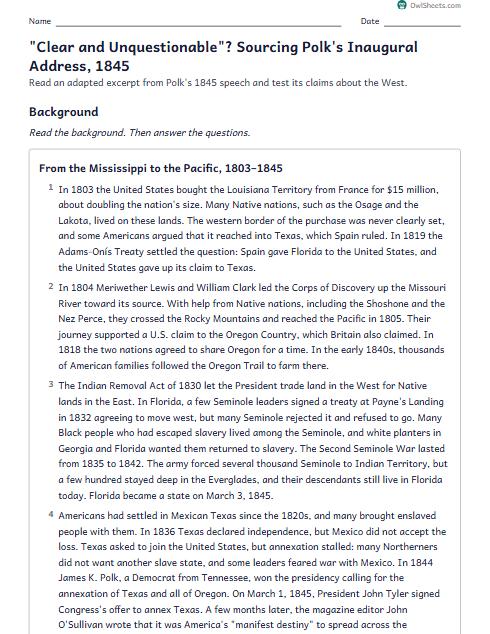
"Clear and Unquestionable"? Sourcing Polk's Inaugural Address, 1845
Grade 8 · HIS.8.3
14 questionsPremium
Medals, Maps and a March: Westward Expansion in Six Objects
Grade 8 · HIS.8.3
14 questionsPremium
Census Clues: Removal and the Cotton Frontier, 1803–1850
Grade 8 · HIS.8.3
11 questionsFree
A Historian's Field Notes: From New Orleans to Palo Alto
Grade 8 · HIS.8.3
11 questionsPremium