Grade 8 · Social StudiesHIS.8.3Premium
Two Votes on the West: A Mock Senate, 1803 and 1830
Grade 8 westward expansion: a mock Senate debates the Louisiana treaty and the Removal bill, with Lewis and Clark, vote data and manifest destiny.
Preview
OwlSheets.com
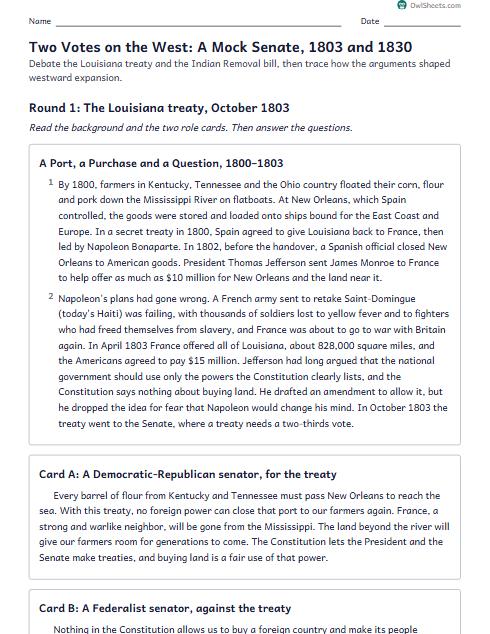
Two Votes on the West: A Mock Senate, 1803 and 1830
Debate the Louisiana treaty and the Indian Removal bill, then trace how the arguments shaped westward expansion.
Round 1: The Louisiana treaty, October 1803
Read the background and the two role cards. Then answer the questions.
A Port, a Purchase and a Question, 1800–1803
1By 1800, farmers in Kentucky, Tennessee and the Ohio country floated their corn, flour and pork down the Mississippi River on flatboats. At New Orleans, which Spain controlled, the goods were stored and loaded onto ships bound for the East Coast and Europe. In a secret treaty in 1800, Spain agreed to give Louisiana back to France, then led by Napoleon Bonaparte. In 1802, before the handover, a Spanish official closed New Orleans to American goods. President Thomas Jefferson sent James Monroe to France to help offer as much as $10 million for New Orleans and the land near it.
2Napoleon's plans had gone wrong. A French army sent to retake Saint-Domingue (today's Haiti) was failing, with thousands of soldiers lost to yellow fever and to fighters who had freed themselves from slavery, and France was about to go to war with Britain again. In April 1803 France offered all of Louisiana, about 828,000 square miles, and the Americans agreed to pay $15 million. Jefferson had long argued that the national government should use only the powers the Constitution clearly lists, and the Constitution says nothing about buying land. He drafted an amendment to allow it, but he dropped the idea for fear that Napoleon would change his mind. In October 1803 the treaty went to the Senate, where a treaty needs a two-thirds vote.
Card A: A Democratic-Republican senator, for the treaty
Every barrel of flour from Kentucky and Tennessee must pass New Orleans to reach the sea. With this treaty, no foreign power can close that port to our farmers again. France, a strong and warlike neighbor, will be gone from the Mississippi. The land beyond the river will give our farmers room for generations to come. The Constitution lets the President and the Senate make treaties, and buying land is a fair use of that power.
Card B: A Federalist senator, against the treaty
Nothing in the Constitution allows us to buy a foreign country and make its people citizens without the consent of the states. Fifteen million dollars is a heavy debt for forests and plains that few of us will ever see. Spread our people over so vast a land, and the republic will grow too large to hold together. New states carved from this territory will soon outvote the old states of the East. We do not even know where the borders of this purchase lie.
The preview shows the first questions. Unlock the worksheet to see all of it.
Related worksheets
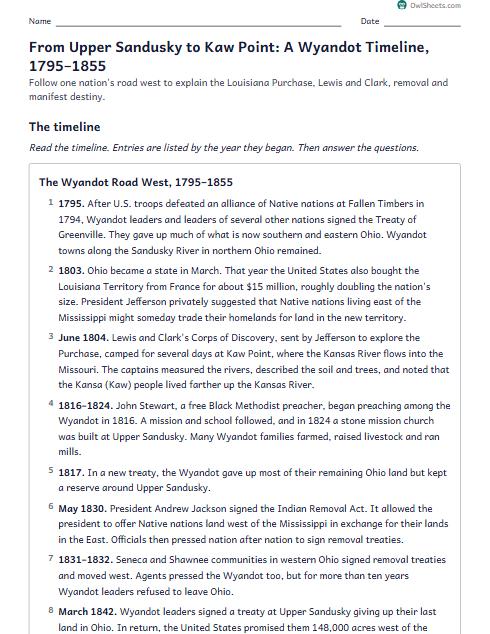
From Upper Sandusky to Kaw Point: A Wyandot Timeline, 1795–1855
Grade 8 · HIS.8.3
14 questionsPremium
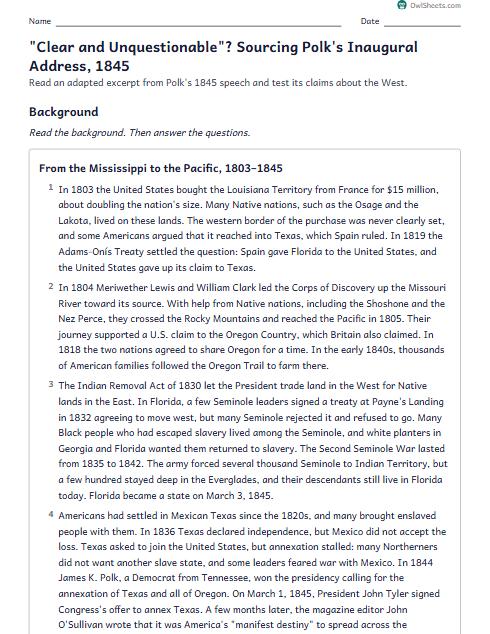
"Clear and Unquestionable"? Sourcing Polk's Inaugural Address, 1845
Grade 8 · HIS.8.3
14 questionsPremium
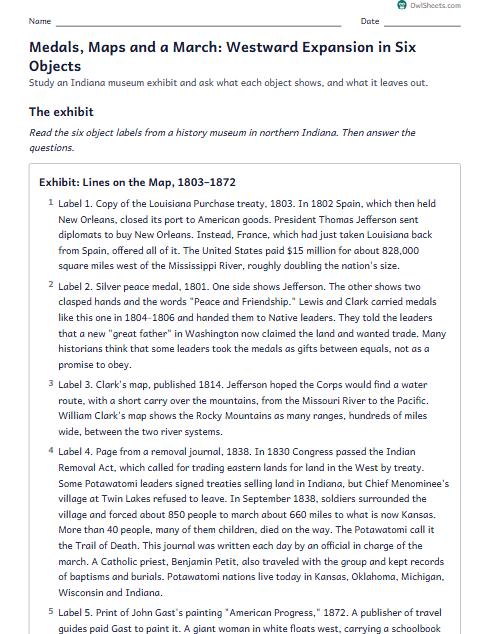
Medals, Maps and a March: Westward Expansion in Six Objects
Grade 8 · HIS.8.3
14 questionsPremium
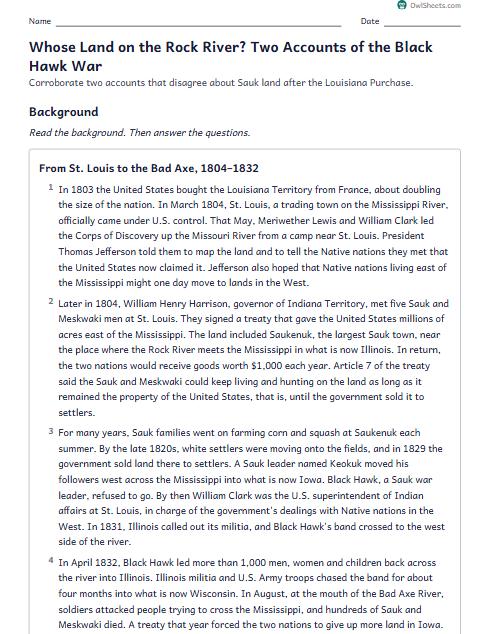
Whose Land on the Rock River? Two Accounts of the Black Hawk War
Grade 8 · HIS.8.3
13 questionsPremium
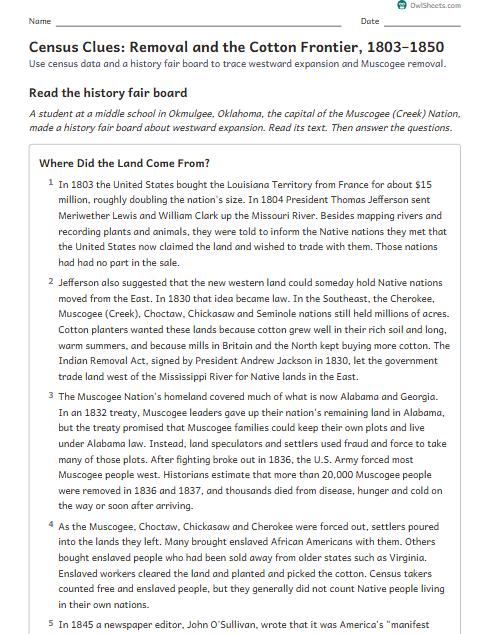
Census Clues: Removal and the Cotton Frontier, 1803–1850
Grade 8 · HIS.8.3
11 questionsFree
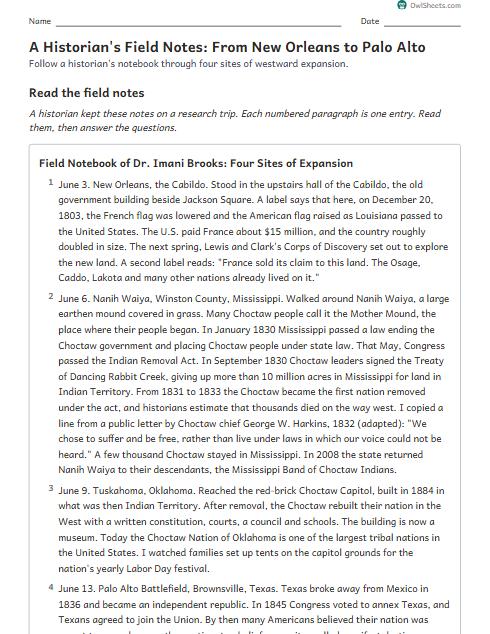
A Historian's Field Notes: From New Orleans to Palo Alto
Grade 8 · HIS.8.3
11 questionsPremium