Grade 7 · Social StudiesGEO.7.3Premium
Twenty-Five Days by Ox Wagon: A Merchant's Road to Cathay
Grade 7 geography: read a table of travel days from Pegolotti's handbook of about 1340 and trace how three trade networks spread goods, ideas and plague.
Preview
OwlSheets.com
Twenty-Five Days by Ox Wagon: A Merchant's Road to Cathay
Use a merchant handbook's table of travel days to trace three trade networks and what they carried.
A merchant's handbook
Read the passage and the excerpt. Then answer the questions.
From Tana to Cathay
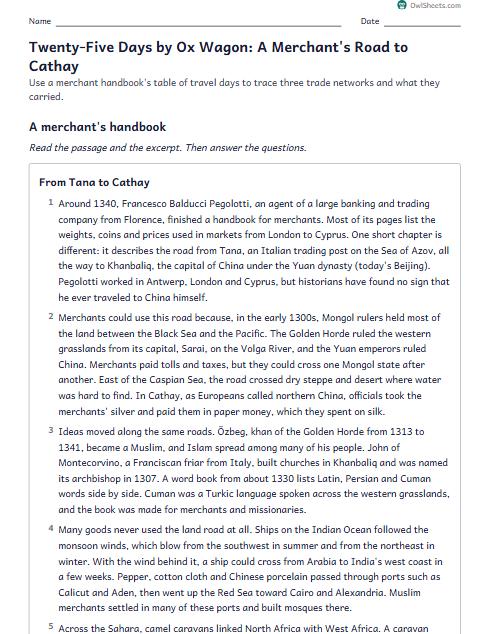
1Around 1340, Francesco Balducci Pegolotti, an agent of a large banking and trading company from Florence, finished a handbook for merchants. Most of its pages list the weights, coins and prices used in markets from London to Cyprus. One short chapter is different: it describes the road from Tana, an Italian trading post on the Sea of Azov, all the way to Khanbaliq, the capital of China under the Yuan dynasty (today's Beijing). Pegolotti worked in Antwerp, London and Cyprus, but historians have found no sign that he ever traveled to China himself.
2Merchants could use this road because, in the early 1300s, Mongol rulers held most of the land between the Black Sea and the Pacific. The Golden Horde ruled the western grasslands from its capital, Sarai, on the Volga River, and the Yuan emperors ruled China. Merchants paid tolls and taxes, but they could cross one Mongol state after another. East of the Caspian Sea, the road crossed dry steppe and desert where water was hard to find. In Cathay, as Europeans called northern China, officials took the merchants' silver and paid them in paper money, which they spent on silk.
3Ideas moved along the same roads. Özbeg, khan of the Golden Horde from 1313 to 1341, became a Muslim, and Islam spread among many of his people. John of Montecorvino, a Franciscan friar from Italy, built churches in Khanbaliq and was named its archbishop in 1307. A word book from about 1330 lists Latin, Persian and Cuman words side by side. Cuman was a Turkic language spoken across the western grasslands, and the book was made for merchants and missionaries.
4Many goods never used the land road at all. Ships on the Indian Ocean followed the monsoon winds, which blow from the southwest in summer and from the northeast in winter. With the wind behind it, a ship could cross from Arabia to India's west coast in a few weeks. Pepper, cotton cloth and Chinese porcelain passed through ports such as Calicut and Aden, then went up the Red Sea toward Cairo and Alexandria. Muslim merchants settled in many of these ports and built mosques there.
5Across the Sahara, camel caravans linked North Africa with West Africa. A caravan from Sijilmasa, in today's Morocco, took about two months to reach Walata, a market town of the kingdom of Mali, and stopped at the salt mines of Taghaza on the way. Salt went south and gold came north. Camels can go many days without water, so caravans could cross stretches of desert that oxen could not. Muslim traders and scholars traveled with the caravans, and books on Islamic law were sold in Mali's towns.
6In the 1340s, the roads carried something no merchant wanted. Historians think plague moved west across the lands of the Golden Horde. In 1346 it broke out among the khan's soldiers who were besieging Caffa, a Genoese port on the Black Sea. Ships from the Black Sea brought it to Constantinople in 1347 and to Sicily and Egypt soon after. After the Yuan dynasty fell in 1368, the land road to China grew much harder to use.
Excerpt: "First, you should let your beard grow long and not shave. At Tana, hire a good interpreter, and do not try to save money by taking a poor one. The road from Tana to Cathay is perfectly safe, by day and by night, according to what the merchants say who have used it. If a merchant dies on the road, everything he carries goes to the lord of the land where he dies. Whatever silver you carry to Cathay, the lord of Cathay takes into his treasury and gives you paper money in exchange. With this paper money you can buy silk and any other goods you want."
- A. Chinese emperors ruled the grasslands as far as the Volga.
- B. The road ran mostly by sea, so no rulers could tax it.
- C. One Italian city ruled the trading posts along the road.
- D. Mongol rulers held most of the lands the road crossed.
The preview shows the first questions. Unlock the worksheet to see all of it.
Related worksheets
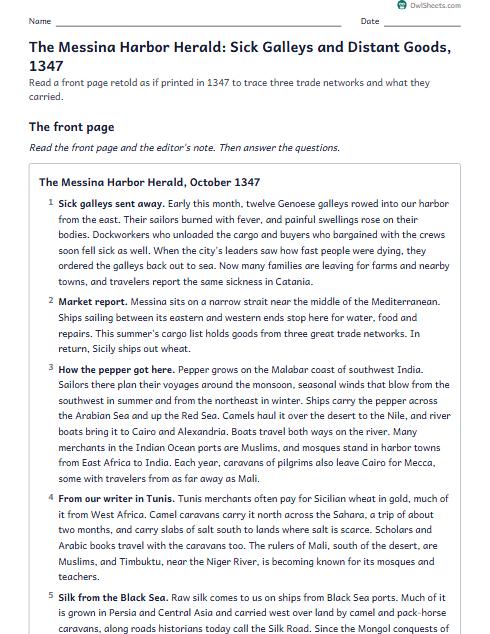
The Messina Harbor Herald: Sick Galleys and Distant Goods, 1347
Grade 7 · GEO.7.3
14 questionsPremium
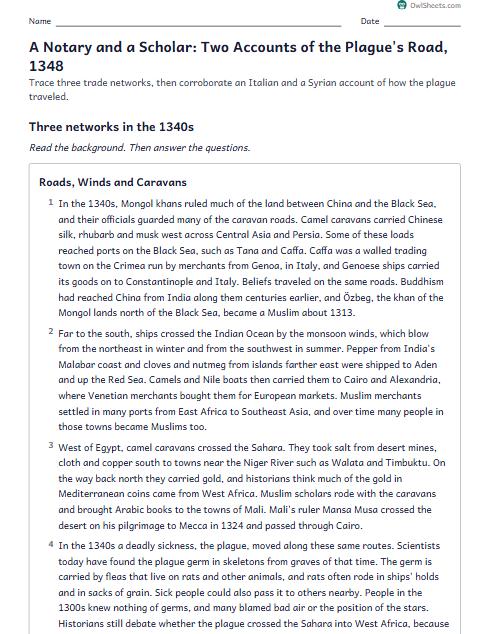
A Notary and a Scholar: Two Accounts of the Plague's Road, 1348
Grade 7 · GEO.7.3
16 questionsPremium
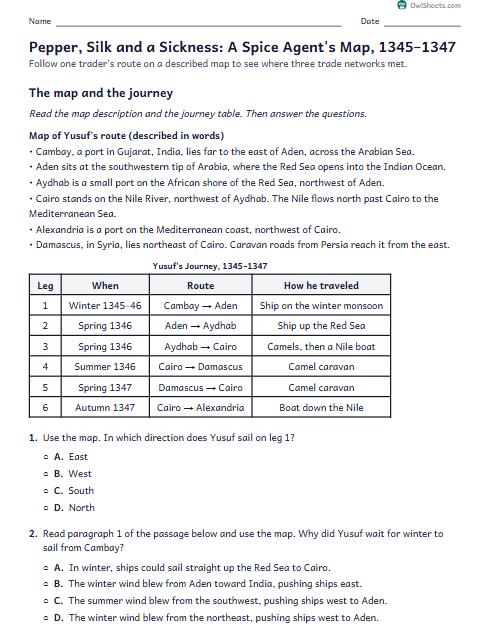
Pepper, Silk and a Sickness: A Spice Agent's Map, 1345–1347
Grade 7 · GEO.7.3
15 questionsPremium
Three Crossroads in the Dust: Field Notes from Merv, Sijilmasa and Kilwa
Grade 7 · GEO.7.3
14 questionsPremium
Bowls, Books and a Gravestone: A Gallery of Trade Routes
Grade 7 · GEO.7.3
12 questionsPremium
Thirty Days Outside the Walls: Ragusa's Plague Council, 1377
Grade 7 · GEO.7.3
11 questionsFree