Grade 7 · Social StudiesGEO.7.3Premium
Three Crossroads in the Dust: Field Notes from Merv, Sijilmasa and Kilwa
Grade 7 geography: a historian's field notes from Merv, Sijilmasa and Kilwa trace how three trade networks spread goods, ideas and disease.
Preview
OwlSheets.com
Three Crossroads in the Dust: Field Notes from Merv, Sijilmasa and Kilwa
Follow a historian's notebook to an oasis, a desert gate and an island port.
Read the field notes
Read the historian's field notes and the table. Then answer the questions.
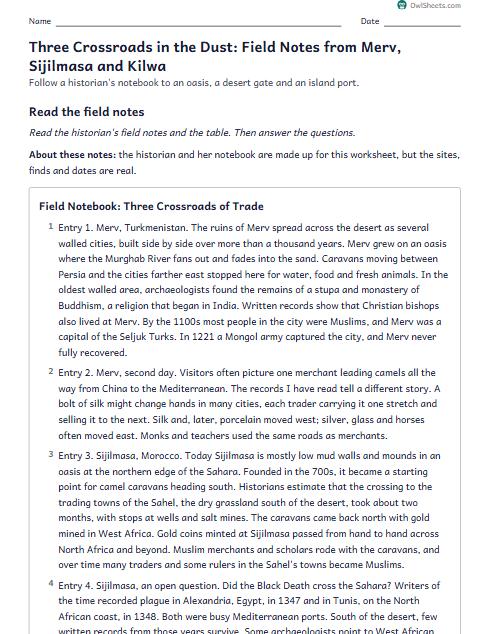
Field Notebook: Three Crossroads of Trade
1Entry 1. Merv, Turkmenistan. The ruins of Merv spread across the desert as several walled cities, built side by side over more than a thousand years. Merv grew on an oasis where the Murghab River fans out and fades into the sand. Caravans moving between Persia and the cities farther east stopped here for water, food and fresh animals. In the oldest walled area, archaeologists found the remains of a stupa and monastery of Buddhism, a religion that began in India. Written records show that Christian bishops also lived at Merv. By the 1100s most people in the city were Muslims, and Merv was a capital of the Seljuk Turks. In 1221 a Mongol army captured the city, and Merv never fully recovered.
2Entry 2. Merv, second day. Visitors often picture one merchant leading camels all the way from China to the Mediterranean. The records I have read tell a different story. A bolt of silk might change hands in many cities, each trader carrying it one stretch and selling it to the next. Silk and, later, porcelain moved west; silver, glass and horses often moved east. Monks and teachers used the same roads as merchants.
3Entry 3. Sijilmasa, Morocco. Today Sijilmasa is mostly low mud walls and mounds in an oasis at the northern edge of the Sahara. Founded in the 700s, it became a starting point for camel caravans heading south. Historians estimate that the crossing to the trading towns of the Sahel, the dry grassland south of the desert, took about two months, with stops at wells and salt mines. The caravans came back north with gold mined in West Africa. Gold coins minted at Sijilmasa passed from hand to hand across North Africa and beyond. Muslim merchants and scholars rode with the caravans, and over time many traders and some rulers in the Sahel's towns became Muslims.
4Entry 4. Sijilmasa, an open question. Did the Black Death cross the Sahara? Writers of the time recorded plague in Alexandria, Egypt, in 1347 and in Tunis, on the North African coast, in 1348. Both were busy Mediterranean ports. South of the desert, few written records from those years survive. Some archaeologists point to West African towns that were abandoned in the late 1300s, but a long drought or a war could also empty a town. For now I am marking this question unsettled.
5Entry 5. Kilwa Kisiwani, Tanzania. Kilwa stands on a small island just off the coast of East Africa, with a sheltered harbor on the Indian Ocean. From about the 1100s to the 1400s it was one of the richest towns on the Swahili coast. Gold mined far inland, in the region of Great Zimbabwe, reached the port of Sofala, farther south, and much of it was traded on by Kilwa's merchants. In the ruins of the Great Mosque and of a palace called Husuni Kubwa, archaeologists have found pieces of Chinese porcelain, glass beads and glazed pottery from the Persian Gulf.
6Entry 6. Kilwa, waiting for the wind. The sailing calendar of this coast was set by the monsoon winds (see the table). A ship from Arabia or India usually could not sail home the week after it arrived; its crew waited months for the wind to turn. Many traders lived in the coastal towns during that wait, and some married into local families and prayed in local mosques. Over the centuries Swahili, an African language of the Bantu family, took in many words from Arabic, and most people of the coastal towns became Muslims.
| Months | Wind blows from the | Ships can sail toward |
|---|---|---|
| November to March | northeast | Africa, from Arabia and India |
| April to September | southwest | ? |
The preview shows the first questions. Unlock the worksheet to see all of it.
Related worksheets
The Messina Harbor Herald: Sick Galleys and Distant Goods, 1347
Grade 7 · GEO.7.3
14 questionsPremium
A Notary and a Scholar: Two Accounts of the Plague's Road, 1348
Grade 7 · GEO.7.3
16 questionsPremium
Twenty-Five Days by Ox Wagon: A Merchant's Road to Cathay
Grade 7 · GEO.7.3
16 questionsPremium
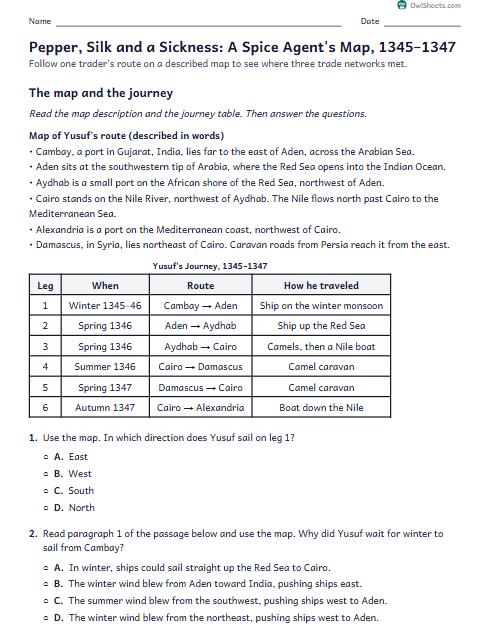
Pepper, Silk and a Sickness: A Spice Agent's Map, 1345–1347
Grade 7 · GEO.7.3
15 questionsPremium
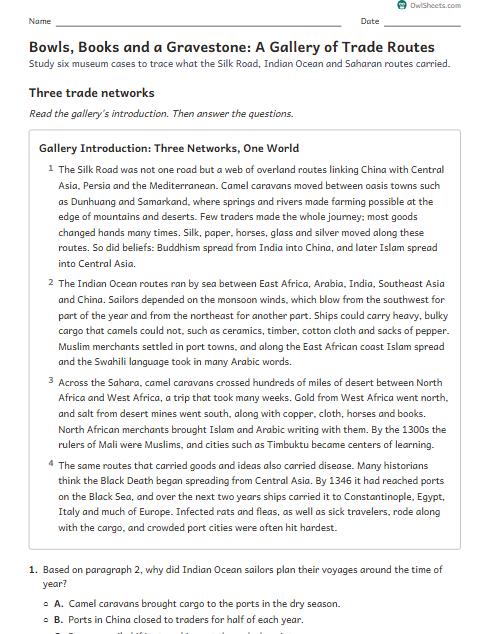
Bowls, Books and a Gravestone: A Gallery of Trade Routes
Grade 7 · GEO.7.3
12 questionsPremium
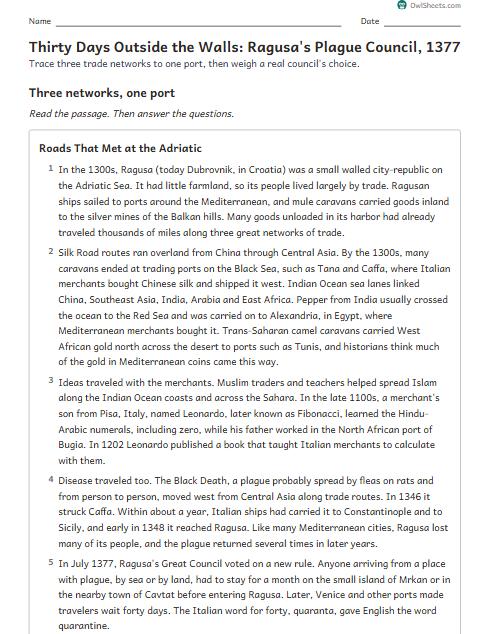
Thirty Days Outside the Walls: Ragusa's Plague Council, 1377
Grade 7 · GEO.7.3
11 questionsFree