Grade 7 · Social StudiesGEO.7.3Premium
A Notary and a Scholar: Two Accounts of the Plague's Road, 1348
Grade 7 geography: trace the Silk Road, Indian Ocean and Saharan routes, then compare two 1348 accounts that disagree about how the plague traveled.
Preview
OwlSheets.com
A Notary and a Scholar: Two Accounts of the Plague's Road, 1348
Trace three trade networks, then corroborate an Italian and a Syrian account of how the plague traveled.
Three networks in the 1340s
Read the background. Then answer the questions.
Roads, Winds and Caravans
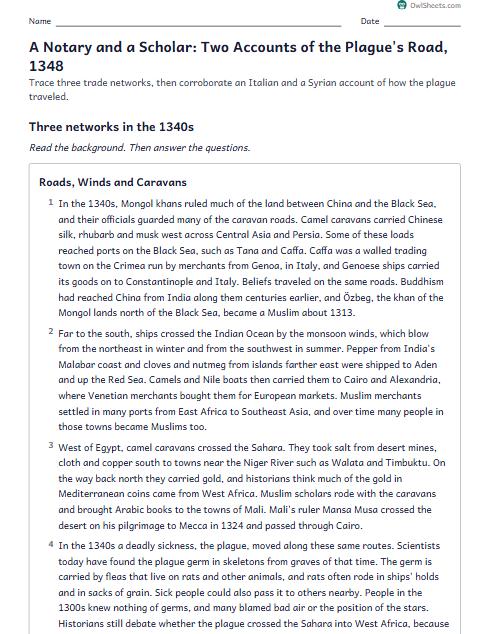
1In the 1340s, Mongol khans ruled much of the land between China and the Black Sea, and their officials guarded many of the caravan roads. Camel caravans carried Chinese silk, rhubarb and musk west across Central Asia and Persia. Some of these loads reached ports on the Black Sea, such as Tana and Caffa. Caffa was a walled trading town on the Crimea run by merchants from Genoa, in Italy, and Genoese ships carried its goods on to Constantinople and Italy. Beliefs traveled on the same roads. Buddhism had reached China from India along them centuries earlier, and Özbeg, the khan of the Mongol lands north of the Black Sea, became a Muslim about 1313.
2Far to the south, ships crossed the Indian Ocean by the monsoon winds, which blow from the northeast in winter and from the southwest in summer. Pepper from India's Malabar coast and cloves and nutmeg from islands farther east were shipped to Aden and up the Red Sea. Camels and Nile boats then carried them to Cairo and Alexandria, where Venetian merchants bought them for European markets. Muslim merchants settled in many ports from East Africa to Southeast Asia, and over time many people in those towns became Muslims too.
3West of Egypt, camel caravans crossed the Sahara. They took salt from desert mines, cloth and copper south to towns near the Niger River such as Walata and Timbuktu. On the way back north they carried gold, and historians think much of the gold in Mediterranean coins came from West Africa. Muslim scholars rode with the caravans and brought Arabic books to the towns of Mali. Mali's ruler Mansa Musa crossed the desert on his pilgrimage to Mecca in 1324 and passed through Cairo.
4In the 1340s a deadly sickness, the plague, moved along these same routes. Scientists today have found the plague germ in skeletons from graves of that time. The germ is carried by fleas that live on rats and other animals, and rats often rode in ships' holds and in sacks of grain. Sick people could also pass it to others nearby. People in the 1300s knew nothing of germs, and many blamed bad air or the position of the stars. Historians still debate whether the plague crossed the Sahara into West Africa, because few written records from there survive.
- A. By ship to Aden and the Red Sea, then by camel and Nile boat
- B. By ship around the southern tip of Africa into the Mediterranean
- C. By caravan along the Silk Road to Caffa, then by a Genoese ship
- D. By camel caravan north across the Sahara from Timbuktu
- A. Both crossed the Sahara on camels to North Africa and then went north by ship.
- B. The silk crossed Asia to the Black Sea, and the gold crossed the Sahara to the north.
- C. Both came up the Red Sea from India and were sold in the markets of Cairo.
- D. The silk crossed the Sahara from Timbuktu, and the gold was shipped from Caffa.
The preview shows the first questions. Unlock the worksheet to see all of it.
Related worksheets
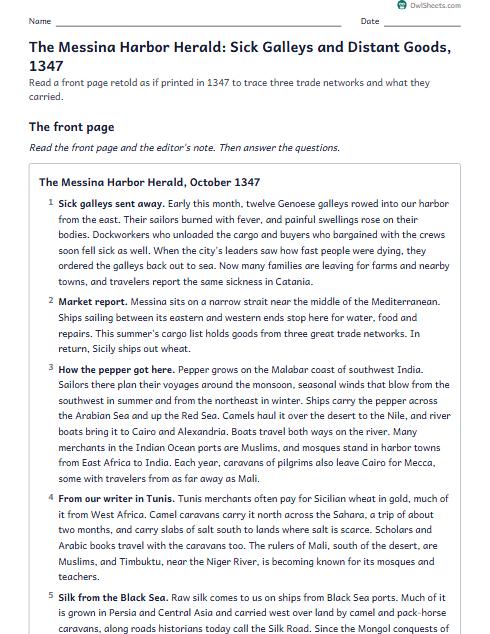
The Messina Harbor Herald: Sick Galleys and Distant Goods, 1347
Grade 7 · GEO.7.3
14 questionsPremium
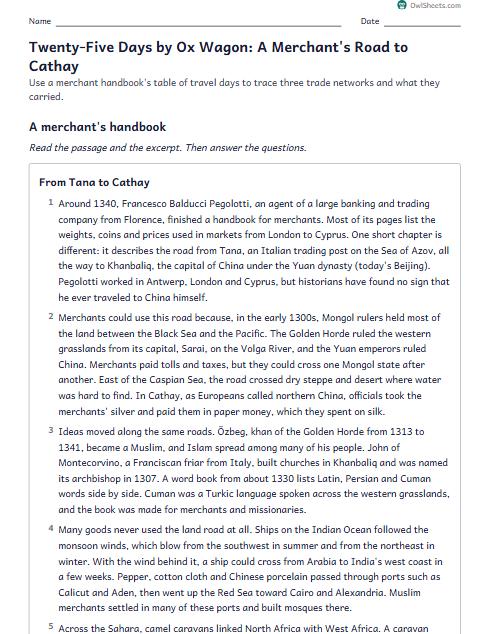
Twenty-Five Days by Ox Wagon: A Merchant's Road to Cathay
Grade 7 · GEO.7.3
16 questionsPremium
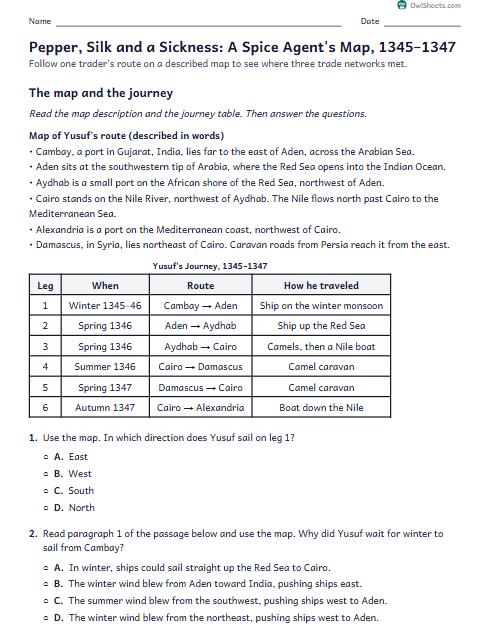
Pepper, Silk and a Sickness: A Spice Agent's Map, 1345–1347
Grade 7 · GEO.7.3
15 questionsPremium
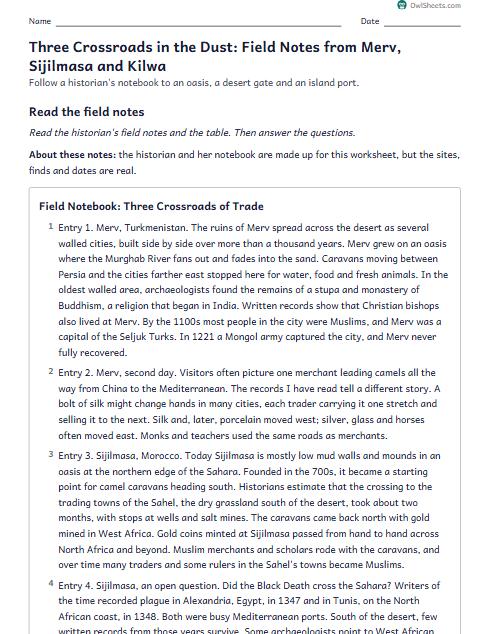
Three Crossroads in the Dust: Field Notes from Merv, Sijilmasa and Kilwa
Grade 7 · GEO.7.3
14 questionsPremium
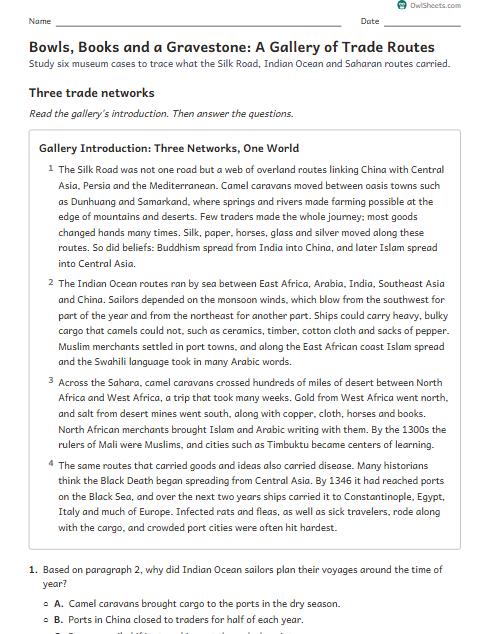
Bowls, Books and a Gravestone: A Gallery of Trade Routes
Grade 7 · GEO.7.3
12 questionsPremium
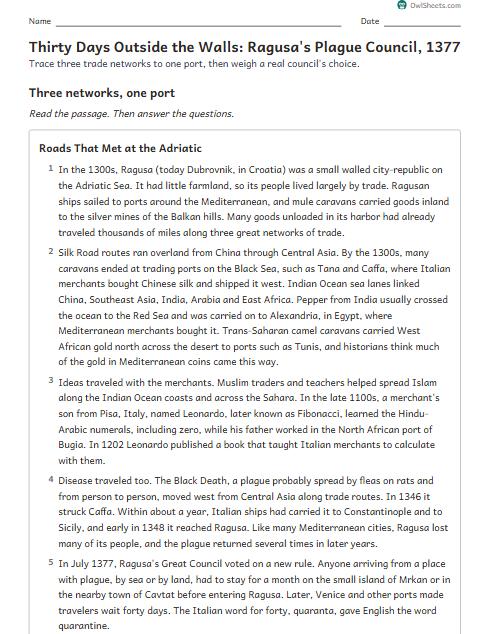
Thirty Days Outside the Walls: Ragusa's Plague Council, 1377
Grade 7 · GEO.7.3
11 questionsFree