Grade 7 · Social StudiesGEO.7.3Premium
The Messina Harbor Herald: Sick Galleys and Distant Goods, 1347
Grade 7 geography: a front page retold from Messina in 1347 traces Silk Road, Indian Ocean and Saharan routes that carried goods, ideas and plague.
Preview
OwlSheets.com
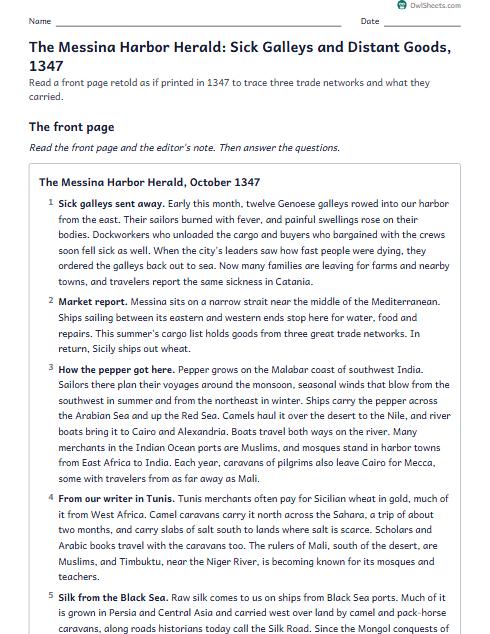
The Messina Harbor Herald: Sick Galleys and Distant Goods, 1347
Read a front page retold as if printed in 1347 to trace three trade networks and what they carried.
The front page
Read the front page and the editor's note. Then answer the questions.
The Messina Harbor Herald, October 1347
1Sick galleys sent away. Early this month, twelve Genoese galleys rowed into our harbor from the east. Their sailors burned with fever, and painful swellings rose on their bodies. Dockworkers who unloaded the cargo and buyers who bargained with the crews soon fell sick as well. When the city's leaders saw how fast people were dying, they ordered the galleys back out to sea. Now many families are leaving for farms and nearby towns, and travelers report the same sickness in Catania.
2Market report. Messina sits on a narrow strait near the middle of the Mediterranean. Ships sailing between its eastern and western ends stop here for water, food and repairs. This summer's cargo list holds goods from three great trade networks. In return, Sicily ships out wheat.
3How the pepper got here. Pepper grows on the Malabar coast of southwest India. Sailors there plan their voyages around the monsoon, seasonal winds that blow from the southwest in summer and from the northeast in winter. Ships carry the pepper across the Arabian Sea and up the Red Sea. Camels haul it over the desert to the Nile, and river boats bring it to Cairo and Alexandria. Boats travel both ways on the river. Many merchants in the Indian Ocean ports are Muslims, and mosques stand in harbor towns from East Africa to India. Each year, caravans of pilgrims also leave Cairo for Mecca, some with travelers from as far away as Mali.
4From our writer in Tunis. Tunis merchants often pay for Sicilian wheat in gold, much of it from West Africa. Camel caravans carry it north across the Sahara, a trip of about two months, and carry slabs of salt south to lands where salt is scarce. Scholars and Arabic books travel with the caravans too. The rulers of Mali, south of the desert, are Muslims, and Timbuktu, near the Niger River, is becoming known for its mosques and teachers.
5Silk from the Black Sea. Raw silk comes to us on ships from Black Sea ports. Much of it is grown in Persia and Central Asia and carried west over land by camel and pack-horse caravans, along roads historians today call the Silk Road. Since the Mongol conquests of the 1200s, merchants have crossed those lands more safely, though wars among the khans have made some roads dangerous again. On the way home, Black Sea ships pass through the strait at Constantinople. Travelers say a deadly sickness broke out last year among a Mongol army near the Black Sea.
6From our past. In 1154, al-Idrisi finished a world map and geography book for King Roger II at Palermo. Al-Idrisi, a Muslim scholar born in North Africa, had not visited most of the lands he described. Instead, he questioned merchants, sailors and pilgrims who stopped in Sicily and compared their reports. When Arab rulers held the island, before the Normans, farmers here began to grow sugar cane, lemons, bitter oranges and cotton, crops first raised in and around India.
- A. Catania's sickness was a different illness from the one in Messina.
- B. The sickness reached Catania first and then came on to Messina.
- C. People leaving Messina may have carried the sickness to other towns.
- D. Sending the galleys back out to sea had kept the sickness from spreading.
The preview shows the first questions. Unlock the worksheet to see all of it.
Related worksheets
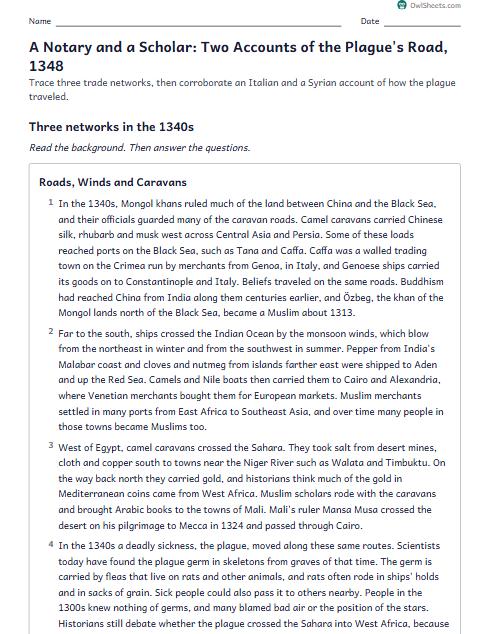
A Notary and a Scholar: Two Accounts of the Plague's Road, 1348
Grade 7 · GEO.7.3
16 questionsPremium
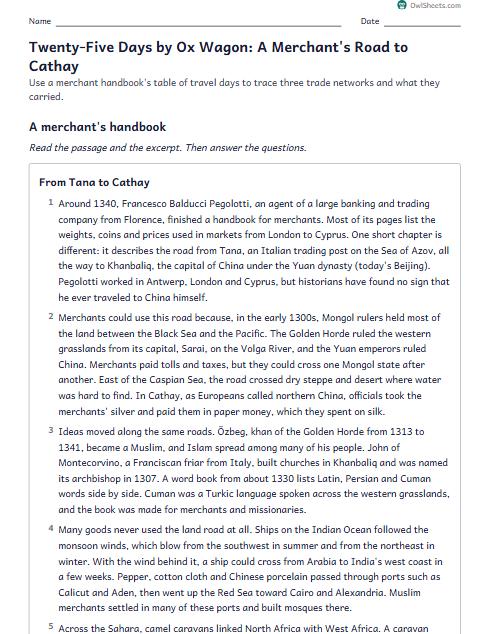
Twenty-Five Days by Ox Wagon: A Merchant's Road to Cathay
Grade 7 · GEO.7.3
16 questionsPremium
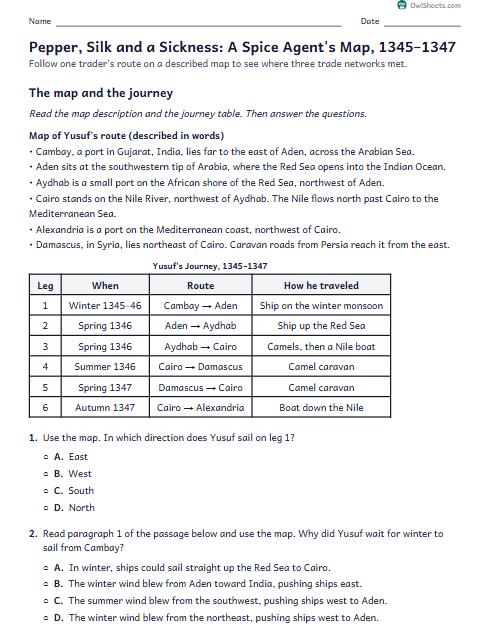
Pepper, Silk and a Sickness: A Spice Agent's Map, 1345–1347
Grade 7 · GEO.7.3
15 questionsPremium
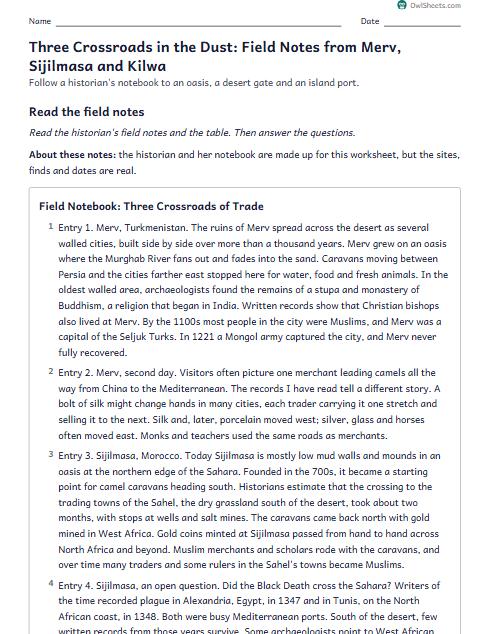
Three Crossroads in the Dust: Field Notes from Merv, Sijilmasa and Kilwa
Grade 7 · GEO.7.3
14 questionsPremium
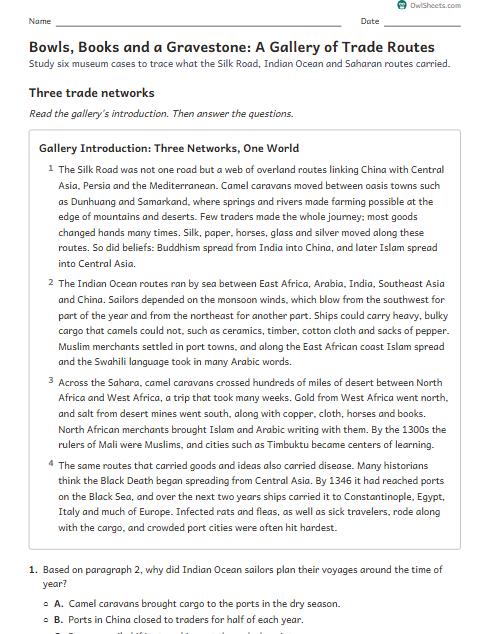
Bowls, Books and a Gravestone: A Gallery of Trade Routes
Grade 7 · GEO.7.3
12 questionsPremium
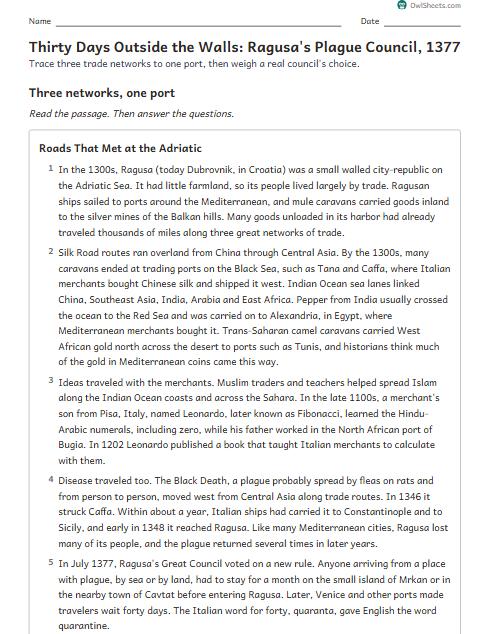
Thirty Days Outside the Walls: Ragusa's Plague Council, 1377
Grade 7 · GEO.7.3
11 questionsFree