Grade 7 · Social StudiesCIV.7.3Premium
Up the Grand Canal: A Ming Scholar's Road to Office
Grade 7 civics: follow an imagined Ming scholar from Suzhou up the Grand Canal to Beijing to see how exams and posting rules governed China.
Preview
OwlSheets.com
Up the Grand Canal: A Ming Scholar's Road to Office
Follow one candidate across a described map to see how exams and posting rules helped govern Ming China.
The journey
Read Wen Bao's journey. Use the directions in each stop as your map. Then answer the questions.
Wen Bao's Road to Office, 1549–1551
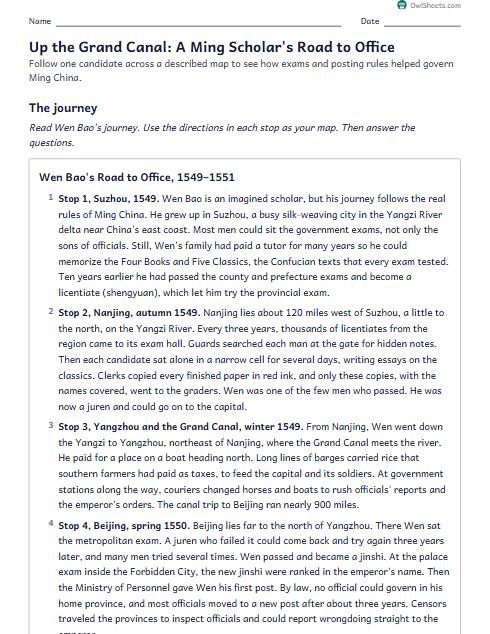
1Stop 1, Suzhou, 1549. Wen Bao is an imagined scholar, but his journey follows the real rules of Ming China. He grew up in Suzhou, a busy silk-weaving city in the Yangzi River delta near China's east coast. Most men could sit the government exams, not only the sons of officials. Still, Wen's family had paid a tutor for many years so he could memorize the Four Books and Five Classics, the Confucian texts that every exam tested. Ten years earlier he had passed the county and prefecture exams and become a licentiate (shengyuan), which let him try the provincial exam.
2Stop 2, Nanjing, autumn 1549. Nanjing lies about 120 miles west of Suzhou, a little to the north, on the Yangzi River. Every three years, thousands of licentiates from the region came to its exam hall. Guards searched each man at the gate for hidden notes. Then each candidate sat alone in a narrow cell for several days, writing essays on the classics. Clerks copied every finished paper in red ink, and only these copies, with the names covered, went to the graders. Wen was one of the few men who passed. He was now a juren and could go on to the capital.
3Stop 3, Yangzhou and the Grand Canal, winter 1549. From Nanjing, Wen went down the Yangzi to Yangzhou, northeast of Nanjing, where the Grand Canal meets the river. He paid for a place on a boat heading north. Long lines of barges carried rice that southern farmers had paid as taxes, to feed the capital and its soldiers. At government stations along the way, couriers changed horses and boats to rush officials' reports and the emperor's orders. The canal trip to Beijing ran nearly 900 miles.
4Stop 4, Beijing, spring 1550. Beijing lies far to the north of Yangzhou. There Wen sat the metropolitan exam. A juren who failed it could come back and try again three years later, and many men tried several times. Wen passed and became a jinshi. At the palace exam inside the Forbidden City, the new jinshi were ranked in the emperor's name. Then the Ministry of Personnel gave Wen his first post. By law, no official could govern in his home province, and most officials moved to a new post after about three years. Censors traveled the provinces to inspect officials and could report wrongdoing straight to the emperor.
5Stop 5, Guangxi, 1551. Wen's post was a county in Guangxi province, in China's far south. As magistrate he collected taxes, judged cases and kept order for many thousands of people. He could not understand the local speech well, so he depended on local clerks. Every month or so, his reports went north to Beijing by courier.
- A. From Suzhou to Nanjing
- B. From Nanjing to Yangzhou
- C. From Beijing to Guangxi
- D. From Yangzhou to Beijing
- A. So candidates could take their own papers home to study again
- B. So graders could not tell whose paper was whose from the writing
- C. So the essays could be sent ahead to the graders in Beijing
- D. So clerks could quietly fix mistakes in the weaker essays
The preview shows the first questions. Unlock the worksheet to see all of it.
Related worksheets
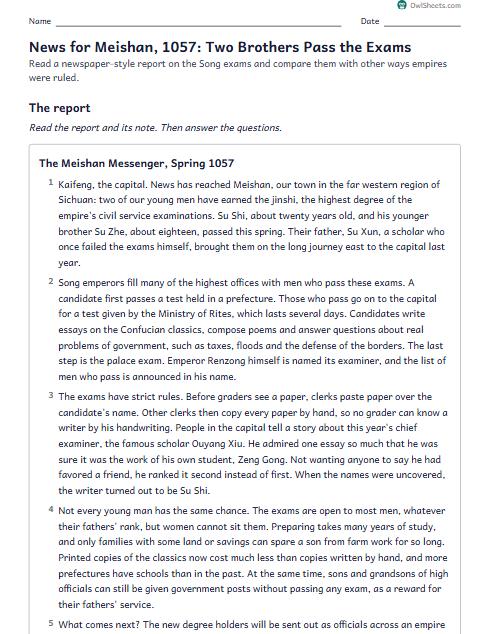
News for Meishan, 1057: Two Brothers Pass the Exams
Grade 7 · CIV.7.3
15 questionsPremium
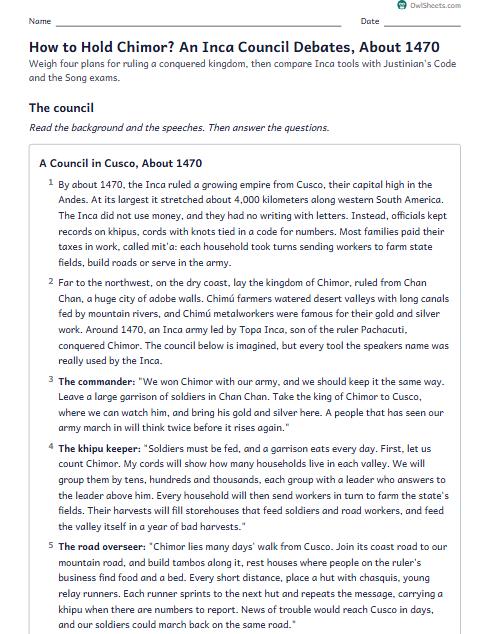
How to Hold Chimor? An Inca Council Debates, About 1470
Grade 7 · CIV.7.3
15 questionsPremium
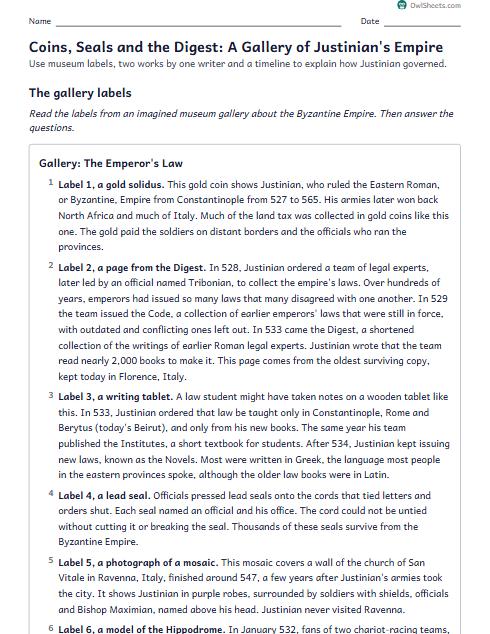
Coins, Seals and the Digest: A Gallery of Justinian's Empire
Grade 7 · CIV.7.3
16 questionsPremium
Stones of Karakorum: A Historian's Notes on Mongol Rule
Grade 7 · CIV.7.3
16 questionsPremium
An Elephant for Aachen: How Charlemagne and Harun al-Rashid Ruled
Grade 7 · CIV.7.3
11 questionsPremium
Ranks, Lands and Taxes: How Akbar Ruled Mughal India
Grade 7 · CIV.7.3
12 questionsFree