Grade 7 · Social StudiesCIV.7.3Premium
News for Meishan, 1057: Two Brothers Pass the Exams
Grade 7 civics: a retold 1057 news report on the Su brothers and the Song civil service exams, compared with Justinian's Code and Inca runners.
Preview
OwlSheets.com
News for Meishan, 1057: Two Brothers Pass the Exams
Read a newspaper-style report on the Song exams and compare them with other ways empires were ruled.
The report
Read the report and its note. Then answer the questions.
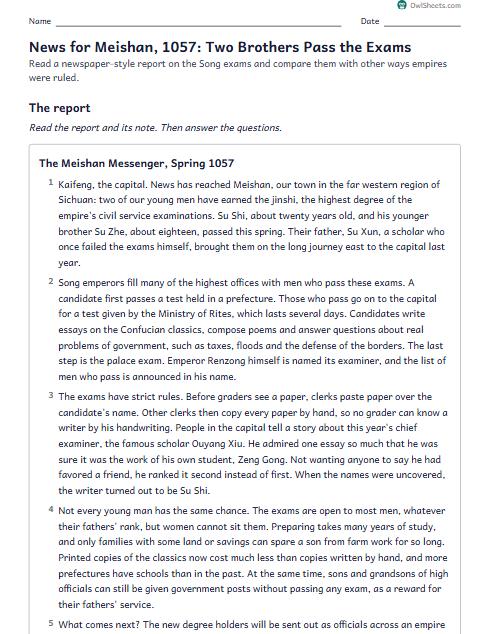
The Meishan Messenger, Spring 1057
1Kaifeng, the capital. News has reached Meishan, our town in the far western region of Sichuan: two of our young men have earned the jinshi, the highest degree of the empire's civil service examinations. Su Shi, about twenty years old, and his younger brother Su Zhe, about eighteen, passed this spring. Their father, Su Xun, a scholar who once failed the exams himself, brought them on the long journey east to the capital last year.
2Song emperors fill many of the highest offices with men who pass these exams. A candidate first passes a test held in a prefecture. Those who pass go on to the capital for a test given by the Ministry of Rites, which lasts several days. Candidates write essays on the Confucian classics, compose poems and answer questions about real problems of government, such as taxes, floods and the defense of the borders. The last step is the palace exam. Emperor Renzong himself is named its examiner, and the list of men who pass is announced in his name.
3The exams have strict rules. Before graders see a paper, clerks paste paper over the candidate's name. Other clerks then copy every paper by hand, so no grader can know a writer by his handwriting. People in the capital tell a story about this year's chief examiner, the famous scholar Ouyang Xiu. He admired one essay so much that he was sure it was the work of his own student, Zeng Gong. Not wanting anyone to say he had favored a friend, he ranked it second instead of first. When the names were uncovered, the writer turned out to be Su Shi.
4Not every young man has the same chance. The exams are open to most men, whatever their fathers' rank, but women cannot sit them. Preparing takes many years of study, and only families with some land or savings can spare a son from farm work for so long. Printed copies of the classics now cost much less than copies written by hand, and more prefectures have schools than in the past. At the same time, sons and grandsons of high officials can still be given government posts without passing any exam, as a reward for their fathers' service.
5What comes next? The new degree holders will be sent out as officials across an empire that stretches from Sichuan to the eastern sea. An official collects taxes, judges cases and sends reports to the capital. By long custom, he is not sent to govern his own home region, and he usually moves to a new post after about three years. His record is reviewed before he can be promoted.
- A. So the men who passed would see the throne as the source of their rank
- B. So candidates could skip the prefecture test and the capital test
- C. So each region could choose its officials without the capital
- D. So he could give the top places to young men of his own family
The preview shows the first questions. Unlock the worksheet to see all of it.
Related worksheets
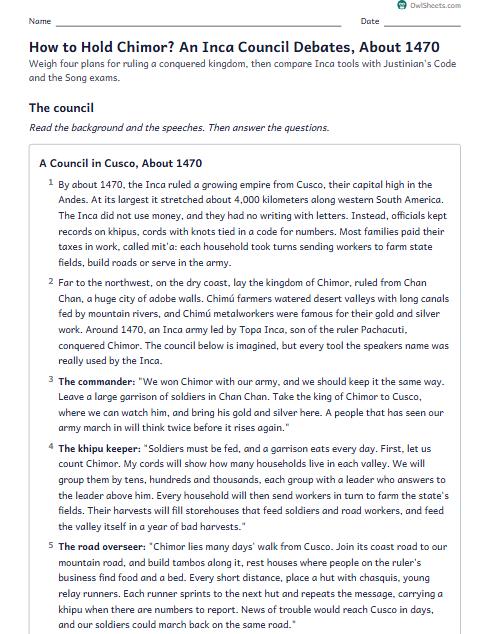
How to Hold Chimor? An Inca Council Debates, About 1470
Grade 7 · CIV.7.3
15 questionsPremium
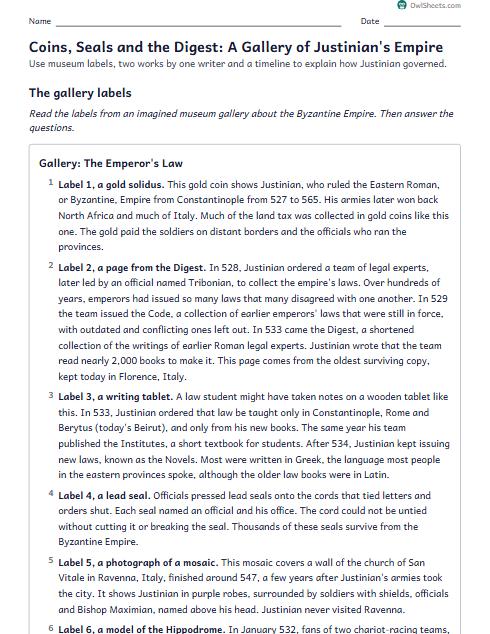
Coins, Seals and the Digest: A Gallery of Justinian's Empire
Grade 7 · CIV.7.3
16 questionsPremium
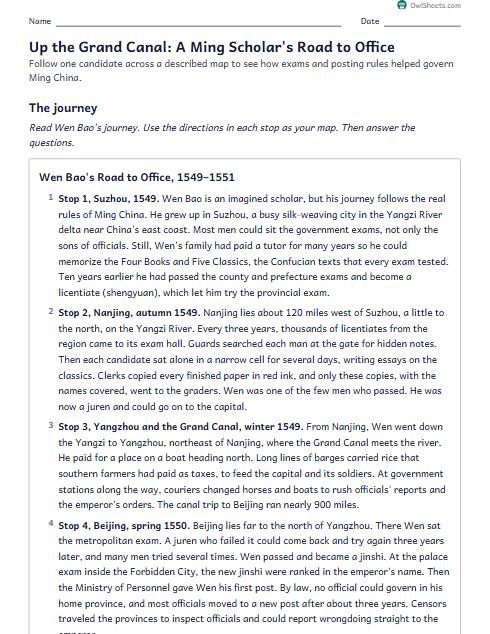
Up the Grand Canal: A Ming Scholar's Road to Office
Grade 7 · CIV.7.3
16 questionsPremium
Stones of Karakorum: A Historian's Notes on Mongol Rule
Grade 7 · CIV.7.3
16 questionsPremium
An Elephant for Aachen: How Charlemagne and Harun al-Rashid Ruled
Grade 7 · CIV.7.3
11 questionsPremium
Ranks, Lands and Taxes: How Akbar Ruled Mughal India
Grade 7 · CIV.7.3
12 questionsFree