Grade 7 · Social StudiesCIV.7.3Premium
Coins, Seals and the Digest: A Gallery of Justinian's Empire
Grade 7 civics: museum labels on Justinian's coins, seals, law books and the Nika riot, plus two works by Procopius to source and a timeline.
Preview
OwlSheets.com
Coins, Seals and the Digest: A Gallery of Justinian's Empire
Use museum labels, two works by one writer and a timeline to explain how Justinian governed.
The gallery labels
Read the labels from an imagined museum gallery about the Byzantine Empire. Then answer the questions.
Gallery: The Emperor's Law
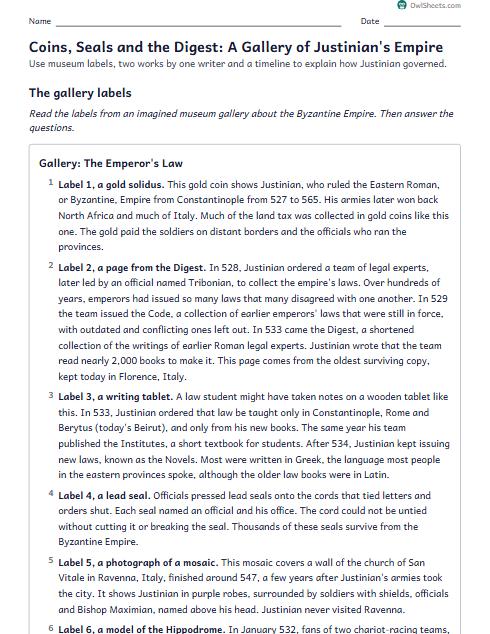
1Label 1, a gold solidus. This gold coin shows Justinian, who ruled the Eastern Roman, or Byzantine, Empire from Constantinople from 527 to 565. His armies later won back North Africa and much of Italy. Much of the land tax was collected in gold coins like this one. The gold paid the soldiers on distant borders and the officials who ran the provinces.
2Label 2, a page from the Digest. In 528, Justinian ordered a team of legal experts, later led by an official named Tribonian, to collect the empire's laws. Over hundreds of years, emperors had issued so many laws that many disagreed with one another. In 529 the team issued the Code, a collection of earlier emperors' laws that were still in force, with outdated and conflicting ones left out. In 533 came the Digest, a shortened collection of the writings of earlier Roman legal experts. Justinian wrote that the team read nearly 2,000 books to make it. This page comes from the oldest surviving copy, kept today in Florence, Italy.
3Label 3, a writing tablet. A law student might have taken notes on a wooden tablet like this. In 533, Justinian ordered that law be taught only in Constantinople, Rome and Berytus (today's Beirut), and only from his new books. The same year his team published the Institutes, a short textbook for students. After 534, Justinian kept issuing new laws, known as the Novels. Most were written in Greek, the language most people in the eastern provinces spoke, although the older law books were in Latin.
4Label 4, a lead seal. Officials pressed lead seals onto the cords that tied letters and orders shut. Each seal named an official and his office. The cord could not be untied without cutting it or breaking the seal. Thousands of these seals survive from the Byzantine Empire.
5Label 5, a photograph of a mosaic. This mosaic covers a wall of the church of San Vitale in Ravenna, Italy, finished around 547, a few years after Justinian's armies took the city. It shows Justinian in purple robes, surrounded by soldiers with shields, officials and Bishop Maximian, named above his head. Justinian never visited Ravenna.
6Label 6, a model of the Hippodrome. In January 532, fans of two chariot-racing teams, the Blues and the Greens, joined together in Constantinople's race track and rioted. Many were angry about high taxes and officials such as Tribonian and the tax chief John the Cappadocian. Justinian removed both men, but the rioters burned much of the city, including the great church of Hagia Sophia. Days later, his troops trapped the crowd in the Hippodrome; the writer Procopius reported about 30,000 deaths. Both officials later returned to their posts.
7Label 7, a printed law book from 1583. Around 1100, teachers in Bologna, Italy, began studying a copy of the Digest. Over the next centuries, Justinian's law books, later printed together as the Corpus Juris Civilis (Body of Civil Law), shaped the laws of many European countries.
- A. Follow the version of the rule kept in the Code
- B. Follow whichever of the two laws was issued first
- C. Let the two families vote on which law to use
- D. Ask the city's bishop which of the two laws to follow
- A. Fees paid by students at the three law schools
- B. Fines paid by the racing teams after the riot
- C. Land taxes collected in gold across the provinces
- D. Gifts sent each year by the bishops of Italy
The preview shows the first questions. Unlock the worksheet to see all of it.
Related worksheets
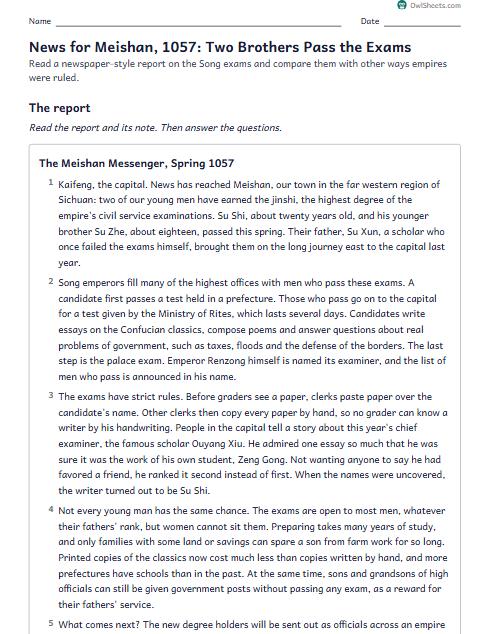
News for Meishan, 1057: Two Brothers Pass the Exams
Grade 7 · CIV.7.3
15 questionsPremium
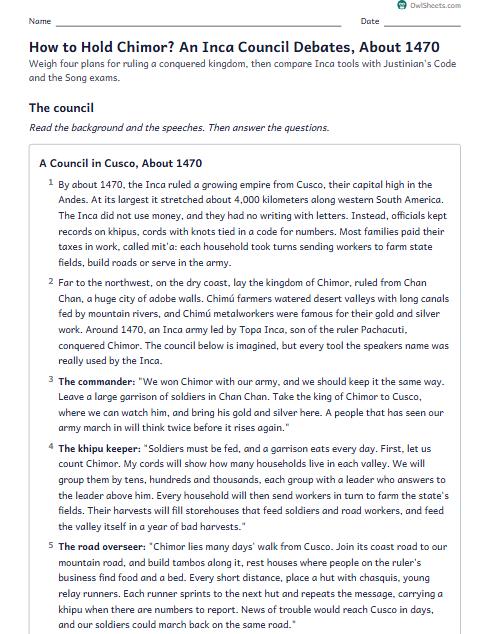
How to Hold Chimor? An Inca Council Debates, About 1470
Grade 7 · CIV.7.3
15 questionsPremium
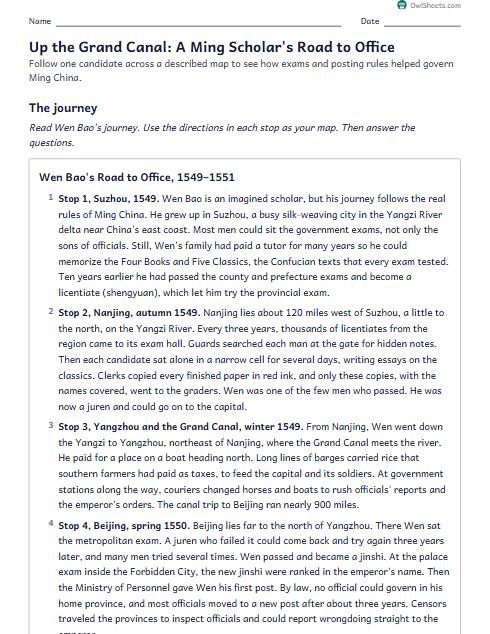
Up the Grand Canal: A Ming Scholar's Road to Office
Grade 7 · CIV.7.3
16 questionsPremium
Stones of Karakorum: A Historian's Notes on Mongol Rule
Grade 7 · CIV.7.3
16 questionsPremium
An Elephant for Aachen: How Charlemagne and Harun al-Rashid Ruled
Grade 7 · CIV.7.3
11 questionsPremium
Ranks, Lands and Taxes: How Akbar Ruled Mughal India
Grade 7 · CIV.7.3
12 questionsFree