Grade 7 · Social StudiesCIV.7.3Premium
Stones of Karakorum: A Historian's Notes on Mongol Rule
Grade 7 civics: a historian's field notes on Karakorum, the yam relay stations, Mongol censuses and the Yuan exam rules, with a traveler's report.
Preview
OwlSheets.com
Stones of Karakorum: A Historian's Notes on Mongol Rule
Use field notes, a traveler's report and exam rules to explain how the Mongol khans governed a huge empire.
The field notes
Read the historian's field notes. Then answer the questions.
Field Notes from the Orkhon Valley
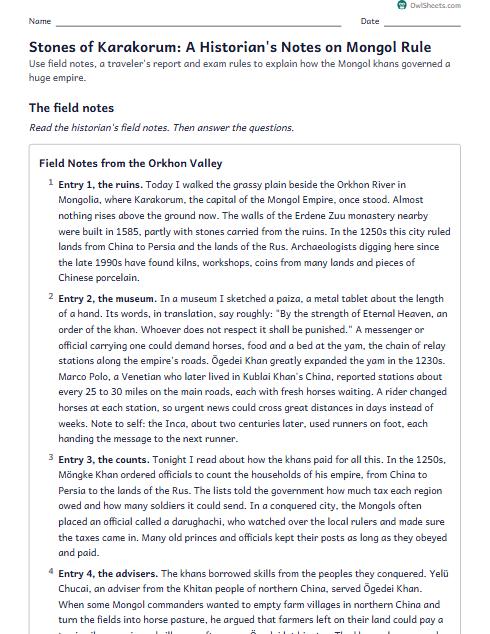
1Entry 1, the ruins. Today I walked the grassy plain beside the Orkhon River in Mongolia, where Karakorum, the capital of the Mongol Empire, once stood. Almost nothing rises above the ground now. The walls of the Erdene Zuu monastery nearby were built in 1585, partly with stones carried from the ruins. In the 1250s this city ruled lands from China to Persia and the lands of the Rus. Archaeologists digging here since the late 1990s have found kilns, workshops, coins from many lands and pieces of Chinese porcelain.
2Entry 2, the museum. In a museum I sketched a paiza, a metal tablet about the length of a hand. Its words, in translation, say roughly: "By the strength of Eternal Heaven, an order of the khan. Whoever does not respect it shall be punished." A messenger or official carrying one could demand horses, food and a bed at the yam, the chain of relay stations along the empire's roads. Ögedei Khan greatly expanded the yam in the 1230s. Marco Polo, a Venetian who later lived in Kublai Khan's China, reported stations about every 25 to 30 miles on the main roads, each with fresh horses waiting. A rider changed horses at each station, so urgent news could cross great distances in days instead of weeks. Note to self: the Inca, about two centuries later, used runners on foot, each handing the message to the next runner.
3Entry 3, the counts. Tonight I read about how the khans paid for all this. In the 1250s, Möngke Khan ordered officials to count the households of his empire, from China to Persia to the lands of the Rus. The lists told the government how much tax each region owed and how many soldiers it could send. In a conquered city, the Mongols often placed an official called a darughachi, who watched over the local rulers and made sure the taxes came in. Many old princes and officials kept their posts as long as they obeyed and paid.
4Entry 4, the advisers. The khans borrowed skills from the peoples they conquered. Yelü Chucai, an adviser from the Khitan people of northern China, served Ögedei Khan. When some Mongol commanders wanted to empty farm villages in northern China and turn the fields into horse pasture, he argued that farmers left on their land could pay a tax in silver, grain and silk year after year. Ögedei let him try. The khans also excused Buddhist monks, Christian priests, Muslim imams and Daoist teachers from many taxes and asked them to pray for the khan.
5Entry 5, the exams. Kublai Khan, a grandson of Chinggis Khan, became khan in 1260. He moved his capital to Dadu, today's Beijing, and in 1271 gave his dynasty a Chinese name, the Yuan. For centuries China had chosen many officials by written exams on the Confucian classics, but for more than 40 years the Yuan held none. Many Chinese scholars resented losing their old road into government. When the exams returned, the rules split the places among four groups (see the table), and Mongol and Central Asian candidates took an easier test.
- A. The messenger pays the keeper in silver for the horse.
- B. The keeper was chosen by exam to serve all travelers.
- C. The messenger's tablet shows he rides on the khan's orders.
- D. The keeper owns the horses and rents them to anyone.
- A. The yam had no stations, but the Inca built stations on their roads.
- B. Yam riders switched horses, but Inca runners passed the message on.
- C. The yam carried spoken news, but Inca runners carried written letters.
- D. The yam ran only in wartime, but Inca runners worked in peacetime.
The preview shows the first questions. Unlock the worksheet to see all of it.
Related worksheets
News for Meishan, 1057: Two Brothers Pass the Exams
Grade 7 · CIV.7.3
15 questionsPremium
How to Hold Chimor? An Inca Council Debates, About 1470
Grade 7 · CIV.7.3
15 questionsPremium
Coins, Seals and the Digest: A Gallery of Justinian's Empire
Grade 7 · CIV.7.3
16 questionsPremium
Up the Grand Canal: A Ming Scholar's Road to Office
Grade 7 · CIV.7.3
16 questionsPremium
An Elephant for Aachen: How Charlemagne and Harun al-Rashid Ruled
Grade 7 · CIV.7.3
11 questionsPremium
Ranks, Lands and Taxes: How Akbar Ruled Mughal India
Grade 7 · CIV.7.3
12 questionsFree