Grade 7 · Social StudiesHIS.7.2Premium
Basins, Numerals and Letters: Field Notes from Kairouan and Béjaïa
Grade 7 history: a historian's field notes from Kairouan and Béjaïa trace how Islam spread to North Africa and how its medicine, math and trade reached Europe.
Preview
OwlSheets.com
Basins, Numerals and Letters: Field Notes from Kairouan and Béjaïa
Follow a historian through North Africa to trace the spread of Islam and its achievements.
Read the field notes
Read the historian's field notes and the timeline. Then answer the questions.
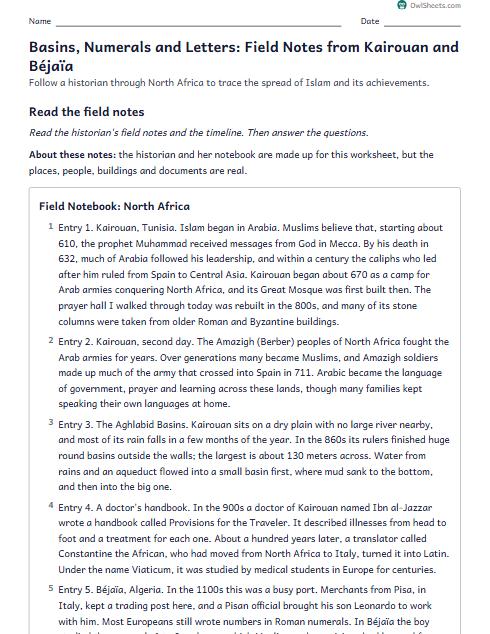
Field Notebook: North Africa
1Entry 1. Kairouan, Tunisia. Islam began in Arabia. Muslims believe that, starting about 610, the prophet Muhammad received messages from God in Mecca. By his death in 632, much of Arabia followed his leadership, and within a century the caliphs who led after him ruled from Spain to Central Asia. Kairouan began about 670 as a camp for Arab armies conquering North Africa, and its Great Mosque was first built then. The prayer hall I walked through today was rebuilt in the 800s, and many of its stone columns were taken from older Roman and Byzantine buildings.
2Entry 2. Kairouan, second day. The Amazigh (Berber) peoples of North Africa fought the Arab armies for years. Over generations many became Muslims, and Amazigh soldiers made up much of the army that crossed into Spain in 711. Arabic became the language of government, prayer and learning across these lands, though many families kept speaking their own languages at home.
3Entry 3. The Aghlabid Basins. Kairouan sits on a dry plain with no large river nearby, and most of its rain falls in a few months of the year. In the 860s its rulers finished huge round basins outside the walls; the largest is about 130 meters across. Water from rains and an aqueduct flowed into a small basin first, where mud sank to the bottom, and then into the big one.
4Entry 4. A doctor's handbook. In the 900s a doctor of Kairouan named Ibn al-Jazzar wrote a handbook called Provisions for the Traveler. It described illnesses from head to foot and a treatment for each one. About a hundred years later, a translator called Constantine the African, who had moved from North Africa to Italy, turned it into Latin. Under the name Viaticum, it was studied by medical students in Europe for centuries.
5Entry 5. Béjaïa, Algeria. In the 1100s this was a busy port. Merchants from Pisa, in Italy, kept a trading post here, and a Pisan official brought his son Leonardo to work with him. Most Europeans still wrote numbers in Roman numerals. In Béjaïa the boy studied the numerals 1 to 9 and zero, which Muslim mathematicians had learned from India and used across their lands. In 1202 Leonardo, later known as Fibonacci, published a book in Italy that taught these numerals to European merchants.
6Entry 6. Letters from a storeroom. Today I read copies of letters found in the storeroom of a synagogue in Fustat, Old Cairo, called the Cairo Geniza. Jewish merchants of Kairouan wrote many of them in the 1000s. They shipped goods such as flax, silk and olive oil across the Mediterranean, and they wrote in Arabic using Hebrew letters. Some letters mention written orders to pay money in another city, so a merchant did not have to send coins.
| Date | Event |
|---|---|
| About 610 | Muhammad begins preaching in Mecca |
| 622 | Muhammad's followers move to Medina |
| 632 | Muhammad dies |
| About 670 | Kairouan founded as an army camp |
| 711 | Muslim army crosses into Spain |
| 860s | Aghlabid Basins finished |
| 900s | Ibn al-Jazzar writes his handbook |
| 1000s | Kairouan merchants write letters |
| About 1080 | Constantine translates the handbook |
| 1202 | Leonardo publishes his numerals book |
The preview shows the first questions. Unlock the worksheet to see all of it.
Related worksheets
The Isfahan Herald, 1079: A Sultan's Calendar and a Busy Bazaar
Grade 7 · HIS.7.2
13 questionsPremium
Should Every Doctor Pass a Test? Baghdad, 931
Grade 7 · HIS.7.2
15 questionsPremium
From a Gold Dinar to a Viking Hoard: A Gallery of the Islamic World
Grade 7 · HIS.7.2
14 questionsPremium
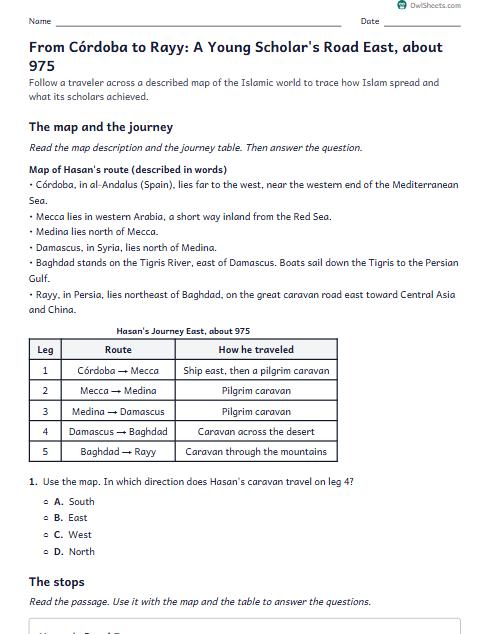
From Córdoba to Rayy: A Young Scholar's Road East, about 975
Grade 7 · HIS.7.2
14 questionsPremium
Stars, Hospitals and Sultans: A Timeline of the Islamic World, 610–1430
Grade 7 · HIS.7.2
12 questionsPremium
A Doctor Tells His Own Story: Ibn Sina in Bukhara
Grade 7 · HIS.7.2
11 questionsPremium