Grade 7 · Social StudiesHIS.7.2Premium
Should Every Doctor Pass a Test? Baghdad, 931
Grade 7 history: trace the rise and spread of Islam and its science, math and trade, then weigh a mock Baghdad meeting on testing doctors in 931.
Preview
OwlSheets.com
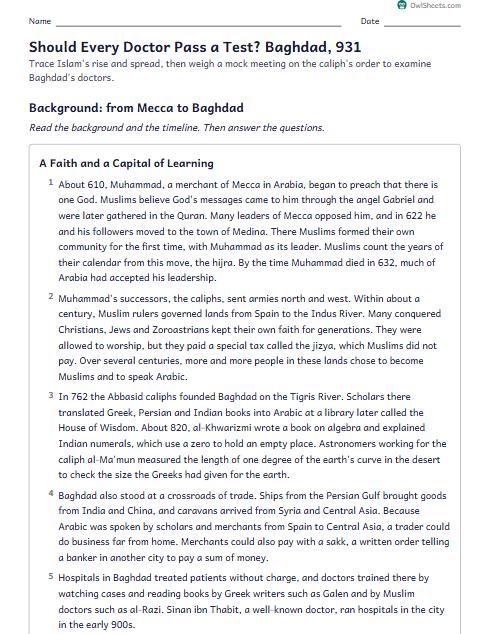
Should Every Doctor Pass a Test? Baghdad, 931
Trace Islam's rise and spread, then weigh a mock meeting on the caliph's order to examine Baghdad's doctors.
Background: from Mecca to Baghdad
Read the background and the timeline. Then answer the questions.
A Faith and a Capital of Learning
1About 610, Muhammad, a merchant of Mecca in Arabia, began to preach that there is one God. Muslims believe God's messages came to him through the angel Gabriel and were later gathered in the Quran. Many leaders of Mecca opposed him, and in 622 he and his followers moved to the town of Medina. There Muslims formed their own community for the first time, with Muhammad as its leader. Muslims count the years of their calendar from this move, the hijra. By the time Muhammad died in 632, much of Arabia had accepted his leadership.
2Muhammad's successors, the caliphs, sent armies north and west. Within about a century, Muslim rulers governed lands from Spain to the Indus River. Many conquered Christians, Jews and Zoroastrians kept their own faith for generations. They were allowed to worship, but they paid a special tax called the jizya, which Muslims did not pay. Over several centuries, more and more people in these lands chose to become Muslims and to speak Arabic.
3In 762 the Abbasid caliphs founded Baghdad on the Tigris River. Scholars there translated Greek, Persian and Indian books into Arabic at a library later called the House of Wisdom. About 820, al-Khwarizmi wrote a book on algebra and explained Indian numerals, which use a zero to hold an empty place. Astronomers working for the caliph al-Ma'mun measured the length of one degree of the earth's curve in the desert to check the size the Greeks had given for the earth.
4Baghdad also stood at a crossroads of trade. Ships from the Persian Gulf brought goods from India and China, and caravans arrived from Syria and Central Asia. Because Arabic was spoken by scholars and merchants from Spain to Central Asia, a trader could do business far from home. Merchants could also pay with a sakk, a written order telling a banker in another city to pay a sum of money.
5Hospitals in Baghdad treated patients without charge, and doctors trained there by watching cases and reading books by Greek writers such as Galen and by Muslim doctors such as al-Razi. Sinan ibn Thabit, a well-known doctor, ran hospitals in the city in the early 900s.
| Year | Event |
|---|---|
| About 610 | Muhammad begins preaching in Mecca |
| 622 | Move to Medina; Muslim year 1 |
| 632 | Muhammad dies; first caliph chosen |
| About 642 | Muslim armies hold Syria and Egypt |
| 711 | Muslim armies enter Spain |
| 750 | The Abbasid family takes power |
| 762 | Baghdad is founded |
| About 820 | Al-Khwarizmi writes on algebra |
| About 918 | New hospital opens in Baghdad |
| 931 | Caliph orders all doctors examined |
- A. Muslims saw the year the Quran was gathered in a book as the start.
- B. Muslims saw the first Muslim community at Medina as a new beginning.
- C. Muslims saw the year Muhammad was born as the start of their faith.
- D. Muslims saw the year Mecca's leaders accepted Islam as the true start.
The preview shows the first questions. Unlock the worksheet to see all of it.
Related worksheets
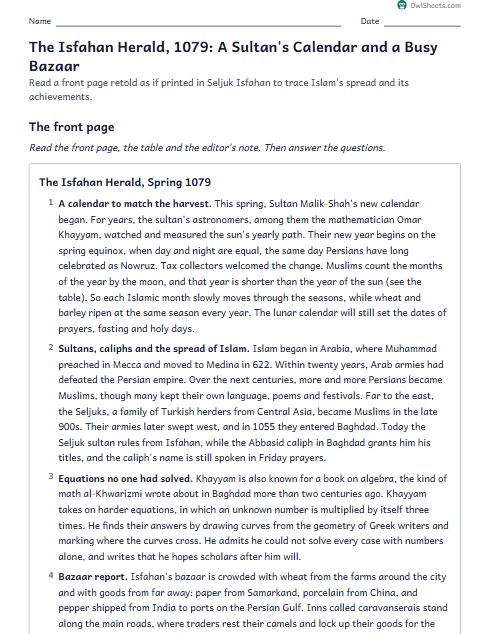
The Isfahan Herald, 1079: A Sultan's Calendar and a Busy Bazaar
Grade 7 · HIS.7.2
13 questionsPremium
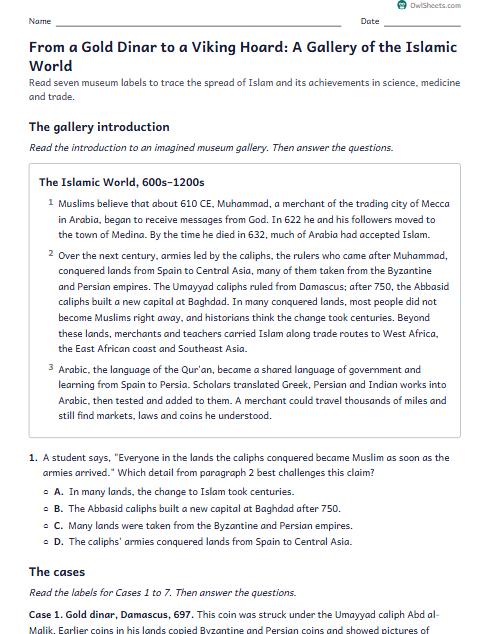
From a Gold Dinar to a Viking Hoard: A Gallery of the Islamic World
Grade 7 · HIS.7.2
14 questionsPremium
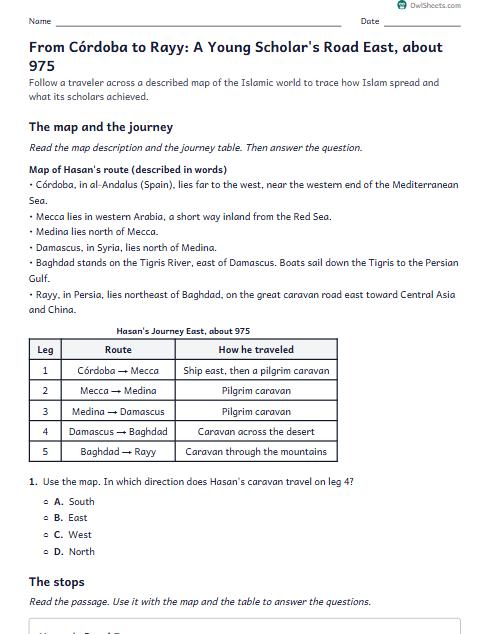
From Córdoba to Rayy: A Young Scholar's Road East, about 975
Grade 7 · HIS.7.2
14 questionsPremium
Basins, Numerals and Letters: Field Notes from Kairouan and Béjaïa
Grade 7 · HIS.7.2
14 questionsPremium
Stars, Hospitals and Sultans: A Timeline of the Islamic World, 610–1430
Grade 7 · HIS.7.2
12 questionsPremium
A Doctor Tells His Own Story: Ibn Sina in Bukhara
Grade 7 · HIS.7.2
11 questionsPremium