Grade 7 · Social StudiesHIS.7.2Premium
The Isfahan Herald, 1079: A Sultan's Calendar and a Busy Bazaar
Grade 7 history: a front page retold from Isfahan in 1079 covers Islam's spread to Persia and the Turks, Khayyam's math, medicine and trade.
Preview
OwlSheets.com
The Isfahan Herald, 1079: A Sultan's Calendar and a Busy Bazaar
Read a front page retold as if printed in Seljuk Isfahan to trace Islam's spread and its achievements.
The front page
Read the front page, the table and the editor's note. Then answer the questions.
The Isfahan Herald, Spring 1079
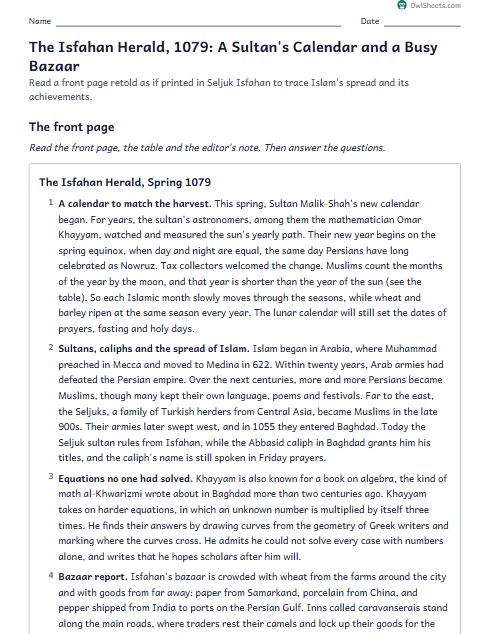
1A calendar to match the harvest. This spring, Sultan Malik-Shah's new calendar began. For years, the sultan's astronomers, among them the mathematician Omar Khayyam, watched and measured the sun's yearly path. Their new year begins on the spring equinox, when day and night are equal, the same day Persians have long celebrated as Nowruz. Tax collectors welcomed the change. Muslims count the months of the year by the moon, and that year is shorter than the year of the sun (see the table). So each Islamic month slowly moves through the seasons, while wheat and barley ripen at the same season every year. The lunar calendar will still set the dates of prayers, fasting and holy days.
2Sultans, caliphs and the spread of Islam. Islam began in Arabia, where Muhammad preached in Mecca and moved to Medina in 622. Within twenty years, Arab armies had defeated the Persian empire. Over the next centuries, more and more Persians became Muslims, though many kept their own language, poems and festivals. Far to the east, the Seljuks, a family of Turkish herders from Central Asia, became Muslims in the late 900s. Their armies later swept west, and in 1055 they entered Baghdad. Today the Seljuk sultan rules from Isfahan, while the Abbasid caliph in Baghdad grants him his titles, and the caliph's name is still spoken in Friday prayers.
3Equations no one had solved. Khayyam is also known for a book on algebra, the kind of math al-Khwarizmi wrote about in Baghdad more than two centuries ago. Khayyam takes on harder equations, in which an unknown number is multiplied by itself three times. He finds their answers by drawing curves from the geometry of Greek writers and marking where the curves cross. He admits he could not solve every case with numbers alone, and writes that he hopes scholars after him will.
4Bazaar report. Isfahan's bazaar is crowded with wheat from the farms around the city and with goods from far away: paper from Samarkand, porcelain from China, and pepper shipped from India to ports on the Persian Gulf. Inns called caravanserais stand along the main roads, where traders rest their camels and lock up their goods for the night. Many merchants work in partnerships. One partner puts up the money, and another travels with the goods. When the trip is done, they share the profit as agreed. Shopkeepers keep their accounts with numerals that first came from India.
5Schools and doctors. Nizam al-Mulk, the sultan's chief minister, has founded schools called madrasas, starting with one in Baghdad in 1067. Each pays its teachers and gives students food and a room. In the city, doctors still study the Canon of Medicine by Ibn Sina, who worked in Isfahan until shortly before his death in 1037. The Canon gathers what Greek doctors and earlier Muslim doctors taught, along with what Ibn Sina saw in his own patients.
| Calendar | Follows | Days in a year | Used for |
|---|---|---|---|
| Islamic (lunar) | The moon | 354 or 355 | Prayers, fasting, holy days |
| Sultan's new (solar) | The sun | 365 or 366 | Taxes and farm seasons |
- A. The lunar year was longer, so tax dates kept arriving too late.
- B. Merchants from China would trade only by a calendar of the sun.
- C. Harvests come at a fixed season, but the lunar months keep shifting.
- D. The Islamic months had been banned for any use outside of prayers.
The preview shows the first questions. Unlock the worksheet to see all of it.
Related worksheets
Should Every Doctor Pass a Test? Baghdad, 931
Grade 7 · HIS.7.2
15 questionsPremium
From a Gold Dinar to a Viking Hoard: A Gallery of the Islamic World
Grade 7 · HIS.7.2
14 questionsPremium
From Córdoba to Rayy: A Young Scholar's Road East, about 975
Grade 7 · HIS.7.2
14 questionsPremium
Basins, Numerals and Letters: Field Notes from Kairouan and Béjaïa
Grade 7 · HIS.7.2
14 questionsPremium
Stars, Hospitals and Sultans: A Timeline of the Islamic World, 610–1430
Grade 7 · HIS.7.2
12 questionsPremium
A Doctor Tells His Own Story: Ibn Sina in Bukhara
Grade 7 · HIS.7.2
11 questionsPremium