Grade 6 · Social StudiesHIS.6.1Premium
Hunters at the Edge of the Map: Sourcing Tacitus on the Fenni
Grade 6 history: source an adapted excerpt of Tacitus on the Fenni and use archaeology to explain how farming replaced foraging and led to villages.
Preview
OwlSheets.com
Hunters at the Edge of the Map: Sourcing Tacitus on the Fenni
Compare a Roman writer's view of hunter-gatherers with what archaeology shows about early farming.
What archaeology shows
Read the passage and study the table. Then answer the questions.
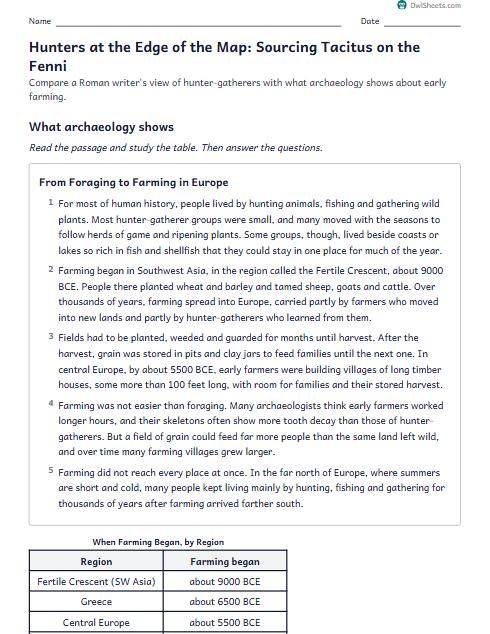
From Foraging to Farming in Europe
1For most of human history, people lived by hunting animals, fishing and gathering wild plants. Most hunter-gatherer groups were small, and many moved with the seasons to follow herds of game and ripening plants. Some groups, though, lived beside coasts or lakes so rich in fish and shellfish that they could stay in one place for much of the year.
2Farming began in Southwest Asia, in the region called the Fertile Crescent, about 9000 BCE. People there planted wheat and barley and tamed sheep, goats and cattle. Over thousands of years, farming spread into Europe, carried partly by farmers who moved into new lands and partly by hunter-gatherers who learned from them.
3Fields had to be planted, weeded and guarded for months until harvest. After the harvest, grain was stored in pits and clay jars to feed families until the next one. In central Europe, by about 5500 BCE, early farmers were building villages of long timber houses, some more than 100 feet long, with room for families and their stored harvest.
4Farming was not easier than foraging. Many archaeologists think early farmers worked longer hours, and their skeletons often show more tooth decay than those of hunter-gatherers. But a field of grain could feed far more people than the same land left wild, and over time many farming villages grew larger.
5Farming did not reach every place at once. In the far north of Europe, where summers are short and cold, many people kept living mainly by hunting, fishing and gathering for thousands of years after farming arrived farther south.
| Region | Farming began |
|---|---|
| Fertile Crescent (SW Asia) | about 9000 BCE |
| Greece | about 6500 BCE |
| Central Europe | about 5500 BCE |
| Britain | about 4000 BCE |
| Southern Scandinavia | about 4000 BCE |
| Far north of Europe | thousands of years later |
- A. Farmers had more free time than foragers to build large houses.
- B. Farmers had to follow their herds of cattle to new grass each season.
- C. Long timber houses could be taken apart and carried to new fields.
- D. Crops needed care for months, and stored grain was hard to move.
The preview shows the first questions. Unlock the worksheet to see all of it.
Related worksheets
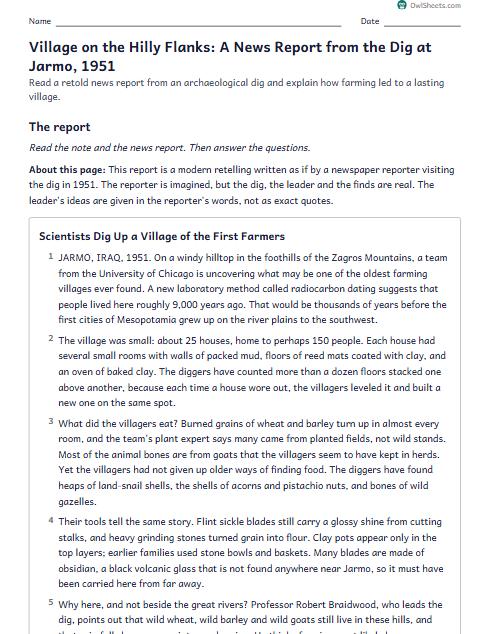
Village on the Hilly Flanks: A News Report from the Dig at Jarmo, 1951
Grade 6 · HIS.6.1
14 questionsPremium
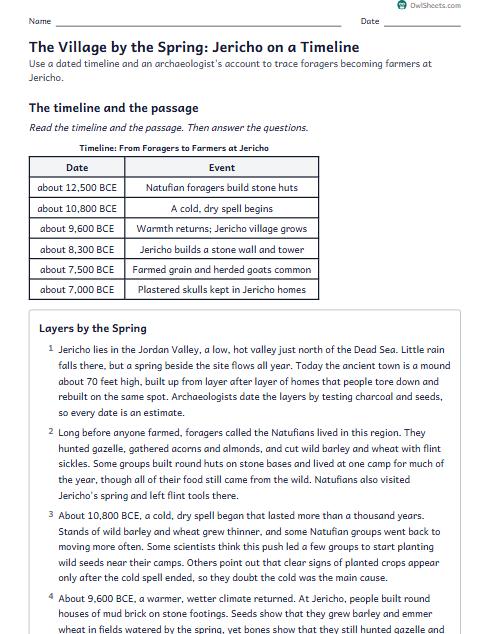
The Village by the Spring: Jericho on a Timeline
Grade 6 · HIS.6.1
14 questionsPremium
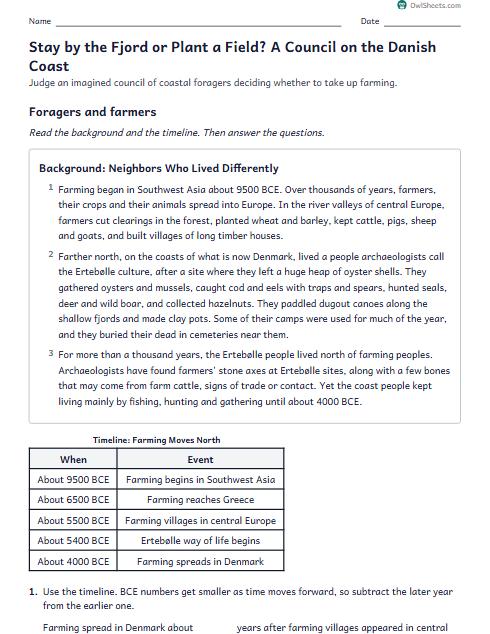
Stay by the Fjord or Plant a Field? A Council on the Danish Coast
Grade 6 · HIS.6.1
14 questionsPremium
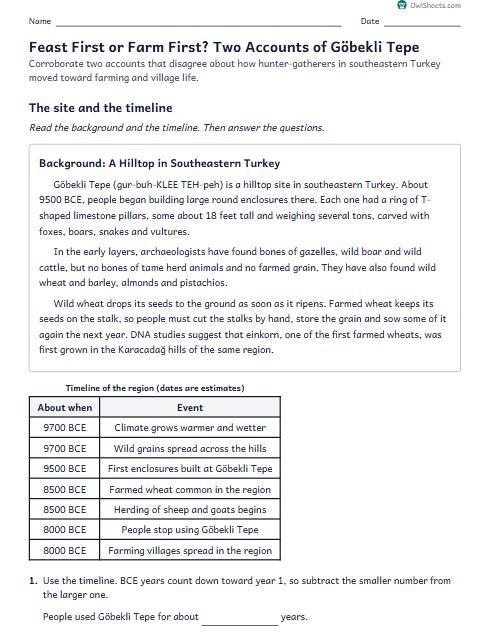
Feast First or Farm First? Two Accounts of Göbekli Tepe
Grade 6 · HIS.6.1
13 questionsPremium
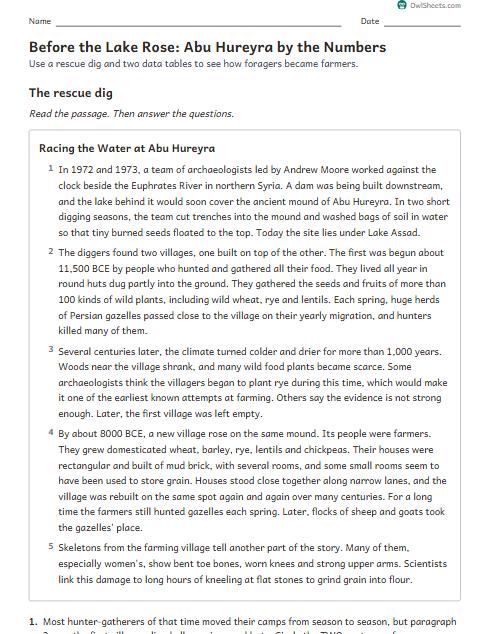
Before the Lake Rose: Abu Hureyra by the Numbers
Grade 6 · HIS.6.1
12 questionsPremium
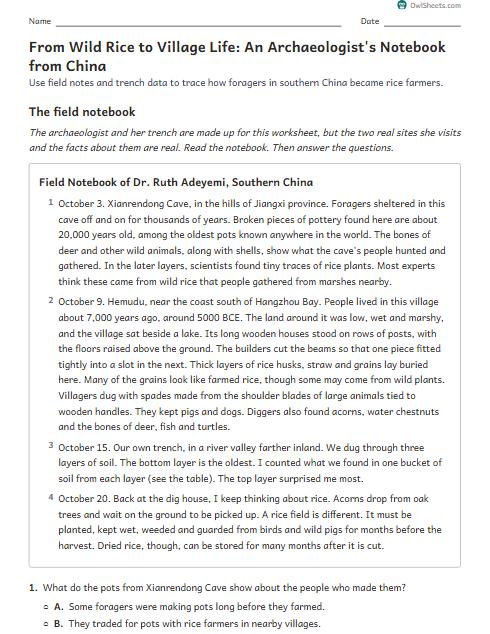
From Wild Rice to Village Life: An Archaeologist's Notebook from China
Grade 6 · HIS.6.1
10 questionsFree