Grade 6 · Social StudiesHIS.6.1Premium
Village on the Hilly Flanks: A News Report from the Dig at Jarmo, 1951
Grade 6 history: read a retold 1951 news report from the dig at Jarmo, Iraq, and explain how early people moved from foraging to farming and village life.
Preview
OwlSheets.com
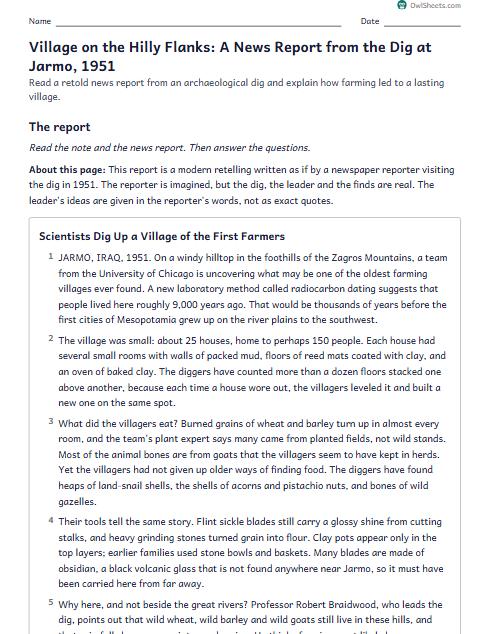
Village on the Hilly Flanks: A News Report from the Dig at Jarmo, 1951
Read a retold news report from an archaeological dig and explain how farming led to a lasting village.
The report
Read the note and the news report. Then answer the questions.
Scientists Dig Up a Village of the First Farmers
1JARMO, IRAQ, 1951. On a windy hilltop in the foothills of the Zagros Mountains, a team from the University of Chicago is uncovering what may be one of the oldest farming villages ever found. A new laboratory method called radiocarbon dating suggests that people lived here roughly 9,000 years ago. That would be thousands of years before the first cities of Mesopotamia grew up on the river plains to the southwest.
2The village was small: about 25 houses, home to perhaps 150 people. Each house had several small rooms with walls of packed mud, floors of reed mats coated with clay, and an oven of baked clay. The diggers have counted more than a dozen floors stacked one above another, because each time a house wore out, the villagers leveled it and built a new one on the same spot.
3What did the villagers eat? Burned grains of wheat and barley turn up in almost every room, and the team's plant expert says many came from planted fields, not wild stands. Most of the animal bones are from goats that the villagers seem to have kept in herds. Yet the villagers had not given up older ways of finding food. The diggers have found heaps of land-snail shells, the shells of acorns and pistachio nuts, and bones of wild gazelles.
4Their tools tell the same story. Flint sickle blades still carry a glossy shine from cutting stalks, and heavy grinding stones turned grain into flour. Clay pots appear only in the top layers; earlier families used stone bowls and baskets. Many blades are made of obsidian, a black volcanic glass that is not found anywhere near Jarmo, so it must have been carried here from far away.
5Why here, and not beside the great rivers? Professor Robert Braidwood, who leads the dig, points out that wild wheat, wild barley and wild goats still live in these hills, and that rain falls here every winter and spring. He thinks farming most likely began on these "hilly flanks" of the Fertile Crescent, where people already knew the wild plants and animals well. Some other scholars have argued that farming began at desert oases, where a drying climate crowded people, plants and animals together around water.
6Unusually, the team includes a botanist, a zoologist and a geologist as well as archaeologists. Their job is to read seeds, bones and soil as carefully as other scholars read ancient writing.
- A. Rain fell in the hills each winter and spring.
- B. Wheat and barley need no more water once they are planted.
- C. A nearby river flooded the hilltop fields every summer.
- D. The villagers carried river water up the hill in clay pots.
The preview shows the first questions. Unlock the worksheet to see all of it.
Related worksheets
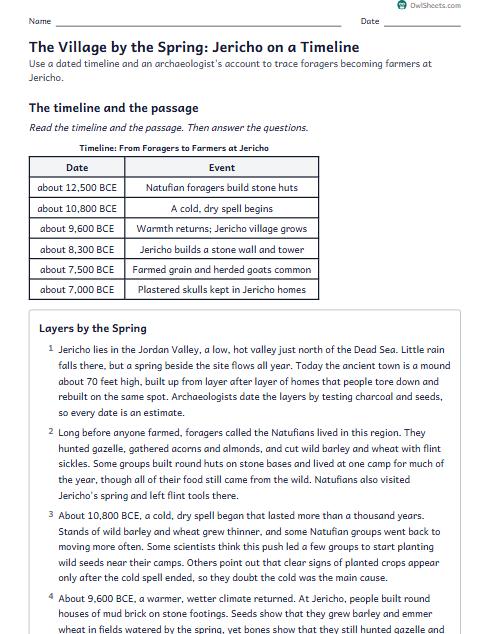
The Village by the Spring: Jericho on a Timeline
Grade 6 · HIS.6.1
14 questionsPremium
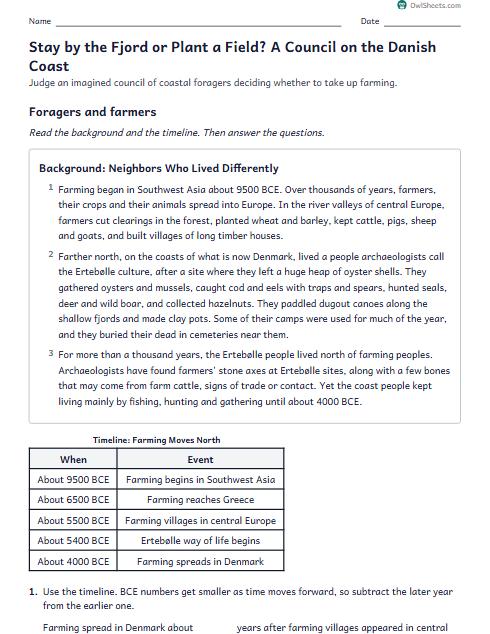
Stay by the Fjord or Plant a Field? A Council on the Danish Coast
Grade 6 · HIS.6.1
14 questionsPremium
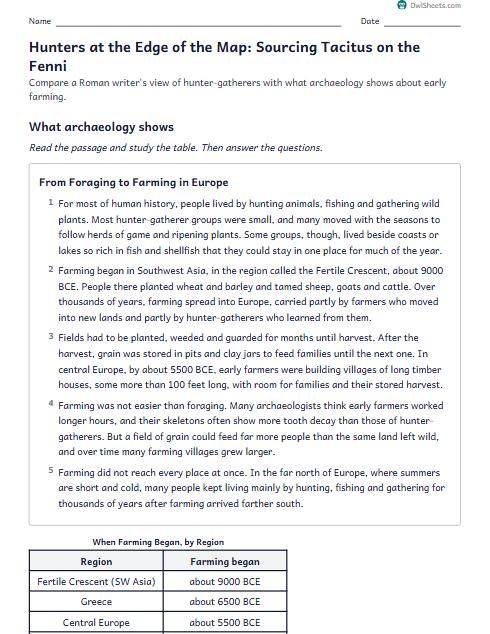
Hunters at the Edge of the Map: Sourcing Tacitus on the Fenni
Grade 6 · HIS.6.1
13 questionsPremium
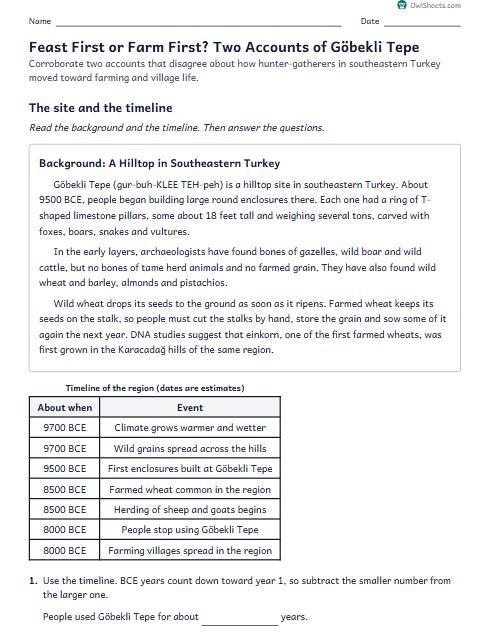
Feast First or Farm First? Two Accounts of Göbekli Tepe
Grade 6 · HIS.6.1
13 questionsPremium
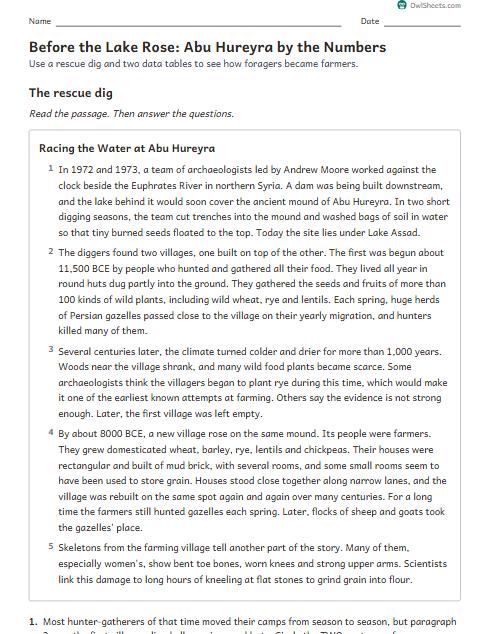
Before the Lake Rose: Abu Hureyra by the Numbers
Grade 6 · HIS.6.1
12 questionsPremium
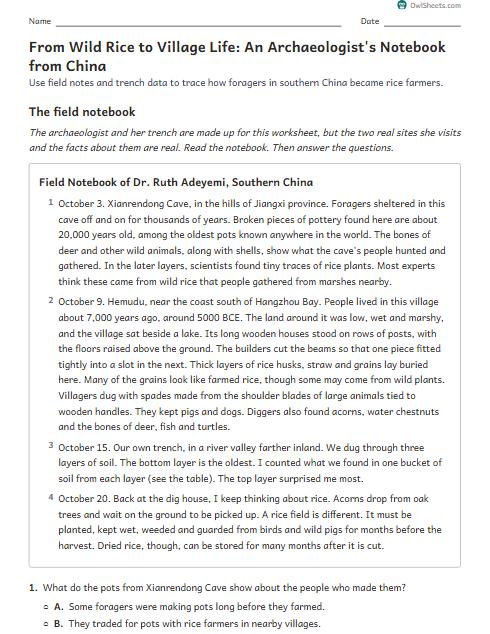
From Wild Rice to Village Life: An Archaeologist's Notebook from China
Grade 6 · HIS.6.1
10 questionsFree