Grade 6 · Social StudiesHIS.6.3Premium
Two Houses of Amun: Builders at Karnak and Jebel Barkal
Grade 6 history: use a data table of six rulers who built for Amun at Karnak and Jebel Barkal to compare Egypt and Kush and their beliefs and daily life.
Preview
OwlSheets.com
Two Houses of Amun: Builders at Karnak and Jebel Barkal
Use a table of rulers and their temple building to compare Egypt and Kush.
Rulers in the data
Read the passage and study the table. Then answer the questions.
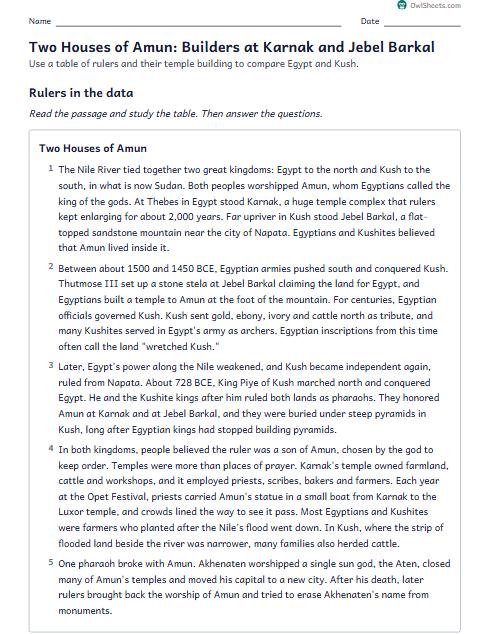
Two Houses of Amun
1The Nile River tied together two great kingdoms: Egypt to the north and Kush to the south, in what is now Sudan. Both peoples worshipped Amun, whom Egyptians called the king of the gods. At Thebes in Egypt stood Karnak, a huge temple complex that rulers kept enlarging for about 2,000 years. Far upriver in Kush stood Jebel Barkal, a flat-topped sandstone mountain near the city of Napata. Egyptians and Kushites believed that Amun lived inside it.
2Between about 1500 and 1450 BCE, Egyptian armies pushed south and conquered Kush. Thutmose III set up a stone stela at Jebel Barkal claiming the land for Egypt, and Egyptians built a temple to Amun at the foot of the mountain. For centuries, Egyptian officials governed Kush. Kush sent gold, ebony, ivory and cattle north as tribute, and many Kushites served in Egypt's army as archers. Egyptian inscriptions from this time often call the land "wretched Kush."
3Later, Egypt's power along the Nile weakened, and Kush became independent again, ruled from Napata. About 728 BCE, King Piye of Kush marched north and conquered Egypt. He and the Kushite kings after him ruled both lands as pharaohs. They honored Amun at Karnak and at Jebel Barkal, and they were buried under steep pyramids in Kush, long after Egyptian kings had stopped building pyramids.
4In both kingdoms, people believed the ruler was a son of Amun, chosen by the god to keep order. Temples were more than places of prayer. Karnak's temple owned farmland, cattle and workshops, and it employed priests, scribes, bakers and farmers. Each year at the Opet Festival, priests carried Amun's statue in a small boat from Karnak to the Luxor temple, and crowds lined the way to see it pass. Most Egyptians and Kushites were farmers who planted after the Nile's flood went down. In Kush, where the strip of flooded land beside the river was narrower, many families also herded cattle.
5One pharaoh broke with Amun. Akhenaten worshipped a single sun god, the Aten, closed many of Amun's temples and moved his capital to a new city. After his death, later rulers brought back the worship of Amun and tried to erase Akhenaten's name from monuments.
| Ruler | Kingdom | Ruled | Years | Building for Amun |
|---|---|---|---|---|
| Hatshepsut | Egypt | 1479–1458 | 21 | Obelisks at Karnak |
| Thutmose III | Egypt | 1479–1425 | 54 | Hall at Karnak; stela at Barkal |
| Akhenaten | Egypt | 1353–1336 | 17 | Turned worship to the Aten |
| Ramses II | Egypt | 1279–1213 | 66 | Finished Karnak's great hall |
| Piye | Kush | 744–714 | 30 | Enlarged Amun temple at Barkal |
| Taharqa | Kush | 690–664 | 26 | Built at Karnak and at Barkal |
The preview shows the first questions. Unlock the worksheet to see all of it.
Related worksheets
The Great Flood of Year 6: News from Thebes Under a King of Kush
Grade 6 · HIS.6.3
14 questionsPremium
Caravans to Yam: Sourcing Harkhuf's Tomb at Aswan
Grade 6 · HIS.6.3
14 questionsPremium
Who Won at Kadesh? Two Accounts of Ramses II's Battle
Grade 6 · HIS.6.3
14 questionsPremium
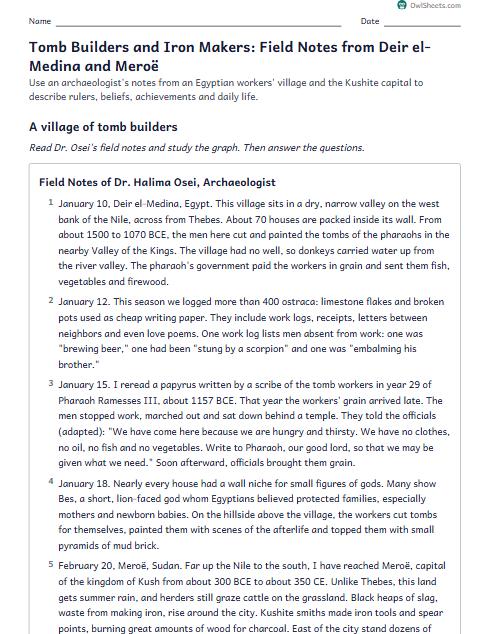
Tomb Builders and Iron Makers: Field Notes from Deir el-Medina and Meroë
Grade 6 · HIS.6.3
14 questionsPremium
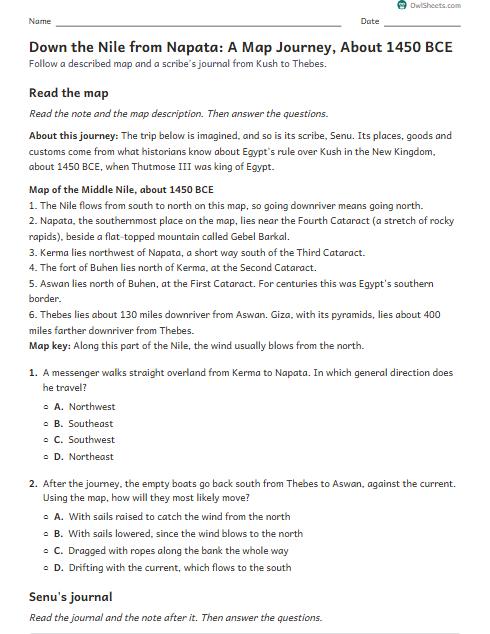
Down the Nile from Napata: A Map Journey, About 1450 BCE
Grade 6 · HIS.6.3
11 questionsPremium
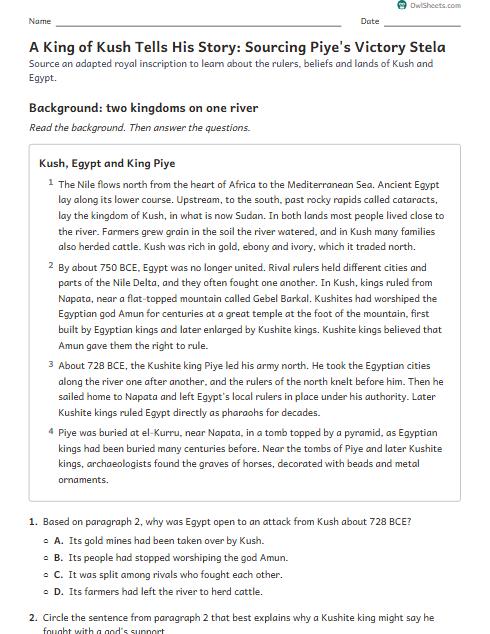
A King of Kush Tells His Story: Sourcing Piye's Victory Stela
Grade 6 · HIS.6.3
10 questionsFree