Grade 6 · Social StudiesHIS.6.3Premium
Tomb Builders and Iron Makers: Field Notes from Deir el-Medina and Meroë
Grade 6 history: field notes from Egypt's tomb builders' village and the Kushite city of Meroë on rulers, beliefs, achievements and daily life.
Preview
OwlSheets.com
Tomb Builders and Iron Makers: Field Notes from Deir el-Medina and Meroë
Use an archaeologist's notes from an Egyptian workers' village and the Kushite capital to describe rulers, beliefs, achievements and daily life.
A village of tomb builders
Read Dr. Osei's field notes and study the graph. Then answer the questions.
Field Notes of Dr. Halima Osei, Archaeologist
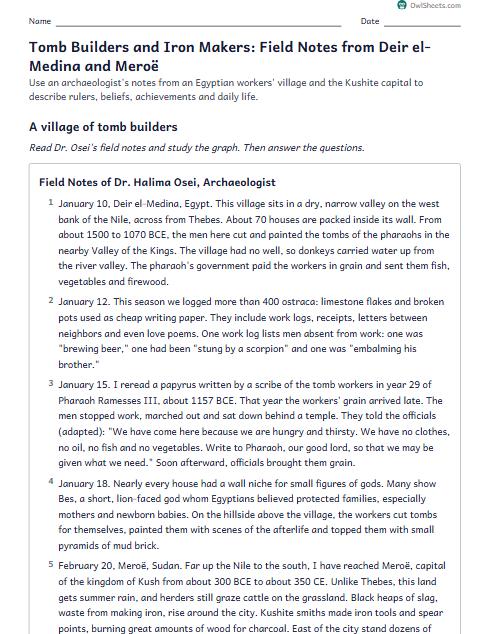
1January 10, Deir el-Medina, Egypt. This village sits in a dry, narrow valley on the west bank of the Nile, across from Thebes. About 70 houses are packed inside its wall. From about 1500 to 1070 BCE, the men here cut and painted the tombs of the pharaohs in the nearby Valley of the Kings. The village had no well, so donkeys carried water up from the river valley. The pharaoh's government paid the workers in grain and sent them fish, vegetables and firewood.
2January 12. This season we logged more than 400 ostraca: limestone flakes and broken pots used as cheap writing paper. They include work logs, receipts, letters between neighbors and even love poems. One work log lists men absent from work: one was "brewing beer," one had been "stung by a scorpion" and one was "embalming his brother."
3January 15. I reread a papyrus written by a scribe of the tomb workers in year 29 of Pharaoh Ramesses III, about 1157 BCE. That year the workers' grain arrived late. The men stopped work, marched out and sat down behind a temple. They told the officials (adapted): "We have come here because we are hungry and thirsty. We have no clothes, no oil, no fish and no vegetables. Write to Pharaoh, our good lord, so that we may be given what we need." Soon afterward, officials brought them grain.
4January 18. Nearly every house had a wall niche for small figures of gods. Many show Bes, a short, lion-faced god whom Egyptians believed protected families, especially mothers and newborn babies. On the hillside above the village, the workers cut tombs for themselves, painted them with scenes of the afterlife and topped them with small pyramids of mud brick.
5February 20, Meroë, Sudan. Far up the Nile to the south, I have reached Meroë, capital of the kingdom of Kush from about 300 BCE to about 350 CE. Unlike Thebes, this land gets summer rain, and herders still graze cattle on the grassland. Black heaps of slag, waste from making iron, rise around the city. Kushite smiths made iron tools and spear points, burning great amounts of wood for charcoal. East of the city stand dozens of royal pyramids, smaller and steeper than the great pyramids of Egypt.
6February 23, Naqa. At the Lion Temple, south of Meroë, the walls show Apedemak, a lion-headed god whom Kushites believed protected their kingdom in war. King Natakamani and the kandake, or queen, Amanitore are carved side by side, the same size, each defeating enemies. Their names are written in Meroitic script. Scholars can read the sound of each Meroitic sign, but they still understand only a few of the language's words.
- A. To keep the workers from farming the land along the river
- B. To protect the village from floods on the west bank
- C. To train the workers as soldiers for the pharaoh's army
- D. To keep skilled workers close to the royal tombs
This season we logged more than 400 ostraca: limestone flakes and broken pots used as cheap writing paper.They include work logs, receipts, letters between neighbors and even love poems.One work log lists men absent from work: one was "brewing beer," one had been "stung by a scorpion" and one was "embalming his brother."
The preview shows the first questions. Unlock the worksheet to see all of it.
Related worksheets
The Great Flood of Year 6: News from Thebes Under a King of Kush
Grade 6 · HIS.6.3
14 questionsPremium
Caravans to Yam: Sourcing Harkhuf's Tomb at Aswan
Grade 6 · HIS.6.3
14 questionsPremium
Who Won at Kadesh? Two Accounts of Ramses II's Battle
Grade 6 · HIS.6.3
14 questionsPremium
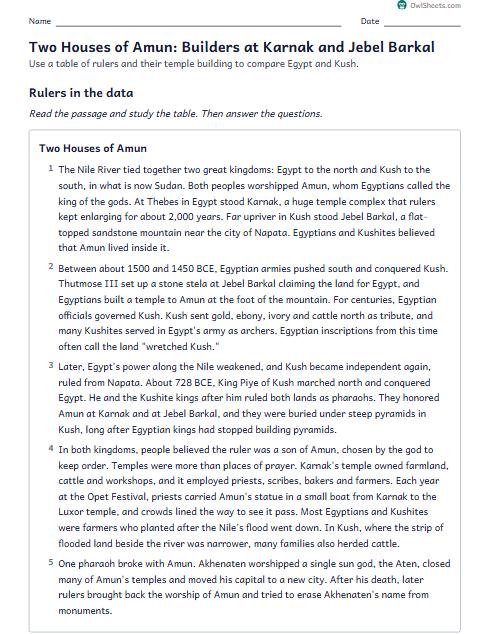
Two Houses of Amun: Builders at Karnak and Jebel Barkal
Grade 6 · HIS.6.3
13 questionsPremium
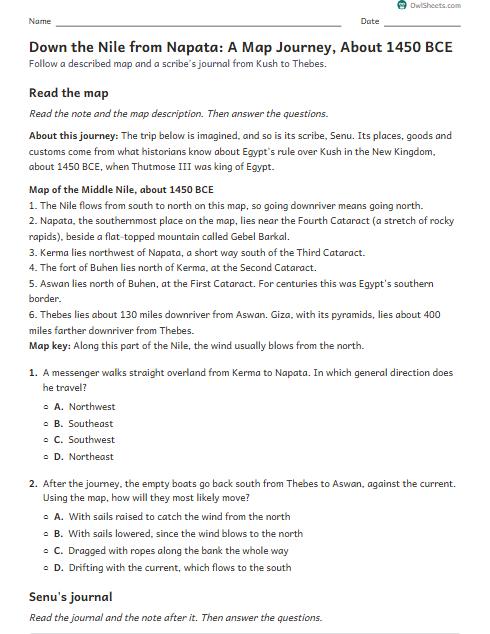
Down the Nile from Napata: A Map Journey, About 1450 BCE
Grade 6 · HIS.6.3
11 questionsPremium
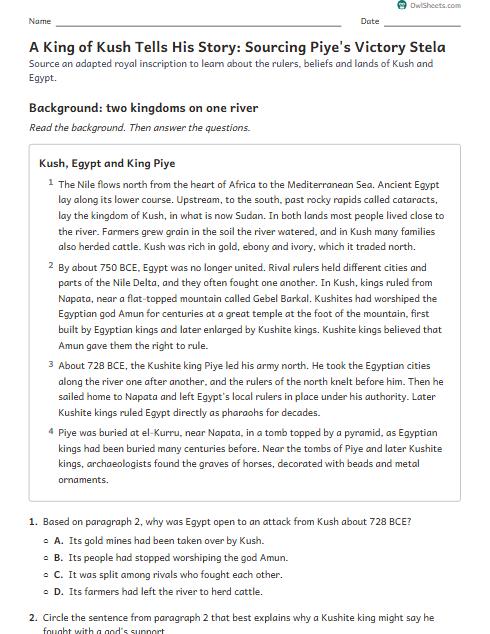
A King of Kush Tells His Story: Sourcing Piye's Victory Stela
Grade 6 · HIS.6.3
10 questionsFree